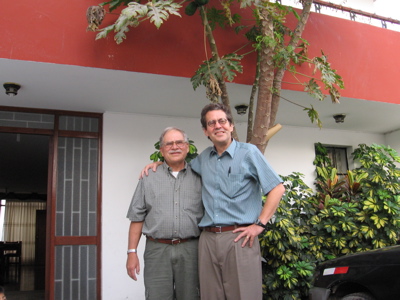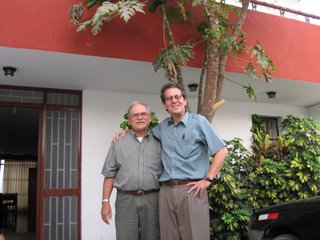
I went to Peru for business reasons but also made a couple of personal connections. The photo is with a former high school teacher of mine, Paul Lammermeier, who has been in Peru for 19 years, most of that running homes for adolescent boys who have been either abandoned by their families or kicked out of the house.
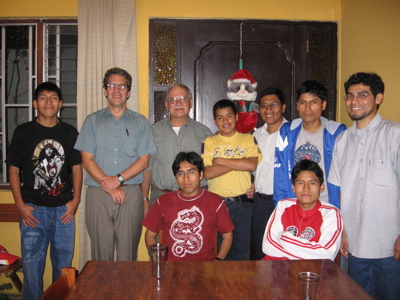
Cindy and I had started contributing to Paul's project a couple of years ago when we heard about it through the alumni magazine of my high school, St. Ignatius in Cleveland. I hadn't seen Paul since 1967, when he gave me an 85 in American History. So it was great to see his project in Lima firsthand. Contributions from alumni of Cincinnati St. Xavier, where Paul taught for 14 years, and St. Ignatius, have allowed him to get two homes up and running.
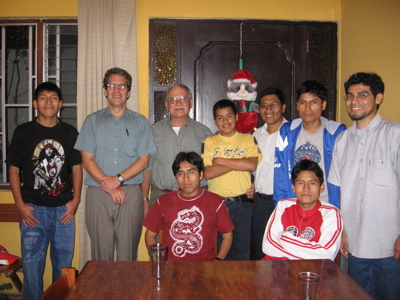
I spent an evening talking with a half-dozen of the boys about their interests, their favorite school subjects, what they might be thinking about for a career and answering their questions about the U.S. It was a lot of fun, and it was clear that the boys are like a family, like brothers, who like and support each other. One of the boys pictured had spoken only Quechua until he was 12. Spanish is his second language. He's now at the university studying French and German as well as Spanish and English, and he is quite good at all of them.
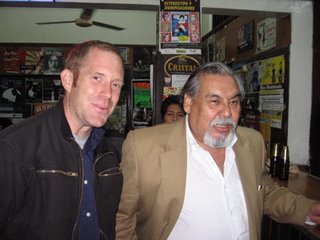
I also had a chance to catch up with Jesse Hardman, who is doing the same fellowship I am but at a university in Lima. He's been working on some interesting projects with radio journalists outside of Lima. He and I went together to call on the business editor of El Comercio, the country's largest and most influential daily newspaper. We also chatted up Raul Vargas, a nationally known radio journalist (his show reaches 2 million people daily) when we ran into him at Lima's equivalent of the Billy Goat Tavern. This is Jesse with Raul.
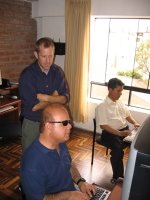
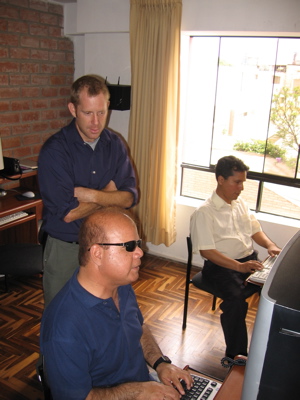
Jesse is working with a blind journalist on developing a blog site for blind people that would include news and information that they might not be able to get anywhere else. There is software available in some libraries that translates web text into audio. Jesse is a native of Minnesota who was a correspondent for National Public Radio in Chicago for four years. However, to prove the theory that everyone must pass through Ohio in his career, he is a graduate of Kenyon College in Gambier.
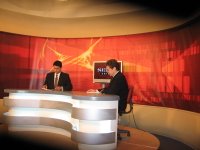
For some reason, journalists have been interviewing me. The photo at left is from a 5-minute interview at Channel 19 in Lima. The host was interested in finding out about a seminar I was doing on the art of interviewing, and we talked a little about the ethics and behavior of journalists, particularly television journalists, when interviewing ordinary people on the street.

In this other photo, a staff member from the National Association of Peruvian Journalists is interviewing me for their daily web newsletter. He wanted to know about some of the differences between how journalists do things in the U.S. and Latin America. The practices are really not that different. Journalists in Latin America just have less money and time to devote to investigative journalism.
One big difference is on the business side. There is incredibly low readership and circulation for daily papers, partly from the lack of public education and from a tradition of newspapers appealing to the elite. Lima is a city of more than 8 million people, and its leading newspaper, El Comercio, has a circulation of about 150,000. In a city that size in the U.S., the circulation might be five or six times that.
El Deber, based in Santa Cruz in Bolivia, is the country's largest circulation paper, but it has daily circulation of only 30,000 and Sunday of 50,000. In a similar size city in the U.S. (1.3 million), the circulation would be expected to be at least five times that.
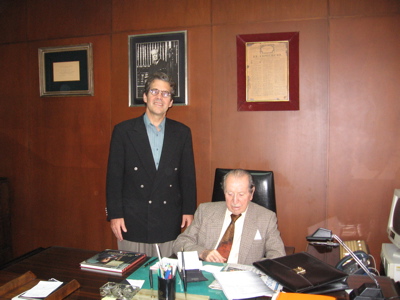
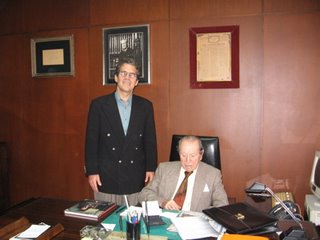
I got to meet the 91-year-old former publisher of El Comercio, Alejandro Miro Quesada Garland, whose family founded the paper in 1835. El Comercio was shut down for six years from 1974 to 1980 by the military dictator of the time.
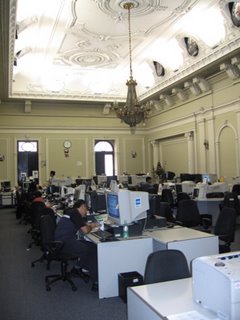
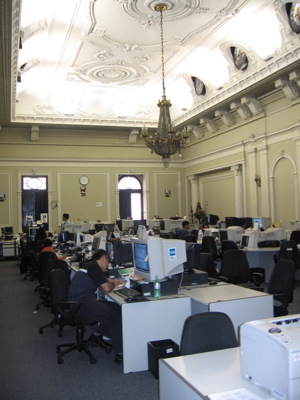
El Comercio's offices, built in 1924, have much of the elegance of a bank from that era. The two-story lobby is lit by a stained glass skylight, and the newsroom is the only one I've ever seen with a coffered ceiling and chandelier.
Lima has a weekly business journal, La Semana Economica, that is similar in many respects to business papers in the U.S. I gave a workshop one morning to nine of their editorial staff on how to humanize technical and economic stories. They were a lively group with lots of questions.
Seventy people showed up for the workshop on interviewing at the National Journalists Association, and it was also a very lively session with lots of interactivity.