Showing posts with label Evo Morales. Show all posts

Thursday, June 14, 2007

The red ponchos and talk of civil war

The Aymara people, who represent about a third of Bolivia, have a tradition of putting on their red ponchos when they go on a war footing. So any display of this symbol can be interpreted as merely tradition or a threat.

On the day I arrived in Bolivia in September, the vice president, Alvaro Garcia Linera, recalled his days as a guerilla fighter and urged a crowd of indigenous people to have their rifles ready inside their red ponchos to fight against any attempt to divide the country.


He was talking about the eastern half of the country, known as the Half-Moon, which voted last July for autonomy, meaning more local control of its money and government affairs.

Talk of civil war heated up at that time and again in January when President Evo Morales, at a gathering of 10,000 Aymara in their red ponchos, called on them to fight against any attempt to divide the country. (People in the Half-Moon would say they´re not trying to secede, but they do want more autonomy.)


Morales´s Aymara host announced that day that he had 100,000 people ready to take up arms at a moment´s notice if the president wanted. You can imagine what a stir that caused. These images (the one at the top is from La Razon, the other is from El Nuevo Dia) were on TV and the front pages.

Morales, who has a very positive reputation in Europe and the U.S., frequently engages in saber rattling. When he was campaigning for office, for example, he ended speeches with, `Death to the Americans.´

The talk of civil war died down for a couple of months, but tension is growing again because of conflicts between the central government and the Half-Moon about everything from the Supreme Court to foreign trade agreements.

Tuesday, June 12, 2007

The people you meet in La Paz


In the Plaza Murillo, which faces the Presidential Palace and the home of the Bolivian congress, you see a mix of people in modern and traditional dress.


A military band performs on a Sunday morning on the Prado, the main drag in La Paz. They performed a medley of Strauss waltzes punctuated with a lot of heavy pounding on the bass drum.


This lovely woman was standing outside my hotel yesterday. An hour later, as I was working at a computer in the hotel lobby, she sat down at the computer next to me. During a cell phone call she identified herself as Carla Ortiz. She is famous as the actress in the most expensive Bolivian movie ever made, The Andes Don´t Believe in God. Its budget was $500,000. She was great in it, and I told her so. She was very gracious and friendly. She´s a native of Cochabamba here, but she lives in the U.S., where she appears in TV shows like CSI Miami. This photo is from La Razon newspaper.


Theese men in traditional dress were walking on the Prado yesterday. You more often see women in traditional dress. I followed them for a block or two trying to discretely photograph them. They all hopped onto a big tourist bus.

In La Paz you have much more sense of the indigenous culture of the country. There is a museum of traditional clothing here as well as the Museum of Coca, which chronicles the history of coca in patent medicines (legalized opiates common in drugstores in the last century), toothpaste and modern anesthestics. The coca leaf is considered sacred.

On the street of the witches, ironically right behind the main cathedral, locals come to buy the stuff needed to cast spells on enemies, bring good fortune and guarantee fertility. A typical store is below. Mummified llama fetuses are in abundance in many stores (not this one). Not sure what they’re used for.


Up until 1975, most people in Bolivia did not speak Spanish. The education system missed them. Two-thirds of Bolivians consider themselves to be members of an indigenous group, with 30 percent identifying themselves as Aymara (the group of President Evo Morales) and 27 percent Quechua. About six in 10 Bolivians speak an indigenous language, depending on which source you refer to. Last fall El Nuevo Dia published a language map of the country that showed some 36 languages spoken, but most of these are very small groups and their languages are in danger of dying out.


Mount Illimani looms over downtown La Paz. How high is Bolivia? The western third averages about 15,000 feet. A wall three miles high separates the plains in the east from the capital. Although it’s only 335 miles from La Paz to Santa Cruz in the eastern lowlands, according to my World Book Atlas, a bus ride takes around 20 to 24 hours because of the twisting mountain roads. You´ve probably seen the pictures. I decided not to do it.

Flying is scary enough. La Paz is at about 12,000 feet, and its airport is higher than almost all of the Rocky Mountain peaks. The air is so thin that the takeoff run needed for a Boeing 737 to get airborne is about 30 percent longer than normal, which seems like an eternity when you’re in a passenger seat. The runway is almost twice as long as that of Reagan National.

Bolivia covers 1 million square kilometers, more than 8 times the size of Pennsylvania and 45 times the size of Maryland. Lake Erie has three times the surface area of Lake Titicaca, although the latter is much deeper.

Business note: There are 250 publicly traded U.S. companies that have higher revenues than the gross domestic product of Bolivia, which is $9 billion.

Sunday, April 01, 2007

A trusted voice of news in Bolivia


Father Jose Gramunt, to the right, is a Jesuit priest and highly respected newspaper columnist here in Bolivia. He appears in the major dailies and is a model of fearless political and social commentary. Because of his longevity and his independence of any political party over many decades, he has a unique standing. His opinions carry a lot of weight. He doesn't pull any punches, and he is as likely to question the tactics of the left as the right.

He is also the founder and director of a national news service called Fides that is known for its independence and credibility, which really counts in a country where no one trusts any authority. Most of the papers in the country subscribe to it. It offers general news as well as sports, business, politics, crime, etc. Fides also has a radio news network of some 30 stations around the country.

A recent report from the Interamerican Press Association mentioned that Gramunt's news agency has received threats from President Morales's party, which accuses the journalists of "promoting sedition with the goal of overthrowing the government of Evo Morales."

Father Gramunt asked me to do a critique of a week´s production of the wire service for his 10 journalists. His goal: How could they make their news report more enterprising, with more initiative, and be less reactive? Over two mornings, and two batches of salteñas (tasty filled pastries), we went into that, and the journalists participated with lots of energy and enthusiasm.

Journalists want to work for Father Gramunt. He has trained many of the best in the country. Born in Tarragona in Spain, he came to Bolivia in 1952 as a student and eventually persuaded his Jesuit bosses that he should be a journalist. The news service grew out of a Jesuit radio network whose original focus was on religious programming. Gramunt wanted to do more journalistic programming but the church couldn´t finance it. The only way he could make it work financially was to start a subscriber news service, which is what he did in 1963. It´s managed to pay its own way for more than 40 years. Gramunt, 84, has a real sense of mission. He knows how important a credible news source is in an emerging democracy.

Sunday, January 14, 2007

The siege of Cochabamba

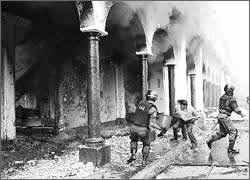
The split widened between the two Bolivias this past week. Tens of thousands of coca growers, peasants and supporters of the socialist government went on the march on Monday to force the resignation of the prefect of Cochabamba. His offense against the socialists was that he was asking for a referendum vote on autonomy for the key coca-growing region of Cochabamba. The socialists oppose autonomy for the departments of the east, which produce most of the country´s cash crops, petroleum and natural gas. (All photos are from El Deber and El Nuevo Dia)


The socialist sympathizers started throwing rocks at the police protecting the prefecture offices, and the police responded with tear gas. The Interior Minister, who is a member of the socialist party, ordered the police to withdraw so they would not repress the social movements. With the police withdrawn, the mob burned the prefecture building.


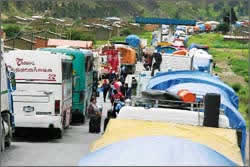
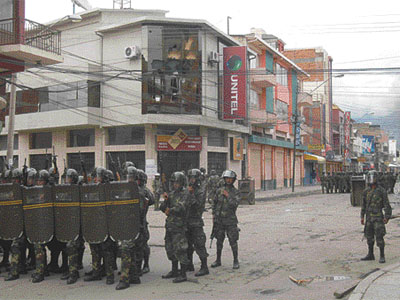
The siege was in its fourth day on Thursday, and Cochabamba, which lies on the road between the country´s two biggest cities, La Paz and Santa Cruz, was shut down by 15 blockades on the roads. Hundreds of trucks and buses were stranded, and the people in Cochabamba, who were running out of food, evidently lost patience with the socialists. A club-wielding group of youths crossed the riverbed to avoid a police barrier and attacked the socialists. Two people were killed and hundreds were injured.


Fifteen journalists were among those attacked and injured. They went on a march with muzzles over their mouths to protest the continuing violence against them. President Morales´s supporters in particular have targeted journalists, who are regarded as enemies of the socialist movement. A socialist mob surrounded the Cochabamba offices of Unitel, a national TV network owned by the government´s most vocal opponent and Evo Morales´s No. 1 enemy, broke windows and threatened the staff. Eventually police set up a barrier so the employees could escape.

It was not until Friday, the fifth day of the siege, before Morales called on his supporters to pull back and stop the blockade. A reasonable person might ask why he didn´t do so five days earlier.

Saturday, December 16, 2006

1 million people say yes


Eight hundred thousand people gathered in the square a couple blocks from me Dec. 15 for a cabildo, a town meeting. They were demanding that the government respect autonomy for this part of the country and respect a law that says each item of the new constitution requires two-thirds approval by the constitutional assembly. The top photo is from El Deber, the bottom from El Nuevo Dia. (My apartment is just outside of the upper right of the top picture.) El Deber did a detailed map with estimates of crowd density at various points to come up with the figure of 800,000. Cabildos in other regions brought the total to more than a million. People started gathering in force around 3:30, the music got going around 4:30, the speeches started around 5:30 and the big moment came at 7:30.


The prefect for the department of Santa Cruz asked the crowd for their approval on two questions, to which they replied yes to each, and the meeting was over. Except for the music and dancing.
The headline in El Nuevo Dia pronounced the event a ¡Cabildazo! You add “azo“ to anything to mean that it´s a big honkin' thing. A great goal in soccer is not just a gol but a golazo.
There were three other cabildos in departments that also want autonomy and respect for the two-thirds vote. These four departments represent about half the country and are referred to as the half-moon because that's what they look like on the map.

The violence

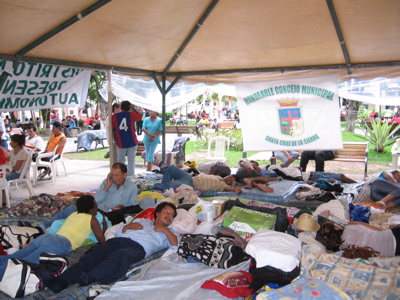
There have been peaceful hunger strikes throughout the eastern half-moon of the country for a couple of weeks to protest the government´s policies. Here are some in the main square of Santa Cruz Dec. 9.


It's kind of the reverse of what we're used to. The hunger strikers are generally white or mestizo and prosperous. They tend to be business people protesting actions taken by the indigenous majority, which is controlling the governnment for the first time in Bolivia´s history. The president made some veiled threats earlier in the week, calling on the army to be prepared to defend the unity of the country against secessionist groups trying to divide Bolivia (code for the half-moon region).


As it happened, the army didn´t try to stop the demonstrations (cabildos), but members of the president´s political party did. They set up roadblocks on a main highway to prevent people from outlying areas from reaching the cabildo in Santa Cruz.
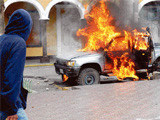
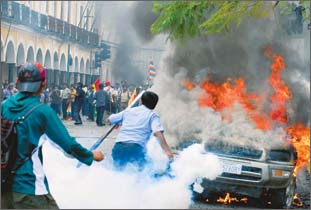
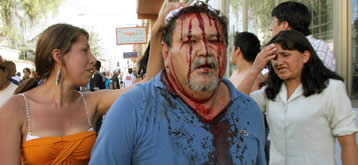
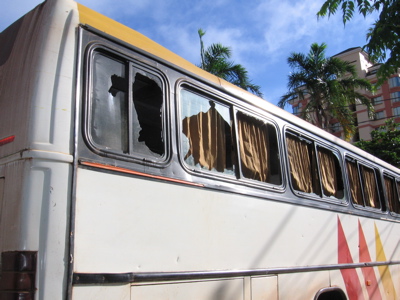
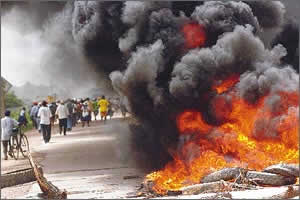
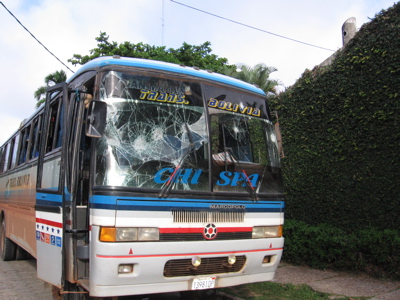
(The photo of the blockade of burning tires is from El Deber. The photo of the injured journalist is from El Nuevo Dia.) They stoned buses carrying people headed for the cabildo and sent five journalists to the hospital with severe head injuries. The trouble started when one of the buses broke through the first line of the blockade, and the blockaders started pelting it with rocks. After three hours of rock throwing, 90 people on both sides were injured. One man lost an eye. One of the buses was burned. Several press vehicles were destroyed. Eventually the buses went through. They were parked in my neighborhood this morning, with most of their windows knocked out. (Photos of the buses are mine.)

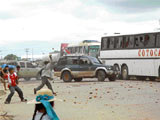
(The photo of the rock-throwers is from El Nuevo Dia)
Unfortunately, those who back the cabildos and autonomy went on their own rampage in several towns and burned the headquarters of the ruling party, the president's party, whom they deemed responsible for the violence in San Julian.
Last week a pro-government crowd in La Paz, which is the heart of the president's power base, set upon some anti-government hunger strikers who were in a church.
The mob wanted to kill one of the hunger strikers, a prominent novelist. They tossed a stick of dynamite into the room where the hunger strikers were located. Fortunately, someone was able to yank the fuse before it exploded. The hunger strikers barely escaped and went into hiding. (In retaliation for the rock attacks, supporters of autonomy burned MAS headquarters in San Ramon, photo from El Deber)
The night of the cabildos, I saw the president on TV, and he was very conciliatory toward the demonstrators, which seemed a statesmanlike thing to do. He was not talking about sending in the army or confrontation. He used the word dialogue a couple of times. Maybe this difficult period in Bolivia's history will be worked out without much violence.

Sunday, November 19, 2006

Politics means high drama in Bolivia

President Evo Morales, the socialist who took office this year, enjoys a good game of soccer and invited members of the press corps to a pickup game in October. Morales had four former members of the national team on his side, which crushed the journalists, 11-1. (This photo from La Prensa was from a different pickup game.) It had to be sweet for Morales, who has called the press his No. 1 enemy, and maybe not without justification. Some of his opponents like to make fun of his humble roots as a shepherd and his lack of a university degree.
Political discourse here is very strident and more provocative than we´re used to in the States.
The day I arrived in Bolivia, Sept. 20, Vice President Álvaro García Linera told an audience of indigenous supporters they should be ready to grab their Mauser rifles to defend the socialist policies of President Evo Morales. (Photo of García Linera with Morales is from Igadi.org). The remarks of the vice president had everyone talking about the possibility of civil war for a time, but that has died down.
A couple of weeks later, Morales´s chancellor, David Choquehuanca, was condemning the racism of the well-to-do folks who live in the south part of La Paz. However Choquehuanca, who is Aymara, added that, "We (the Aymara) don´t hate them, because if we did, we´d poison their food.¨ He was referring to the fact that the household servants for the city´s elite are generally Aymara. (Photo from Aymara.org).
There are regular rumors of a possible U.S. invasion of Bolivia to protect the gas and oil fields, although the U.S. is not a major customer (Brazil and Argentina are), and Spain has far more of an investment interest in Bolivia´s fossil fuels than the U.S. Still, there are a couple of hundred U.S. military personnel over in Paraguay, and that helps fuel the rumors.
Venezuela´s president, Hugo Chavez, who likes to refer to President George W. Bush as a drunkard and ¨Mr. Danger,¨ has promised to defend Bolivia´s socialist democracy with military force, if necessary. Who would be the aggressor? He regularly points the finger at the U.S. as a potential invader of his own country.
Bolivia and Venezuela recently discussed the possibility of a Venezuelan military presence in Bolivia, but that is on hold until after Venezuela´s election. Venezuela´s ambassador to Bolivia, Julio Montes, got into the act a while ago, saying that Venezuela was ready to give blood and lives to protect Bolivia from a counterrevolution. Morales´s government has nationalized the oil and gas fields and is in the process of redistributing land to peasant farmers, both of which have provoked strong opposition from big landholders and business interests.