Showing posts with label Santa Cruz. Show all posts

Tuesday, June 05, 2007

People and places around Santa Cruz


These schoolteachers not only get low salaries, they get paid only once a month AND have to stand in line to collect it. You have to stand in line for everything in Bolivia. To pay your phone, electric and water bills you go to a bank or the utility offices and take a number. The post office doesn't do local mail delivery so you can't pay by check. (Your bill comes by courier.)

To buy a plane ticket, you go to the airline office and take a number. Or you can use a travel agent, but you still have to go to the office and pay in person. You can't pay online. People here accept the lines. Poor service to the public is endemic in government and business.


This little boy comes with his mother every morning as she cleans the classroom building where I'm working these days. Despite her son´s shirt, she is not a graduate of the University of Michigan or a fan of Wolverine sports. Used clothing floods into Bolivian markets from the U.S. and is killing local manufacturers and retailers. The government recently outlawed importing of used clothing, just as Santa Cruz was filling up with street vendors hawking cold-weather gear (it's winter here) from the States.
Cheap shoes made in China, for as little as $2.75 a pair, are another import that hurts local businesses.


Alvaro Garcia Linera, 43, is the vice president of Bolivia and attracted a mob of newspeople when he visited Santa Cruz in March. The newspeople here do act like a mob, especially the television people, who have to get close enough to make pictures and capture sound bites. I decided to watch and shoot from a distance.

Garcia Linera has a reputation as being quite the reader and intellectual. In the 1990s he was part of a leftist rebel group and was arrested and charged with being a terrorist. He spent five years in prison, where he studied Bolivian political history and read Karl Marx's Das Kapital "letter by letter, word by word."


Eduardo Bowles is the director (we would call him editor-in-chief) of El Nuevo Dia newspaper in Santa Cruz and loves to relax at his house in the country, where he keeps and rides quarterhorses. He is demonstrating the correct Santa Cruz hammock technique, with one foot out for balance, ideal for making quick turns to see what's going on. This photo is from Christmas week, high summer, during a churrasco, or barbecue, at his house.

Eduardo's great-great-grandfather came to Bolivia from Cincinnati, Ohio. He had served in the Civil War on the Confederate side and came to capitalize on a rubber-industry boom in Beni, in the Amazon basin to the north. He started many businesses, including Bolivia´s first ice-making plant. Bolivians pronounce the W in his name like a B, so it's pronounced BO-blase.


A construction supply magnate built this castle as a way to advertise his company. It sits on the third ring road here in Santa Cruz. Note the horse. It´s common to see them out scrounging around, even in heavily traveled parts of the city.

Saturday, June 02, 2007

The traditional Bolivian barbecue


In the great plains of Bolivia, they raise cattle and celebrate with big barbecues they call churrascos. "Let's have a churrasco" seems to be the perfect way to mark any occasion, big or small. Here Jorge and Grover, two staff members of the weekly business paper Santa Cruz Economico, work the grill with a typical churrasco offering of beef, sausages, chicken and innards.


I've been working with the staff of Santa Cruz Economico once a week since January, coaching them on everything from in-depth reporting to meeting deadlines to advertising sales strategies. They have many of the same challenges that we had at the weekly business journals in the States. It has been great fun to see the impact of these coaching sessions. For months, Jose Miguel Sanchez, the editor (standing, third from left), has been promising to have a churrasco so that we could get together in a social setting, but it has always been delayed. To get things moving I offered my apartment as the site. We had it Saturday. In the photo above, the owners of the paper, Fernando Neumeyer and Elenir Centenaro, are at the right with their toddler, Nicolas.

One of the paper's struggles has been how to maintain editorial integrity when some of their competitors offer to write stories about businesses in exchange for agreements to advertise. Some of our competitors in Baltimore did the same, so I was able to give them some strategies and language to use to counter this.


Bolivians have a talent for making you feel at home. The pace of business is slower. The family comes first. People who arrive late for meetings are always forgiven. Every excuse is acceptable. The person is more important than the work. They work hard, but in a different way.

Winter arrives in Bolivia


Winter here means cold winds from the south and temperatures in the 50s, occasionally dipping into the 40s. Few homes and commercial buildings have central heating, so temperatures in the 50s mean people feel the cold. Notice that the guest speaker in my ethics class, Hernan Cabrera of the journalists' federation, keeps his jacket and sweater on. Below, Abraham Carrillo, a reporter for Santa Cruz Economico, wears his hat and scarf as he works in the newsroom. At bottom is a photo from El Nuevo Dia of a school that has no windows. The kids are bundled up.


Sunday, January 21, 2007

Carnaval and other cultural notes


People start celebrating Carnaval here months before it arrives. Carnaval is technically a weekend-plus of events leading up to Ash Wednesday and the pentitential period of Lent. But Ash Wednesday is more than a month away, and the party officially kicked off yesterday in Santa Cruz with a big parade presided over by Carnaval Queen Andrea Abudinen (photo from El Deber). Actually, Andrea has been in the newspapers on practically a daily basis for months. She is photographed and written about wherever she goes. Yesterday there was a big article about the creation of the dress you see in this picture.
Carnaval is a very big deal. Maybe it's bigger in Rio de Janeiro, but the New Orleans version would probably pale in comparison to what's planned here in many cities of Bolivia.
I am told that in La Paz I will have to watch out for flying water balloons and in Santa Cruz for paint ball pellets, which evidently are outward expressions of inward joy of the season, the last blast of sensuous indulgence before the fasting and denial of 40 days of Lent. Although it doesn't appear that the indulgence here is always followed by self-denial.
The city of Oruro is known for its more folkloric type of Carnaval (photo here from Oruro festival website)

Here's a sample of some other culture.....We took a day to go to the town of Tarabuco, which is famous for its Sunday market of textiles, some of which we bought and took back with us. While there we also stopped at a local farmers' market and got a glimpse of big red plastic bags filled with coca leaves. We didn't see anyone working on the textiles while we were there, but we could see weavers working at the textile museum in Sucre.


In the mining city of Potosi we were startled to hear a stick of dynamite explode, but it was just to announce the start of a student demonstration against the leadership of the university. The students were protesting 5 percent pay raises for the faculty, and the notorious nepotism of the university president, which would mean reductions in expenditures on various services for students.
Sucre is also famous around the world with students of dinosaurs. It has huge deposits of calcium-based rocks and material that is mined for concrete, and it was there that workers found footprints. There are trails several hundred meters long made by some of these beasts perhaps 100 million years ago.
While in Sucre on Jan. 6, we saw the city celebrate the Feast of the Three Kings, which celebrates the biblical story of the wise men from the East visiting the Christ child. Families go to church to have the priest bless their Jesus in the manger, and we ran into one family that had several.


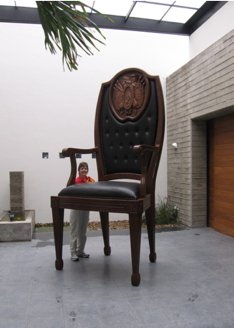
It was also in Sucre at Liberty House, their equivalent of Independence Hall, that we got to see perhaps the biggest representation anywhere of the great liberator, Simon Bolivar, a bust in wood. Bolivia won its independence from Spain in 1825, thanks to Bolivar and a general named Sucre. The wall tapestry you see is one of the few done by men, a phenomenon of recent years.

Friday, January 12, 2007

Cindy's whirlwind visit


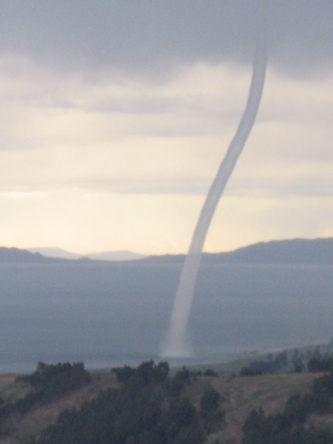
Cindy blew into town Dec. 26 and not a moment too soon. We hadn´t seen each other in three months, the longest separation in our 30-plus years of marriage. This waterspout appeared over Lake Titicaca as we were heading to Copacabana. The crazy weather on this leg of our trip also included a fierce hailstorm that left the ground covered as with snow. The van we were in skidded around on the mountain roads, eliciting yelps from us at moments.


We spent a couple of days in Santa Cruz and then headed for La Paz. We spent an evening there with Luis Ramiro Beltran, who is something of a legend in Bolivian journalism. He was the Defender of the Reader (ombudsman) for eight newspapers here, and he had helped me make connections with the journalists' association in La Paz. He also did a lot of work around the world for Johns Hopkins in the area of health communications, and when he was in Baltimore from time to time, he worked in the Candler Building, the same place I worked. Of course we didn't know each other then.


On our tour of La Paz, Cindy and I took in the Valley of the Moon and went up to a scenic overlook, where we saw an Aymara shaman (he's wearing the hat) working spells for one of his clients. Every so often he and the client would say a few words and toss something into the little fire. Kind of interesting to see this kind of ritual with the metropolitan backdrop. The other scenes are also in La Paz.


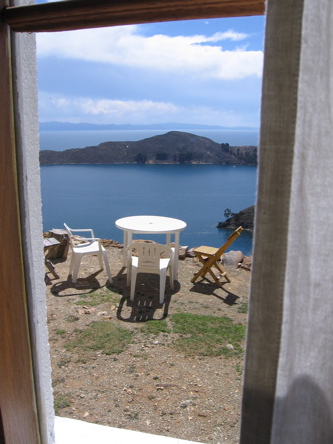
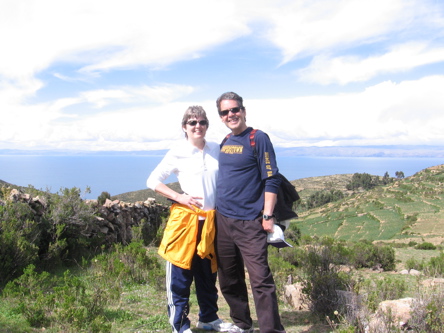
Copacabana is a lovely little town on the shore of Lake Titicaca. We spent a night there and headed out to Isla del Sol (the Island of the Sun), where the Incas believed their people, and all of mankind, were born. We stayed in a modest hostel overlooking the lake. It took us a good half hour hauling a ton of luggage up the hill to get to our place. No motor vehicles are allowed on the island, which is deliberately kept primitive. The Aymara Indians run everything. Every square inch of the island was cultivated at one time, to judge by all the terraced seed beds, but many of the fields appear not to be cultivated these days. I had a lot of excellent trout in our three days there.


On our last day we hiked 10 miles round trip to the Inca ritual site. It´s incredibly beautiful and quiet there, high above the lake. The highest point on the island is just over 4,000 meters, or 13,000 feet.

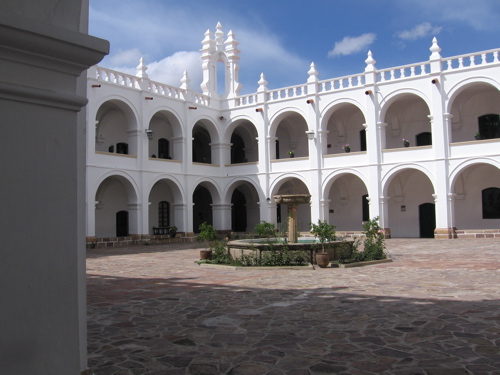
We headed on to Sucre, which is famous for its colonial style architecture. We asked the guide to show us some gardens, and she took us to the cemetery, which is like a little city where the ancestors reside. It was actually very lovely.


These shots are from the church of St. Philip Neri and school.


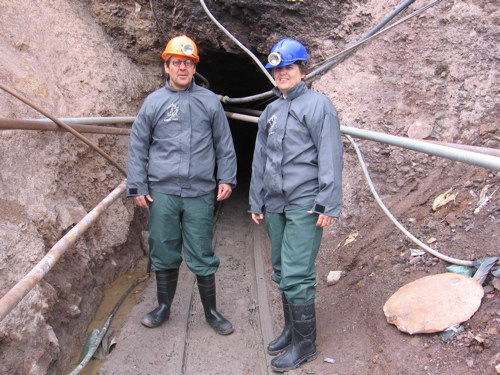
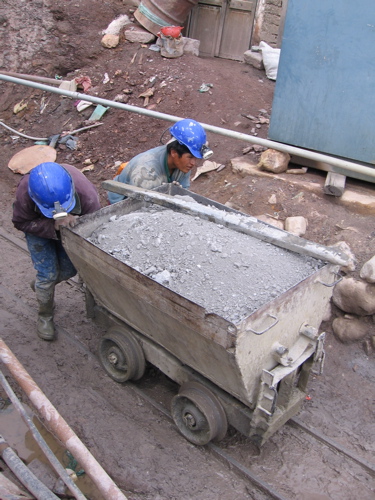
In Potosi, we went into the legendary Cerro Rico, rich mountain, which produced most of the world´s silver for the past 450 years. They´re still mining silver, zinc, copper and tin out of this same mountain. The mining tunnel we entered runs about a mile into the mountain.


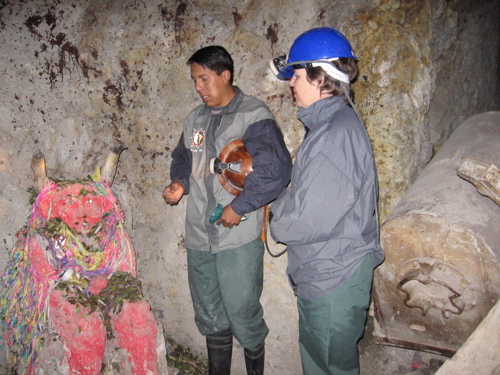
We followed the tracks about 50 meters into the mine and stood inside a little niche where the miners pay tribute to the devil, ruler of the underworld, to ask for his indulgence and protection. The miners give the devil coca leaves, alcohol and cigarettes, which is what they subsist on during their long shifts. Teams of three men push a 1,000-pound handcart into the mine to collect a 2,000-pound load of ore. The guys pushing the empty carts into the mine have to pull their cart off the tracks into a niche and allow the full loads to go by. It´s all by hand. These guys earn about $75 to $150 a month, depending on their status. Lots of miners are in their teens. Our guide, Wilfredo, worked in the mine from the age of 12 till the age of 18. We saw several other young teenagers working there -- 14 and 16.


Wilfredo´s father and grandfather, both miners, died in the same year, his father from silicosis of the lungs at age 37, a common affliction, and his grandfather in a mine collapse.


Cindy looks great, doesn´t she? Although some might think that she may be taking her diet too seriously.

Monday, December 25, 2006

Christmas in Santa Cruz

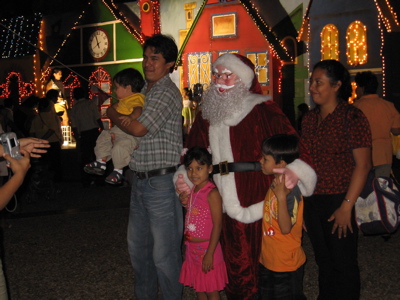
The Christmas decorations started going up in October, and the retailers started advertising that month. Bolivians like Saint Nick, Santa Claus, the reindeer, and the Christmas music that comes from America, a lot of it with Spanish lyrics applied.
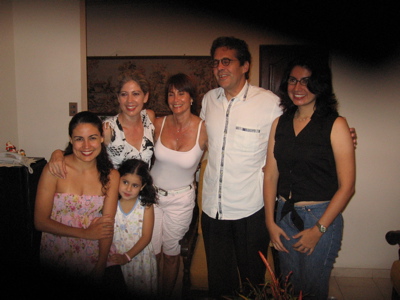
(Photo of Gina's sister, mom, aunt, and niece)

Santa Cruz residents have their own traditions as well, some of which I got a taste of. On Christmas eve, one of the reporters from El Nuevo Dia newspaper, where I had given a series of workshops, called me and invited me to have dinner with her and her family. Mom, sister, brother, aunt, cousin, niece. The event started at 9:30 p.m. and we sat around talking while the 6-year-old niece started opening presents. Beer, wine, cigarettes, lots of stories. At midnight, everyone in the neighborhood started shooting off bottle rockets and firecrackers for about 15 minutes, and then we went in to have dinner.

The traditional dishes are a kind of multi-meat soup, which is very tasty, baked turkey with a rice and date and nut stuffing, asparagus and pureed potatoes, as well as corn on the cob, with the cobs cut into small pieces. Dinner went on till about 1:30 a.m., at which time we all piled into two cars and headed over to an uncle's house, which happens to be right across the street from my condo building. There were about 30 people there, drinking and listening to music, with folks in their 60s down to teenagers. Christmas is all about getting together with members of your extended family. I stayed until about 3:30 a.m., and the party was going strong when I left. I'm known as a wimp, a pendejo, for not staying up late.


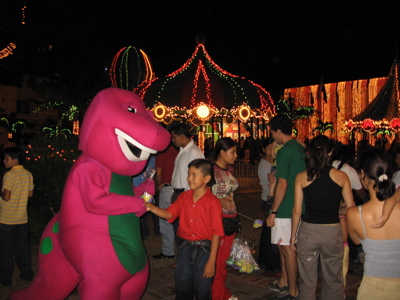
Today's edition of El Deber described different Christmas traditions and dishes in a half-dozen regions of the country. So you're getting a very superficial picture here. The local electric company has a big light display that goes up a couple weeks before Christmas and creates a traffic jam every night as the kids come to play games, get their picture taken with Santa and eat sweets.

Saturday, December 16, 2006

1 million people say yes


Eight hundred thousand people gathered in the square a couple blocks from me Dec. 15 for a cabildo, a town meeting. They were demanding that the government respect autonomy for this part of the country and respect a law that says each item of the new constitution requires two-thirds approval by the constitutional assembly. The top photo is from El Deber, the bottom from El Nuevo Dia. (My apartment is just outside of the upper right of the top picture.) El Deber did a detailed map with estimates of crowd density at various points to come up with the figure of 800,000. Cabildos in other regions brought the total to more than a million. People started gathering in force around 3:30, the music got going around 4:30, the speeches started around 5:30 and the big moment came at 7:30.


The prefect for the department of Santa Cruz asked the crowd for their approval on two questions, to which they replied yes to each, and the meeting was over. Except for the music and dancing.
The headline in El Nuevo Dia pronounced the event a ¡Cabildazo! You add “azo“ to anything to mean that it´s a big honkin' thing. A great goal in soccer is not just a gol but a golazo.
There were three other cabildos in departments that also want autonomy and respect for the two-thirds vote. These four departments represent about half the country and are referred to as the half-moon because that's what they look like on the map.

The violence

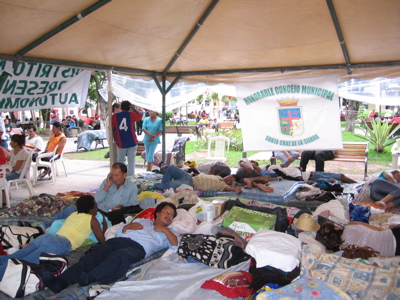
There have been peaceful hunger strikes throughout the eastern half-moon of the country for a couple of weeks to protest the government´s policies. Here are some in the main square of Santa Cruz Dec. 9.


It's kind of the reverse of what we're used to. The hunger strikers are generally white or mestizo and prosperous. They tend to be business people protesting actions taken by the indigenous majority, which is controlling the governnment for the first time in Bolivia´s history. The president made some veiled threats earlier in the week, calling on the army to be prepared to defend the unity of the country against secessionist groups trying to divide Bolivia (code for the half-moon region).


As it happened, the army didn´t try to stop the demonstrations (cabildos), but members of the president´s political party did. They set up roadblocks on a main highway to prevent people from outlying areas from reaching the cabildo in Santa Cruz.
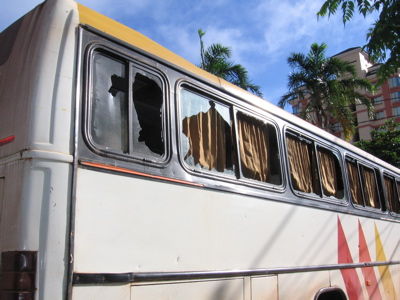
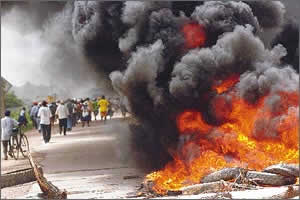
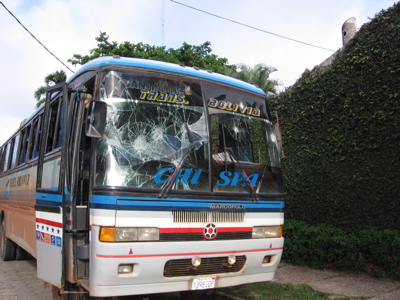
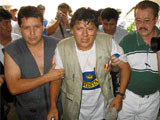
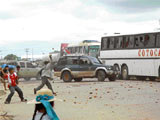
(The photo of the blockade of burning tires is from El Deber. The photo of the injured journalist is from El Nuevo Dia.) They stoned buses carrying people headed for the cabildo and sent five journalists to the hospital with severe head injuries. The trouble started when one of the buses broke through the first line of the blockade, and the blockaders started pelting it with rocks. After three hours of rock throwing, 90 people on both sides were injured. One man lost an eye. One of the buses was burned. Several press vehicles were destroyed. Eventually the buses went through. They were parked in my neighborhood this morning, with most of their windows knocked out. (Photos of the buses are mine.)

(The photo of the rock-throwers is from El Nuevo Dia)
Unfortunately, those who back the cabildos and autonomy went on their own rampage in several towns and burned the headquarters of the ruling party, the president's party, whom they deemed responsible for the violence in San Julian.
Last week a pro-government crowd in La Paz, which is the heart of the president's power base, set upon some anti-government hunger strikers who were in a church.
The mob wanted to kill one of the hunger strikers, a prominent novelist. They tossed a stick of dynamite into the room where the hunger strikers were located. Fortunately, someone was able to yank the fuse before it exploded. The hunger strikers barely escaped and went into hiding. (In retaliation for the rock attacks, supporters of autonomy burned MAS headquarters in San Ramon, photo from El Deber)
The night of the cabildos, I saw the president on TV, and he was very conciliatory toward the demonstrators, which seemed a statesmanlike thing to do. He was not talking about sending in the army or confrontation. He used the word dialogue a couple of times. Maybe this difficult period in Bolivia's history will be worked out without much violence.

Thursday, December 07, 2006

Taking to the streets


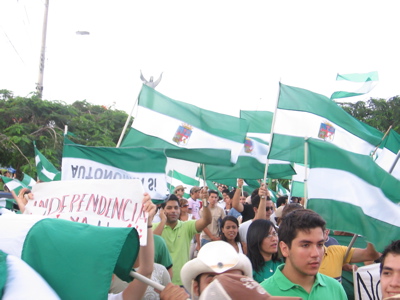
A couple thousand university students and sympathizers marched today from the Christ plaza near my apartment to the center of Santa Cruz to protest the government´s running roughshod over the law in rewriting the Constitution. That grievance is tied up with other grievances, in which the people out here (green flags are for the city and department of Santa Cruz) want more independence from the central government. One of the signs accuses President Evo Morales of being a dictator.

Things are starting to get violent. About 1,000 of the anti-government protesters are staging a hunger strike. A couple of the prominent hunger strikers, who were in a church in La Paz, which is pro-government territory on the other side of the country, were set upon Tuesday by a pro-government mob that tossed a couple of sticks of dynamite into the room where they were staging their protest. Depending on which newspaper you read, the dynamite´s fuse was either not lit or extinguished before it could explode.

The mob was after a prominent novelist among the hunger-strikers and threatened to kill him. All escaped, but the hunger-strikers accused the government of pulling police protection to allow the mob to have its way. The mob tore up parts of the church and burned up the belongings the hunger-strikers left behind.


It may have been retaliation. A few days previously, a group of university students here in Santa Cruz trashed the party headquarters of the government´s ruling party.
Living on the brink

A newspaper editor told me that Bolivians are accustomed to living on the brink of the abyss and that they push things to extremes, up until the last possible moment. He says that the way they conduct politics and the way they drive is exactly the same -- apparently reckless but always leaving themselves a tiny margin for error so they can swerve away from danger at the last moment. Not always, though.

One of the city´s three dailies carried a four-paragraph item about a bus sailing over a 1,300 foot precipice with 52 people aboard, killing 50. (The other two dailies didn´t mention it. Maybe because it was just a bus. Maybe because it was just over the border in Peru. A plane crash that killed 50 would be in all three papers, I would think.) Seems the bus driver was trying to pass another bus and missed the curve.