Showing posts with label Mexico. Show all posts

Monday, December 21, 2015

The Virgin of Guadalupe reveals a language mystery

The image of the Virgin in the Basilica in Mexico City.
Here in Spain my colleagues sometimes kid me on my use of Mexican expressions.

Mexicans have a tendency to add the diminutive suffix -ito or -ita to many words in ordinary conversation: your close friends might be your "amiguitos" (little friends), "Aquí tienes algún papelito" (here's some little paper for you) or "Ven aquí en la sombrita" (come on over here in the little shade).

So sometimes I might say, "tomemos una cervecita" (let's have a little bottle of beer), "vamos por un cafecito" (let's get a little cup of coffee).

I wondered about why this tendency was so common in Mexico but not in Spain. I think I discovered the reason while reading a book about the Virgin of Guadalupe -- the most revered religious figure in  Mexico and much of Latin America.

It was a translation into Spanish of the original text from the Aztec language, Nahuatl, describing the Virgin's miraculous appearance to the Indian Juan Diego in 1531 and the sign she left him -- her image on his tunic.

In the Spanish translation from Nahuatl, Juan Diego calls Mary, "my Little Virgin" (mi Virgencita) and she calls him "my little son" (mi hijito). It turns out that the translator was struggling to find an equivalent in Spanish for the Aztec suffix -tzin, which means something like "beloved" or "revered" but also is used for children and pets. So the translator used the closest Spanish equivalent, the diminutive suffix, -ita or -ito.

Nahuatl is still spoken by more than 1 million Mexicans, and the linguistic tendency has lived on, so that when people are being friendly, they use the diminuitive for all kinds of everyday things.

English translators of Nahuatl have the same problem, as described in an article about the original text describing the Virgin's miracle:

A challenge for the English translator is the suffix -tzin, heavily used in this text. On the one hand, it is a diminutive, used for children and pets. On the other hand it is reverential, used for lords and gods. And sometimes it seems to be thrown in merely to show that the situation, the audience, or the text itself is classy or much loved or both. It is inaccurate to equate -tzin routinely with the Spanish diminutive, which is more limited in scope, although probably somewhat expanded in Colonial Mexico under the influence of Nahuatl usage.

So my use of the diminutive sounds funny here to my colleagues. They enjoy kidding me about other Mexican expressions. For example, the professors refer to the students here as "chavales", roughly "kids", while in Mexico we called them "chavos/chavas". Add that to my soft Latin American accent (not as guttural on the "j" sound, softer consonants), and I am charming without even having to try.

If your Spanish is good and you really want to explore the many variants of diminutives in Nahuatl, I recommend this four-page excerpt from a book by Jose Ignacio Davila Garibi, who wrote extensively about Nahuatl in the 1920s and '30s. (Thanks to Angel Arrese for calling my attention to it.)

Hillary Clinton and the Virgin 

When Hillary Clinton was secretary of state in 2009, she made a visit to the basilica of Guadalupe in Mexico City where Juan Diego's tunic bearing the Virgin's image is framed and displayed (see my photo above).

Despite the vast intelligence-gathering resources of the United States government, and the enormous staff at Hillary's disposal, she made a horrible gaffe. She asked the priest who was explaining the image to her, "Who painted it?" The priest replied, "It was God painted it."

The Mexican press let her off easy. Since Hillary and Bill are people they like, they wrote it off as an itty-bitty error.

Related:

Basque language has mysterious origins
When you say "Tepotzotlán", it's like magic 
How to spend nine weeks in Europe without losing your shirt
Columbus Day story: How he brought me to Spain
20,000-year-old cave art and the north coast of Spain
In Pamplona, they party like it's 1591 
Barcelona's art and architecture make it a favorite
Cordoba's main attraction: mix of Jewish, Moorish, Christian cultures  


Thursday, September 03, 2015

Academic terminology can be complicated

Some of the academic terminology here trips me up. At universities in Mexico, they said things one way. Here in Spain they say them differently.

Fortunately a friend of mine here, Prof. Samuel Negredo, has created an extensive Spanish-English glossary of academic terms. Some of the basics for me have been:

  • "Students" in Mexico were "estudiantes" mainly, but here in Spain they are almost always referred to as "alumnos." 
  • What we would call "alumni" here are called "antiguos alumnos" (old students) or "graduados" (graduates).  However I have sometimes seen and heard people here use the Latin plural "alumni" to refer to their graduates.
  • Mexican professors often referred to their students as "chicos", or boys and girls. And they would even address the classes that way: "Buenos días, Chicos." I didn't feel right doing that. It seemed counterproductive when I wanted them to act as adults. So after asking around, I came up with an  equivalent of "Ladies and Gentlemen" -- "Damas y Caballeros." That's what I use here. I was told that "Señoras y Señores" sounded way too formal.
  • "Grado" doesn't mean grade here but rather "major". To say "I am a journalism major in the Communication Department," you would say, "Estoy en el grado de periodismo de la Facultad de Comunicación." Those who are doing a bilingual major, with half their courses in English, are in the "grado bilingüe."
  • A "grade" is una nota or una calificación.
  • "Facultad", by the way, doesn't mean "faculty." It means "academic department". When you want to refer to "the faculty" you say "el profesorado", and the student body isn't "el cuerpo de alumnos" but rather the "alumnado".
  • What we call a "course", as in "a math course," is called an "asignatura" here in Spain, but in Mexico it was called a "materia". All three words come from Latin and all refer to the same thing but have different roots. 
  • And "curso" here is not a course but an "academic year". So we are in the "curso 2015-2016".
  • Una "clase" here is a singular event. It refers to the class you taught yesterday or the class you are going to teach today. If we want to talk about the class of 2015, you say "generación" or "promoción" de 2015.

Flunk and pass

 If you "pass a course" you don't pasar, you "aprobar" la asignatura. It comes from the same Latin root as "approve." To fail is "reprobar", and someone who has failed is "un reprobado" (English "reprobate" comes from the same root but has a different meaning).

At Tec of Monterrey in Mexico, a "classroom" was a "sala" or if it was really big, a "salón". A classroom building was called "Las aulas 1" or 2 or 3, which was very confusing to me at first because here in Spain the big lecture halls are called "aulas". And the building that houses the aulas is called the "facultad" or faculty. Confusing, yes? I mean, confusing, no?

Sunday, September 14, 2014

A reef dive with sea turtles in Akumal, Mexico

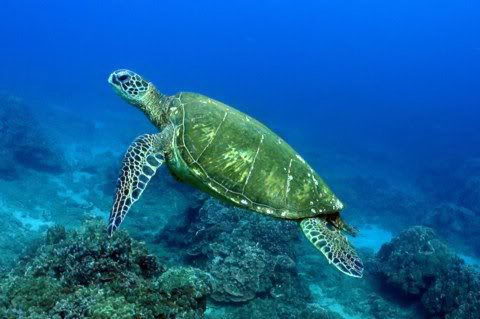
Today I swam with some green sea turtles as big as a table top. There were three of them sort of nuzzling each other on the reef, about 40 feet down, and a couple of remora clung to the shell of one.

These were big adults. They can reach 400 pounds. I swam slowly alongside one of them, an arm's length away. Its yellow and green coloring stood out from the russet and brown corals.

Even at our depth the clear water allowed the noonday sunlight to brighten its coloring. Later I saw some other turtles hiding in crevices in the reef. One was underneath the skeleton of a motorcyle standing on the sand.

Photo from AnimalsTime.com Green sea turtles swim beautifully.

We were only about a half-mile offshore of the town of Akumal, Mexico, about an hour south of Cancun. The town is famous as a nesting ground for loggerhead and green sea turtles. An ecological center uses staff and volunteers to make sure that when female turtles come ashore to lay their eggs, the nests are protected from predators and poachers.


Friday, September 12, 2014

When you say it, it's like magic: Tepotzotlán


Mural inside the town hall (ayuntamiento) of Tepotzotlan shows its Spanish and indigenous roots.
Big chair in the town square.
 Cindy keeps a list of places she wants to visit in Mexico, and there is usually a church involved. This time the church was just a 20-minute cab ride north from us in a town called Tepotzotlan (tay-po-tso-TLAHN).

I find it highly ironic that a young lady of Presbyterian upbringing should find Roman Catholic churches so attractive. But then the Protestants stripped their churches of the excessive adornment common in the 15th century. So it's somewhat new to her.

This particular church was built at the end of the 17th century to honor a co-founder of the Jesuit order of priests, St. Francis Xavier.  This church and this town were a major Jesuit training center in the New World.

The church did turn out to be stunning, but the town itself was charming. It is one of Mexico's so called Magic Towns (pueblos mágicos) and it deserved the designation. A lot of it has been preserved.

In most of these magic towns you get a good feel for how the indigenous culture and Spanish culture mixed while maintaining their separate identities. In the Spanish style town hall, the walls are decorated with murals showing indigenous heroes and historical figures.

Saturday, March 15, 2014

On Mexico's Mayan Riviera: Tulum and Cancun

Cindy and Patrick at Tulum in 2000

When Cindy, Patrick and I visited the Mayan ruins of Tulum 14 years ago, we had the place pretty much to ourselves.

Industrialized tourism was just beginning on the so-called Mayan Riviera on the east coast of Mexico's Yucatan Peninsula.

We could climb the pyramids and walk anywhere around the site.

Today it's a different story. Busloads of tourists pour in from Cancun, about 90 minutes north. You have to park about a half-mile away from the entrance now. The ruins are roped off. More of the buildings of this ancient ceremonial city have been restored and excavated.

Thursday, February 27, 2014

Getting acclimated to one of the world's biggest cities

Letter from Cindy:

At the National Palace in the heart of Mexico City, where we saw Diego Rivera's murals.
Our neighborhood is densely packed, part of a suburb of 500,000. 

Dear Friends and Family,
 
Jim and I are still wandering the globe. We are in Mexico again, as some of you already know. Jim has accepted a one-year appointment as visiting professor of Communications and Digital Arts at Tecnologico de Monterrey's campus near Mexico City. Tec is an innovative private university with 13 branches around Mexico.
 
We are living in Ciudad Lopez Mateos, 30 to 40 minutes northwest of the capital. This is quite different from life in Guadalajara, where we lived in an upscale neighborhood with plenty of shops, restaurants, parks and a car. 

Wednesday, January 29, 2014

Balloon launch over the ancient pyramids of Teotihuacan


Morning balloon launch over Pyramid of the Sun, Teotihuacan. We got to the site at just the right moment.
Cindy and I have been to Teotihuacan (tay-oh-tee-wah-KAHN) a couple of times before, but the scale of the place never ceases to impress us. So when the staff at the university invited us to join a Sunday tour with other international students and professors, we said sure.

We had a pleasant surprise when we got to the site, which is about 30 miles northeast of Mexico City. A balloon launch was under way. It looked at first like an invasion of the aliens.

Sunday, October 20, 2013

Nomadic life: the kindness of friends, family

Pickup soccer below the 16th century city wall in Cartagena, Colombia, old port city on the northeast coast.
You can't do what Cindy and I have done for the past five years without the support of friends and family. They have encouraged us to live a life without a home by making their homes available to us.

We sold our house and everything in it in 2008 so that we would be free to go where my next consulting or teaching gig would take us. That meant most of three years in Guadalajara, Mexico, two years in Beijing and now betwixt and between Atlanta, Miami and Cleveland.

Cindy has been our guide for all this time. She has planned dozens of side trips for us, worked out itineraries, picked out places to visit and even assembled historical background for me to study. She has recorded it all in thousands of photographs.

Most recently I was in Medellin, Colombia, for a few days, giving a lecture and workshop at a journalism conference.

Wednesday, November 17, 2010

Some indicators of corruption

Yesterday I was reading Mural, one of the better local dailies (there are five here), and I came upon this startling statistic: In the past 18 years, Mexico´s Secretary of Public Affairs has levied $3.3 billion dollars in fines (that´s correct, 40 billion pesos, or $3.3 billion dollars) against government officials for corruption.

That amounts to about $190 million dollars in fines a year against corrupt officials.

But the government has actually collected less than 1% of those fines. Why is the collection rate so bad? According to the article, the appeals process can be dragged out indefinitely, and, if it appears there will be a final resolution against the appelant in the case, he merely unloads all his assets so the fine can´t be collected. Perfectly legal.

Unbid contracts represent 97% of the total

On the same front page was a story about the handling of public contracts under the mayor of Guadalajara, Aristóteles Sandoval, who was recently elected on an anti-corruption platform.

As it turns out, the new regime has a worse record than the previous one in terms of awarding contracts not subject to a public bidding process. Under Sandoval, direct contract awards, made by the head of public works, represent 70% of total contracts, and another 27% are awarded to invited bidders.


Evidently the rules that require public bidding are open to interpretation. Juan Carlos Uranga, secretary of public works, says he alone decides who gets contract awards and who gets invited to make proposals for these unbid contracts. "And there is nothing untoward about it," he says.

The previous administration had 13% of contracts open to public bid, compared to this administration´s 3%.

Wednesday, November 03, 2010

Low pay, little opportunity here

An article in the local paper said the highest paid college graduates are those who study civil engineering (construction of highways, water systems, etc.). A new graduate can expect to make $10,700 a year.

Other recent graduates:
-- Marketing, $8,300 a year
-- Computing, $7,700
-- Elementary school teacher, $5,000
-- Law, $4,000
-- Accountant (bookkeeper might be a better description), $4,000

There aren´t a lot of jobs being created here outside of the government or political parties.

At every busy intersection you find people selling stuff to motorists -- toys, windshield wipers, candy, bug zappers, TV trays, you name it.

Many adult males are "cuidacoches", a type of informal valet parker who helps motorists find a parking spot or pull out of one, and offers to clean your car while you shop, for anywhere from $2.50 to $10. If you´re just getting help with parking, it´s considered polite to pay 5 pesos, or about 40 cents.

There are some beggars, mostly old women in country dress or very young women with babies.

Mexico is cheaper than the U.S. for many things but it´s not cheap to live here. I don´t know how many people keep body and soul together.

Monday, November 01, 2010

The Elegant Dead: Mexico´s catrina tradition

An ecologically conscious "catrina" with a skirt made of garbage bags.

Mexico´s Day of the Dead celebration is a mix of indigenous and Spanish cultural traditions, and in Guadalajara this year, it meant that the main street was lined with "catrinas".

The elegantly dressed skeletons (a "catrina" is an elegant woman) were designed by high school and college students and had a variety of themes.


A catrina in native dress captured an admirer.


The goddess of Death and the depiction of skulls go back thousands of years in Mesoamerican culture. There is an Aztec altar composed of hundreds of images of skulls (calaveras) in the heart of Mexico City, next to the main cathedral. Little sweets made in the shapes of skulls, called calaveritas, are part of the modern observance.

But the catrina tradition was made popular in the last century by a Mexican artist and caricaturist.


This catrina is outfitted in handkerchiefs.


The Goddess of Death is condemned by the Catholic Church but is worshiped by the lower classes and by narcotraffickers, who set up shrines to her.


Even young men want to pose with a catrina.


Some of the best catrinas were set up in the square around the cathedral so families out for a Sunday stroll could appreciate them.

The elegant dead like to garden....

...and to play with puppets.

Thursday, September 16, 2010

Mexico´s crisis looms over bicentennial


I´ve just finished reading Mariano Azuela´s gritty novel about the 1910 Mexican revolution, "Los de Abajo".

He uses a stark realism to depict one of the bands of anti-government forces who fought the federales.

The peasants who rise up against the landed gentry and hacienda owners lose their ideals along the way. Hardened by the war, they see the lofty goals of land reform and democracy as dreams of fools. The people´s army degenerates at times into a pitiless gang of thieves and murderers.

It´s a dark tale about the pointlessness of war. The author, who is a native of the state of Jalisco, where we live, served as a physician in the forces of Pancho Villa, one of the revolutionaries. He knew what he was talking about.

A revolution every 100 years

That´s the saying in Mexico, where revolutions were launched in 1810 and 1910.

Mexicans are now celebrating their bicentennial, but there doesn´t appear to be another revolution on the horizon.

Enrique Krauze, a Mexican historian and newspaper columnist, wrote recently in the New York Times:


Despite a bloody mythology that venerates the great protagonists of 1810 and 1910, most of whom met brutal deaths, the common denominators of our national history have been social, ethnic and religious coexistence; the peaceful construction of cities, villages and communities; and the creation of a rich cultural mosaic. Many of us want to believe that we are living through a nightmare from which, one morning, we will simply wake up, once again at ease.


Krauze tends to be an optimist. More than a year ago, he argued passionately that Mexico was not a "failed state" about to fall apart because of the growing power of the drug lords. Obviously, he has maintained this confidence.

At the very least, Mexico´s state is being seriously challenged. Every day there are examples of increasingly audacious defiance of authority by drug lords, who execute mayors, police officials and anyone else who gets in their way.

The cry of freedom in 1810

Mural depicting Miguel Hidalgo, father of the 1810 Revolution, here in Guadalajara. The artist was Clemente Orozco.

So reflections on where Mexico is going are part of the 200th anniversary celebration of the uprising that threw off Spanish control.

The priest Miguel Hidalgo is regarded as the George Washington of Mexico. The revolution he started began in the deliberations of a book club (tertulia) in the town of Dolores, where he was assigned.

(Skip down to the heading "Involvement in Queretaro" to see how the Insurgentes, sort of the Franklin-Adams-Jefferson-Hamilton-Washington of Mexico, got started in a book club.)

Trained by the Jesuits, Hidalgo was an unconventional priest. He had relationships with several women and fathered at least five children.

Here is Krauze´s assessment of the revolution Hidalgo started:

From 1810 to 1821, the war for independence cost about 300,000 lives in a population of around 6 million. Afterward, state income, agricultural, industrial and mining production, and, above all, the availability of capital for investment did not reach their pre-1810 levels until the 1880s. And the material desolation was followed by almost five decades of insecurity on the roads, political instability and grievous civil and international wars.


It was in this church in Dolores that Hidalgo made his call for independence from Spain 200 years ago. This speech sermon is now referred to as El Grito (the shout).

Hidaldo was executed the next year, but not before the revolution was well under way.

We visited Dolores Hidalgo in March with my sister, Nancy, and her husband, Tom Lukens. In the photo below, Nancy and I are at the statue of Hidalgo.

Wednesday, July 21, 2010

Cussing and slang in Mexico: it´s all about Mom

Mexican slang and cursing are different from every other Latin American country. The best place to find out why is in Octavio Paz´s classic essay on Mexican identity, "The Labyrinth of Solitude."

It´s all about Mother. Or the children of the Violated Mother, los hijos de la Chingada.

Mexicans use that phrase to describe themselves with a mixture of pride and bitter irony. It has to do with their history: indigenous women taken or raped by Spanish conquistadors and colonists. The Woman as Victim, a person they identify with. (Her opposite is the Virgin of Guadalupe, the Woman as Refuge and Protector.)

Paz dedicates much of a chapter to the unique Mexican use of the word chingar: in this country, it´s as vulgar as saying f---, but in other countries it means to fail or get drunk or mess up.

Daily speech in Mexico is filled with expressions about mother:

Un desmadre (trans.- dis-mother) is a mess.

Desmadrarse (trans. to dis-mother oneself) means to go wild.

Ya estoy hasta la madre (trans. - I´ve reached motherliness) means I´ve had it, I´m tired, I´m sick of it.

Te voy a romper la madre (trans. - I´m going to break/wreck your mother) means I´m going to kick your ass.

Me vale madre (trans. it´s worth mother to me) means, I don´t give a shit.

A toda madre (trans. - totally mother) means very good.

Me cae de madre (lit. - he/she strikes me as mother) means I think he/she is cool or great.

De poca madre, (trans. - not very mother) means cool, very good.

Mentada de madre (lit. - mention of mother) means to insult someone´s mother.

The legendary mentada de madre here in Jalisco came when the governor, clearly drunk at a fundraising event, presented a check of state money to the Cardinal to build a sanctuary.

The donation was highly controversial because Mexicans have a love-hate relationship with the Church. The governor had been roundly criticized. So in presenting the check to the Cardinal, the governor told his critics and all the electronic media, "If you don't like it, then chingue a su madre" (f--- your mother).

Dad, on the other hand, is not associated with victimhood but with power and control.

Yo soy tu padre (lit. I´m your daddy) means I own your ass.

Qué padre (lit. - How dadly) means cool or great. Padrísimo is even better.

I work with a guy who is a poet in the way he fills every line of speech with creative variations on four or five vulgar words, in all of their shapes and variations. Cab drivers are quite good at it as well.

The words for me do not have the weight of culture and history. I'm like a child playing with sharp knives. I don't know how to pick them up or throw them around without causing injury.

Or the words seem to be mere puffs of air without substance, until I utter one and see it jerk someone's head back.

Saturday, July 17, 2010

Renewing a Mexican visa, or Catch-22

"Catch-22" is one of my favorite books because it makes hilarious comedy out of bureaucratic lunacy.

None of the bomber crew members in the story want to fly the suicidal missions over Italy. The only way they can get out of them is if they´re judged insane by the Air Corps psychiatrist.

But if they tell the psychiatrist they have horrific nightmares and they´re too terrified to fly the missions, that´s a healthy response, therefore they´re sane and have to fly the missions.

If a crewman really is crazy, then he enjoys flying the missions. So everyone has to fly the missions. That´s Catch-22. The world´s bureaucracies are full of Catches.

Mexico´s version of Catch-22

Getting a work visa renewed in Mexico is something like that. You´re wrong even when you´re right, and you will be punished. This year the government developed a new computerized streamlined system for the process. Here´s how it works:

1. It says on the helpful website that you just fill out the renewal form online. I ransack the website without finding the renewal form. There is no place on any page that has a link to it. I do a Google search for FM3 visas and find a blog dispensing immigration advice for Cubans living in Mexico. It has the link.

2. I fill out the form online. There is no English version, which is not a problem for me but must be for some of the other 1 million Americans who live in this country. At the end, the form gives me two choices: "save" (guardar) or "save and copy" (guardar y duplicar). Being a careful sort, I hit "save and copy".

Hitting "save and copy" was, I later learned, a big mistake.

3. Being a careful sort, before I fill out Cindy´s application, I take the printout of my application down to the immigration office to submit it to Answer Lady, whose job it is to help ignorant foreigners decipher the niceties of the system. She reviews my form. In the box for writing where the original visa was issued, I wrote, "Washington, D.C.", just as it said on my visa.

-- This is a mistake, said Answer Lady. Even though your visa says it was issued in Washington, it was really issued on Mexican soil because it was in the embassy there.

-- Oh, I said. So when I fill out my wife´s form online, I should write that her visa was issued in Mexico, right?
-- Right, said Answer Lady.

Believing Answer Lady was a big mistake.

4. At the immigration office the next Monday, the line is amazingly short at 9 a.m. We bring with us a fat file folder filled with documents that we had to present the previous year to renew the visas:
-- letter from me in Spanish attesting to the fact that I will support my wife during the time of my visa and not abandon her,
-- passport and two copies of each page of the passport,
-- visa and two copies of each page of the visa,
-- letters from the University and from Washington saying that I am in Mexico to do good things,
-- copies of passports of the letter writers with their signatures to prove that the letters aren´t forgeries,
-- copies of utility bills as proof of residence,
-- copies of three months of bank statements to prove income,
-- copy of my work contract with the International Center for Journalists,

-- three black-and-white photos face front, two photos in profile.....
-- and although we supposedly don´t need them this year in the streamlined system, I bring along the certified copy of our marriage license and certified copies of our birth certificates.

I also had obtained from Answer Lady the form you use to go to the bank and pay the visa fee for each of us.

To speed up the process, I paid the fees before submitting the application. Big mistake.

5. We submit our papers. Two women scrutinize various documents.

-- We have to reject your application, sir, because you made a mistake by hitting 'save and copy´. You only use that if you´re going to submit a duplicate for a child, and you don´t have a child seeking a visa. So you´ll have to go online and fill out the form again.

-- And we have to reject your wife´s application because it says she got her visa in Mexico but it was really in Washington, D.C.
-- But Answer Lady told me to put down Mexico, I protest.
-- Sorry.

6. We go to an Internet café near the immigration office and fill out the forms again, print them out, get back in line, which is longer now, and wait our turn. We submit our stuff again.
Do you have your payment forms? You bet we do.
-- I´m sorry sir, but we can´t accept your payment. It´s for the wrong amount.

Cindy´s is correct, but it turns out I had made a mistake and paid the same amount for both Cindy and me, about $100 each. I was supposed to pay $160 because I´m earning a salary down here.

7. They accept Cindy´s application but won´t accept mine until I go to a bank and execute a new payment for the correct amount. It´s not possible to just add on to the amount I´ve already paid. Cindy takes a taxi home. I take a taxi to the bank where I originally paid, pay again, this time $160, take a taxi back to the immigration office, take a ticket and get back in line. The line is longer now. I wait. I submit my application again, payment is correct, they accept the application and give me a number to check online. It will tell us when the visas are ready.

8. So what do I do about getting a refund for the erroneous $100 payment I already made?
-- You´ll have to talk to that lady over there.
She has me fill out some forms. Now what?
-- Well, the paperwork has to go through some channels and you´ll have to come back in three days.

9. I come back three days later, expecting to get a check or a voucher I can take to a bank and use to make a deposit.
-- Oh, no, you have to take this form to the office of a different agency, the SAT (tax collector) where they issue refunds.
-- Where is the SAT office?
-- There are several. You can look them up online, but you have to make an appointment.

10. I go online to try to make an appointment. The system is down and not working and continues not working the next day as well. I call the number listed on the website. A person answers and says that I made a mistake, this is the wrong agency. I check the number on the website. I had called the number listed, so evidently everyone who has this problem and calls this number will always get the wrong agency. She gives me the correct phone number.

11. I call the agency to make an appointment for getting my $100 refund. The woman asks me what SAT district I live in. I say I don´t know but I give her my address. She says she can´t tell from that what district I live in. I´ll have to go to one of the offices and ask which office is the correct one to go to for the refund.
Then I can make an appointment.

12. Meanwhile we find out that are visas are ready. On this day, the office is packed. We wait about two hours to get to the front of the line. I´m nervous as hell that I might have made some other mistake, that there is some hoop we forgot to jump through. The clerk asks us where our XXX forms are. What forms?
-- These forms. You mean no one told you to fill these out?
--No.
-- OK, we´ll just fill them out now."

Fortunately do not have to get back in line.
But this new form asks for information that we have already given them two or three times in different documents, but we have to fill it out.
We get our visas. Yay!

13. Now about my $100 refund for the erroneous payment.
There are two possible SAT offices that could be the one I´m required to go to. I pick the one by the Christopher Columbus Circle. I get in the line that says "without appointment". I give them my address. Yes, you´re at the right office. You´ll have to wait to see a counselor. I take a ticket. I wait. The counselor says that to get the refund I will need:
-- Proof of residence from a utility bill
-- a copy of my passport
-- the voucher that I already have and a copy of it
-- copy of my visa, both sides
-- the bank account details where they are to deposit the money (they don´t issue checks)
-- and I will need to make an appointment

Here comes Catch-22

-- So when would you like to make your appointment?
-- How about this week?

She looks at my newly issued visa. It´s a plastic card like a driver´s license instead of the old passport-style booklet. She checks the date. Technically, my new visa doesn´t take effect for two weeks because I renewed it two weeks before the old one expired.

-- I´m sorry sir, but we can´t make an appointment with you until this visa takes effect.
-- But I just renewed it. Look. Here´s a copy of my old visa.
-- Sorry, we´ll have to make an appointment no sooner than the effective date of this new visa.

14. Now uncertain whether my new visa is valid, I prepare to leave on a two-week trip to the U.S. I carry a 24-page full-color photocopy of my old visa, just in case. At the airport in Guadalajara, the immigration officer looks at my card-style visa as if he has never seen one before.
The new rules and new forms have been in effect for two months.
-- What´s this?
-- It´s my FM3 visa. It´s the new style. They just started issuing them.

He looks at me, looks at the picture, studies both sides of the card, trying to figure out what to do. Eventually he sees something he recognizes, writes something down and stamps some forms, giving me two copies.

15. I´m back now from the U.S. and have my appointment at the SAT office. I bring my fat file with me that has 10 times more information than is required because bureaucrats always want you to present something you don´t have.
She asks for a copy of the picture page of my passport, which by dumb luck I have. She looks at the bank account information.

-- This bank account isn´t in your name.
-- No that´s my wife. I don´t have a bank account. Here´s our marriage certificate.

After a half hour of looking at her computer screen and printing out a half-dozen documents, stamping each four or five times, she hands me a form that is a record of my application.

-- It will have to go through channels and be approved she says. You should hear within the next 40 working days.

40 working days. That´s more than eight weeks after you take holidays into account.

At this point, the authentic human response should be a shriek of frustration. But I know that within the bureaucratic system, you have to pretend to be civilized, or the system will punish you even more.

So now I´m waiting to see if the deposit will show up in Cindy´s bank account or for some notification that my application for refund was rejected.

On the other hand

The Mexican bureaucracy functions differently for special people, though. Yesterday I read in the paper that six state government officials, in illegal fashion and with approval from no one, awarded themselves bonuses last year totaling $2 million.

That averages to $333,000 apiece. I´m betting that they didn´t have to make an appointment at the local SAT office to get it.

Monday, May 31, 2010

Lucha libre: wrestling with Thunder Boy and Princessa Maya

Divino has his way with Thunder Boy on the ramp up to the ring, whose ropes are sometimes insufficient to contain all of the action and drama. Cameras aren´t allowed in the arena, but I snapped some images with my iPhone before an usher told me to desist.

You can´t live in Mexico without taking in a match of Lucha Libre (freestyle wrestling).

It´s a combination of morality play, superhero drama and acrobatics. Masked Mexican wrestlers are folk heroes. In movies they fight vampires, criminals and other forces of evil. The masks have a historical and cultural significance in this country whose indigenous roots run deep.

Here is the official website of the World Council of Lucha Libre and here is an article about the history and meaning of the sport.

On Sunday night a friend from the University who is a big fan took me to the Arena Coliseo to see six matches.

Siluetta throws Princessa Maya to the canvas.

Women wrestlers

It was family night. Adults pay $2 to $12 and kids get in for 40 cents. There were maybe 1,000 people for a two-hour spectacle that started at 6. A beer is $2, a bag of microwaved popcorn $1.50.

Not on the card was the leadoff match between two women wrestlers, Princessa Maya and Siluetta (a more appropriate name might have been Big Shadow).

They did some impressive acrobatic and gymnastic moves as they threw each other around the ring for a few minutes. Part of the deal is to create a villain who takes cheap shots. Then the aggrieved makes a comeback and overcomes evil. But sometimes evil wins.

Siluetta won out over Princessa Maya.

Kids love the wrestlers´ masks. Stores have hundreds of different styles and colors.

Aerial combat outside the ring

The top-billed match was between three guys without masks -- Strong Man, Gigante Bernard and Blue Panther -- and the three masked heroes, Atlantis, Averno and Mephisto.

Gigante Bernard and Strong Man were gringos who had a Mexican ally, the Blue Panther, and they beat the snot out of the three masked wrestlers. I wonder if the gringos always win in these dramas.

Gigante Bernard and his two partners claim victory, while the vanquished lie at the right.

Strong Man shakes hands with the fans. Sorry about the light.

In any case, the referee was completely ineffective at keeping the wrestlers inside the ring. A favorite aerial maneuver is to stand on the ropes in the corner and launch oneself onto an opponent.

They execute these flying maneuvers outside the ring as well, which looked awfully dangerous to the wrestlers, not to speak of the audience and vendors.

Leo, a handsome young guy without a mask, was a favorite with the young crowd. He took on the Exterminador.


Wrestler action figures.

The wrestler Alpha pose is everything. The jersey is for the Black Lions, the University of Guadalajara´s professional soccer team.

Thursday, April 01, 2010

Cacaxtla and Xochitécatl: murals and pyramids

Above you see an artist´s depiction of one of the murals at the Cacaxtla archeological site as it might have looked when it was just painted. Below you see the actual painting on which it was based, showing a Bird Man with a snake-headed staff. The mural is about 1,300 years old. What is amazing about all the murals at this site is that they have survived. They´re among the best preserved in Mexico.

If you´ve ever seen the murals from Bonampak in Chiapas, you will recognize the Mayan influence in the colors and the depiction of the face. Archeologists say the sites represent a blending of influences from the Gulf Coast and from the central plain near Mexico City.

Cacaxtla was excavated starting in around 1975 after some grave robbers opened up the pyramid. Across a ravine, about a half mile away, are the pyramids at Xochitécatl, which were excavated only about 15 years ago.

We hiked through this ravine from Xochitecatl (background). It´s steeper than it looks. The guard there told us it was "no recomendable" to walk between the sites, and it was, indeed, a bit rough.

From the top of this pyramid you can see three big volcanoes on a clear day. It was hazy when we were there, so our photos barely showed the outline of Popocatépetl, Iztaccíhuatl and Malinche. Say those first two names fast.

Spiral pyramids are rare in Mexico. This is one of the biggest.

These two sites are breathtaking yet don´t seem to attract a lot of tourists. They´re located about 90 minutes by bus from Puebla. Industrialized marketing and tourism haven´t taken hold yet.

Sunday, March 28, 2010

Folk dancing celebrates Mexico´s 1910 Revolution


This selection of 90 seconds will give you some idea of the folk dancing competition among secondary schools that we saw while we were in Puebla.

Because the dances were celebrating the Mexican Revolution of 1910, guns figure prominently among the props. In contrast with the popular dances of the gun-toting revolutionaries, the formal dances celebrate the elite class that ruled during the dictatorship of Porfirio Díaz, whose government the Revolution replaced.

Wednesday, December 23, 2009

Mexicans don´t trust politicians, police or judges

American newspapers are starting to pick up on the Mexican war (and it is a war) on drug traffickers.

A typical American response would be stronger enforcement, task forces, aggressive prosecution and so on. That is not likely to happen here. (See how it works in Mexico.)

Mexicans believe that their police and judges are corrupt, along with their politicians. Who would you tell about crime and corruption when the highest authorities in your town or state are considered corrupt?

Scary poll results

I share with you a poll from one of the most respected Mexican newspaper groups, Reforma. It´s pretty simple: On a scale of 0 to 10, with 0 being not corrupt and 10 being very corrupt, how would you rate various professions and institutions in Mexico?

One was judges. 71% of those questioned in the poll rated judges as 7 or higher on the corruption scale. And they´re probably right.

Naive me, I would score the U.S. judges at less than 1 on the corruption scale. Would I be right, in your opinion?

Politicans are considered most corrupt, followed by the police

The percentage of people who gave a score of 7-10 on the corruption scale to various professions:
Politicians -- 87% of those polled gave a score of 7-10, up from 81% eight years ago
Police -- 80%
Union leaders -- 79%
Judges -- 71%
Lawyers -- 69%
Bureaucrats -- 65%
Business executives -- 59%
Priests -- 40%, up from 28% seven years ago
Journalists -- 39%, up from 33% eight years ago
Doctors -- 35%

The army, interestingly enough, is one of the country´s most trusted institutions, which is why it is leading the government´s ant-crime effort.

How do you root out crime

Even if you assume that people are wrong in their judgment about who is corrupt, the fact that people don´t trust their institutions makes it difficult to establish rule of law.

People don´t feel confident giving information to authorities about criminal activity.

Corruption is not described or defined for the purposes of the poll, which was of 820 Mexican adults, by telephone at their homes, Nov. 7 and 8. The poll supposedly has a margin of error of 3.4% and a confidence factor of 95 percent. Because Reforma keeps news behind a pay wall, I can´t link to the original article.

Money and arms from the north

Mexico has become the No. 1 source of illegal drugs shipped to the U.S. Rolling Stone did an interesting piece that captures how broadly and deeply the money from this trade has corrupted every level of Mexican society.

As many as a third of Mexico´s states are considered narco states, where everyone from the governor on down is involved in protecting and benefiting from the drug trafficking.

The Wall Street Journal did an in-depth piece on Mexican trafficking of marijuana and cocaine in February.

The trade generates an estimated $20 billion in revenues, which makes illegal drugs Mexico´s third largest export after oil and automotive products, according to the Wall Street Journal. (If you prefer, here´s the WSJ Spanish version.) That figure represents about 2% of the country´s gross domestic product.

Monday, December 21, 2009

84 bicyclists run down and killed in Guadalajara in one year

I worry less about swine flu and armed drug dealers than I do about careless motorists.

Cindy and I don´t ride our bikes here in Guadalajara, nor would we be likely to try it anywhere in Mexico. It just doesn´t seem safe to us.

Today I got confirmation. I read in the paper (Mural) that in 2008, 84 bicyclists were killed in traffic accidents in the city of Guadalajara. Eighty-four! In one year! In one city!

In the first nine months this year, 272 pedestrians have been run down and killed by motorists in Guadalajara, but the authorities didn´t break out how many of those were bicyclists. That´s in one city, in nine months.

Drivers on cellphones, so look out

When Cindy and I walk in our neighborhood, we have to be really careful crossing the street. Drivers don´t seem to pay any attention to pedestrians. They ignore red lights, stop signs, everything.

There are lovely trees and bushes along the streets, but you can´t see the traffic, nor can the drivers see you. Even on the sidewalk, you have to dodge cars pulling in and out of illegal parking spaces.

It´s not just legendary Mexican macho. Male and female drivers seem to be on their cellphones all the time.

Driving on the shoulder

Two-lane highways have an imaginary third lane in the middle for use by the bold and impatient.

It´s just as dangerous outside the cities. There´s an unwritten rule that on a two-lane highway, there is an imaginary third lane down the middle for passing. So it is customary for all drivers to stay to the right with two wheels on the shoulder.

Note that our driver has two wheels on the shoulder.


I wouldn´t want to be a bicyclist on any of those two-lane roads.

There is talk of building bike lanes and bike paths in Guadalajara, but I have my doubts. Motorists would ignore the dividing lines, for sure, and if the bikeways were on sidewalks, people would park in them. That´s what they do with the sidewalks.

Saturday, December 19, 2009

Women rodeo riders in Mexico, like the Blue Angels on horseback


Cindy and I went to see a Mexican rodeo back in October. It was a big championship with teams competing from various clubs and towns around the country.

Mexican rodeo is called charrería, and it includes the usual roping of calves and broncos, and something called the "death pass", in which a bareback rider jumps to another horse without saddle or reins. Sometimes they fall off.

Women riders are the coolest


The most impressive event, though, was something called escaramuza, literally "skirmish" in Spanish, in which women in long skirts, riding sidesaddle, perform precision maneuvers.

It´s easier to show a short video of two and a half minutes rather than to try any more description.


Drinks and snacks are different


Vendors walk through the stands selling bottles of tequila as well as cans of beer. The crowd seemed pretty well behaved, but we were there in the afternoon. Tickets for a later competition also included a show by the famous singer Jenny Rivera.

The crowd might have been in a different mood by then.