Monday, February 19, 2007

Oruro's world-famous festival


Many people had recommended taking a trip into the mountains to the mining town of Oruro to see its annual Carnaval (Mardi Gras) festival of dance and music. Every town has its own version of Carnaval, but Oruro’s is famous in Bolivia for its ancient dances and traditions.
It’s a 40-minute plane flight to Cochabamba and then a winding four-hour bus ride up to 12,000 feet and Oruro. It lies at the foot of the mountain that still yields tin and other mineral riches. I went with about 15 other people, mostly Bolivians but one Russian, two Chileans and a French couple.
It was worth the trip for the pictures I got. The spectacle is impressive. Some 28,000 dancers and 10,000 musicians start making a circuit at around 5:30 a.m. and go for 20 hours. The United Nations has recognized the dances and traditions as Masterpieces of Oral and Intangible Heritage of Humanity.


What the dances mean depends on whose history your read. The 24-page special section in the local paper, La Patria, traces this particular Mardi Gras fest to Feb. 2, 1789, when the Virgin of the Grotto appeared to a mortally wounded thief named Nina Nina and saved his life.


It’s a feast of the Virgin, then. And then she is also connected to a Robin Hood-like character named Chiru Chiru. What’s clear in reading the histories of each of the dances and the origins of the 40-some dance troupes is that there are numerous explanations for the meanings of particular dances and costumes and traditions.

Here is what the United Nations website says about the Oruro festival’s origins: “[It]
was an important pre-Columbian ceremonial site. It was refounded by the Spanish in 1606 and continued to be a sacred site for the Uru people, some of whom would travel from far afield to perform the rituals, especially for the big Ito festival.
“The Spanish banned these ceremonies in the seventeenth century, but they continued under the guise of the Christian
liturgy: the Andean gods were concealed behind Christian icons and the Andean divinities became the saints. The Ito festival was transformed into a Christian ritual, celebrated on Candlemas (2 February). The traditional "lama lama" or "diablada" dance became the main dance in the Oruro Carnival.

“The Carnival now takes place once a year, before Lent. It lasts ten days and gives rise to a whole panoply of popular arts expressed in masks, textiles and embroidery. The main event in the carnival is the procession "entrada", which combines Christian elements and borrowings from the medieval mystery plays.”


So it’s a mixture that is difficult to sort out. Arguing about what’s authentic and pure seems kind of pointless, but people get passionate about it.

Even modern choreography, despite written dance notation forms, is very much handed down person to person. And when you consider the difficulties modern choreographers have in maintaining some consistency in movement and meaning over just one generation, you have to imagine that these dances have been transformed over the past 20 generations by the individuals who performed them.


A sideshow was the battles between those armed with globos (little water balloons) and cans of espuma (foam). I tried to identify myself as a noncombatant by refusing to wear a long plastic poncho that many spectators wore. Mostly I suffered only collateral damage from nearby bombardments, but one globo exploded on my chest when I got caught in a crossfire.


We had great seats in a grandstand along the main drag. Vendors hawked Bolivia’s best-known beer, Paceña, for 60 cents a can, and a lot of people were drinking, but I didn’t see anyone really drunk. I watched and shot pictures for about five hours and then the sun got to me. It’s particularly strong at that altitude, even when you have a wide-brimmed hat and long-sleeved shirt. My exit was delayed for a minute as President Evo Morales and his vice president, Alvaro Garcia Linera, crossed the parade route to take their seats in the celebrity box. I got a good look at close range but a mob of journalists blocked my attempts to snag my own picture.

Monday, February 05, 2007

Watching the Super Bowl in Spanish


Dear Friends,

On Super Bowl Sunday I watched los Potros de Indianapolis trounce los Osos de Chicago on ESPN in Espanol. In about 210 minutes of an NFL broadcast, there is only about 20 minutes of actual action, so I flipped over during breaks to watch “American Splendor” on HBO, the biopic about Harvey Pekar, the comic book author from Cleveland, Shaker Heights High class of 1957. (Photo shows Paul Giamatti as Pekar and Hope Davis as his wife, Joyce Brabner.)
One of the scenes takes place in Elmwood Home Bakery, where I used to buy maple cinnamon doughnuts on the way to elementary school. Another takes place outside the Detroit Theater where we used to take in Saturday matinees for 25 cents. To see those familiar images and hear a couple of authentic Cleveland accents here in Bolivia was at first an emotional shock followed by waves of nostalgia. It was a pretty good movie (subtitled in Spanish). A little too sweet, probably, for the real Harvey.

*************
Get Shorty, and the poetry of profanity

A couple of weeks ago, HBO showed the 1995 movie “Get Shorty,” a great comedy based on an Elmore Leonard novel. I hear and speak Spanish all day, so to hear authentic American accents from a variety of familiar types had me grinning.
Gene Hackman does a wonderful job playing a slimy movie director named Harry Zimm, and Dennis Farina does a perfect rendition of a foul-mouthed Miami loan shark named Ray Bones Barboni. Farina makes profanity sound like poetry. He has the rhythms perfect. It doesn’t translate well into Spanish subtitles. John Travolta might not ever be as good in a movie. I just died laughing. Could be homesickness. (Photo shows Gene Hackman as the movie hack and Danny Devito as the insufferable movie star, Martin Weir.)

************
Shakespeare enamorado

Could be a pattern here…..”Shakespeare in Love” was on cable the other night, and again it was the sound of the words so beautifully and truly spoken that carried me away. Tom Stoppard, one of the best playwrights alive, did the script, which is filled with delightful inside baseball for both Shakespeare fans and modern theatergoers (jokes at the expense of directors and producers).
In an odd way, these doses of English at its best have a way of making Spanish come easier. For the first two months here, all I read was in Spanish – novels, history, newspapers, magazines. And I went to lots of Spanish-language movies. But dipping into great writers of English lately has been very refreshing. It seems to make the Spanish easier. (Photo is of Joseph Fiennes as the young Shakespeare.)
*******

James Bond's botched subtitles

The pirated DVD of Casino Royale that I bought here for $1 had laughably bad subtitles in Spanish. The pirates evidently hired someone who couldn't make heads or tails of one character in the movie who had a German accent. "What did you do with the bodies," he asks Bond at one point. The subtitlist rendered that as, "What did you do about Boris?" There's no Boris in the picture. The subtitle writer also had trouble with the code name Ellipsis, which enters into the plot several times. He confused "ellipsis" with "lips" and used the Spanish word for lips (labios) in several baffling subtitles. The Spanish subtitles in the legitimate version of Casino Royale are, by contrast, quite well done.
The El Nino effect

This is the rainy season, but the El Nino effect has made it worse this year. The city where I live, Santa Cruz, had rain on 27 of the 31 days of January, and the entire eastern half of the country is suffering from flooding. Paved roads are few here, and many of them have been washed away by high water. Many communities are isolated. (The photo is from El Deber.) There are 15,600 families that have been rendered homeless by the flooding, according to El Deber. The Spanish word for victims of natural disasters is "damnificados," which pretty much describes their situation. I wondered how the number of families displaced compares with New Orleans.

Here in the city, the rain is more of an inconvenience than a disaster.
It translates into a lot of mud, big puddles and enormous potholes. People don't dress for it. Only about half the people use umbrellas. They walk through light rain unfazed, and if it's heavy, they wait until it stops. What's the hurry?

*******

My media class

Sunday morning I spoke with Cindy for 90 minutes as a
way of celebrating the completion of final grades for my 25 students in
the course on how to start and run your own newspaper,
magazine, TV or radio program, etc. They had to do a
business plan and marketing plan. The photo shows the dean of Bolivian television sports, Papi Nurnberg, addressing my class. He was one of four guest lecturers I invited, all of whom started their own media companies.

There are lots of
talented people who just shouldn´t be in college, including a couple of my students.
They´re bored out of their minds and want to get their
hands on something real. They should be working as
what used to be called apprentices, now interns.


A tribunal of two other profs
and I listened to 10-minute presentations of the students' projects. We were
supposed to be potential investors or funders who they
were trying to persuade to lend or contribute money.
One kid who is bright and talented
came in with his proposal for a film production
company. He didn´t have any required samples of any
work. I told him, “This is the first time that this
group of movie investors has ever been handed a
proposal by an unkown without being offered a single
film clip or or sample script.” He was shameless and unfazed.

Today, I gave the third of a series of seminars at a weekly business newspaper
here. They asked me for help in meeting deadlines. We were always pretty good at it.
The problem with the paper here is that they basically have one deadline, Friday night. Last week, the paper went out the door at 3 a.m. I gave them a couple of tips. We'll see how they do.

Sunday, January 21, 2007

Carnaval and other cultural notes


People start celebrating Carnaval here months before it arrives. Carnaval is technically a weekend-plus of events leading up to Ash Wednesday and the pentitential period of Lent. But Ash Wednesday is more than a month away, and the party officially kicked off yesterday in Santa Cruz with a big parade presided over by Carnaval Queen Andrea Abudinen (photo from El Deber). Actually, Andrea has been in the newspapers on practically a daily basis for months. She is photographed and written about wherever she goes. Yesterday there was a big article about the creation of the dress you see in this picture.
Carnaval is a very big deal. Maybe it's bigger in Rio de Janeiro, but the New Orleans version would probably pale in comparison to what's planned here in many cities of Bolivia.
I am told that in La Paz I will have to watch out for flying water balloons and in Santa Cruz for paint ball pellets, which evidently are outward expressions of inward joy of the season, the last blast of sensuous indulgence before the fasting and denial of 40 days of Lent. Although it doesn't appear that the indulgence here is always followed by self-denial.
The city of Oruro is known for its more folkloric type of Carnaval (photo here from Oruro festival website)

Here's a sample of some other culture.....We took a day to go to the town of Tarabuco, which is famous for its Sunday market of textiles, some of which we bought and took back with us. While there we also stopped at a local farmers' market and got a glimpse of big red plastic bags filled with coca leaves. We didn't see anyone working on the textiles while we were there, but we could see weavers working at the textile museum in Sucre.


In the mining city of Potosi we were startled to hear a stick of dynamite explode, but it was just to announce the start of a student demonstration against the leadership of the university. The students were protesting 5 percent pay raises for the faculty, and the notorious nepotism of the university president, which would mean reductions in expenditures on various services for students.
Sucre is also famous around the world with students of dinosaurs. It has huge deposits of calcium-based rocks and material that is mined for concrete, and it was there that workers found footprints. There are trails several hundred meters long made by some of these beasts perhaps 100 million years ago.
While in Sucre on Jan. 6, we saw the city celebrate the Feast of the Three Kings, which celebrates the biblical story of the wise men from the East visiting the Christ child. Families go to church to have the priest bless their Jesus in the manger, and we ran into one family that had several.


It was also in Sucre at Liberty House, their equivalent of Independence Hall, that we got to see perhaps the biggest representation anywhere of the great liberator, Simon Bolivar, a bust in wood. Bolivia won its independence from Spain in 1825, thanks to Bolivar and a general named Sucre. The wall tapestry you see is one of the few done by men, a phenomenon of recent years.

Sunday, January 14, 2007

The siege of Cochabamba

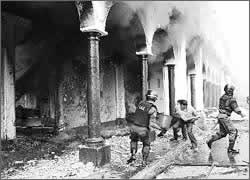
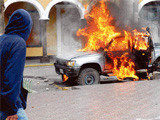
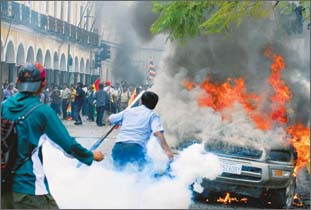
The split widened between the two Bolivias this past week. Tens of thousands of coca growers, peasants and supporters of the socialist government went on the march on Monday to force the resignation of the prefect of Cochabamba. His offense against the socialists was that he was asking for a referendum vote on autonomy for the key coca-growing region of Cochabamba. The socialists oppose autonomy for the departments of the east, which produce most of the country´s cash crops, petroleum and natural gas. (All photos are from El Deber and El Nuevo Dia)


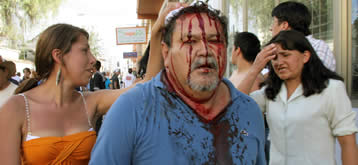
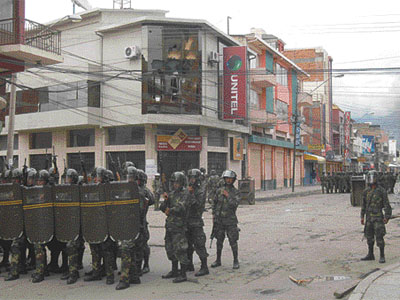
The socialist sympathizers started throwing rocks at the police protecting the prefecture offices, and the police responded with tear gas. The Interior Minister, who is a member of the socialist party, ordered the police to withdraw so they would not repress the social movements. With the police withdrawn, the mob burned the prefecture building.


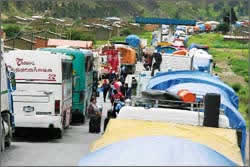
The siege was in its fourth day on Thursday, and Cochabamba, which lies on the road between the country´s two biggest cities, La Paz and Santa Cruz, was shut down by 15 blockades on the roads. Hundreds of trucks and buses were stranded, and the people in Cochabamba, who were running out of food, evidently lost patience with the socialists. A club-wielding group of youths crossed the riverbed to avoid a police barrier and attacked the socialists. Two people were killed and hundreds were injured.


Fifteen journalists were among those attacked and injured. They went on a march with muzzles over their mouths to protest the continuing violence against them. President Morales´s supporters in particular have targeted journalists, who are regarded as enemies of the socialist movement. A socialist mob surrounded the Cochabamba offices of Unitel, a national TV network owned by the government´s most vocal opponent and Evo Morales´s No. 1 enemy, broke windows and threatened the staff. Eventually police set up a barrier so the employees could escape.

It was not until Friday, the fifth day of the siege, before Morales called on his supporters to pull back and stop the blockade. A reasonable person might ask why he didn´t do so five days earlier.

Friday, January 12, 2007

Cindy's whirlwind visit


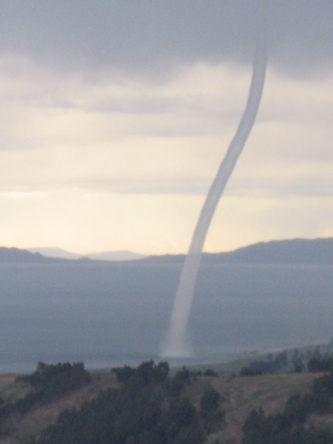
Cindy blew into town Dec. 26 and not a moment too soon. We hadn´t seen each other in three months, the longest separation in our 30-plus years of marriage. This waterspout appeared over Lake Titicaca as we were heading to Copacabana. The crazy weather on this leg of our trip also included a fierce hailstorm that left the ground covered as with snow. The van we were in skidded around on the mountain roads, eliciting yelps from us at moments.


We spent a couple of days in Santa Cruz and then headed for La Paz. We spent an evening there with Luis Ramiro Beltran, who is something of a legend in Bolivian journalism. He was the Defender of the Reader (ombudsman) for eight newspapers here, and he had helped me make connections with the journalists' association in La Paz. He also did a lot of work around the world for Johns Hopkins in the area of health communications, and when he was in Baltimore from time to time, he worked in the Candler Building, the same place I worked. Of course we didn't know each other then.


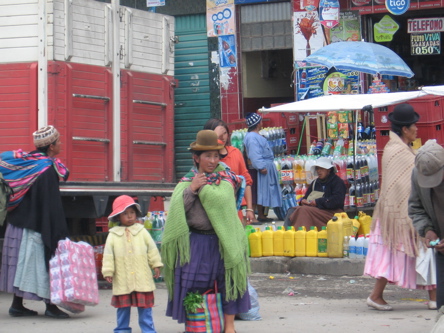
On our tour of La Paz, Cindy and I took in the Valley of the Moon and went up to a scenic overlook, where we saw an Aymara shaman (he's wearing the hat) working spells for one of his clients. Every so often he and the client would say a few words and toss something into the little fire. Kind of interesting to see this kind of ritual with the metropolitan backdrop. The other scenes are also in La Paz.


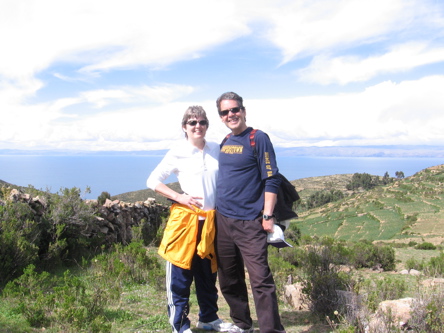
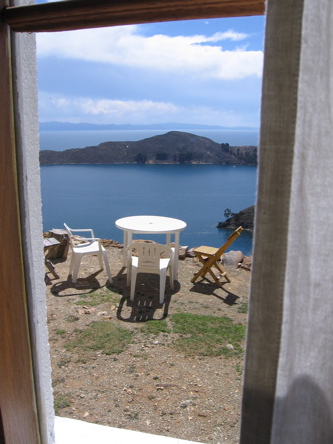
Copacabana is a lovely little town on the shore of Lake Titicaca. We spent a night there and headed out to Isla del Sol (the Island of the Sun), where the Incas believed their people, and all of mankind, were born. We stayed in a modest hostel overlooking the lake. It took us a good half hour hauling a ton of luggage up the hill to get to our place. No motor vehicles are allowed on the island, which is deliberately kept primitive. The Aymara Indians run everything. Every square inch of the island was cultivated at one time, to judge by all the terraced seed beds, but many of the fields appear not to be cultivated these days. I had a lot of excellent trout in our three days there.


On our last day we hiked 10 miles round trip to the Inca ritual site. It´s incredibly beautiful and quiet there, high above the lake. The highest point on the island is just over 4,000 meters, or 13,000 feet.

We headed on to Sucre, which is famous for its colonial style architecture. We asked the guide to show us some gardens, and she took us to the cemetery, which is like a little city where the ancestors reside. It was actually very lovely.


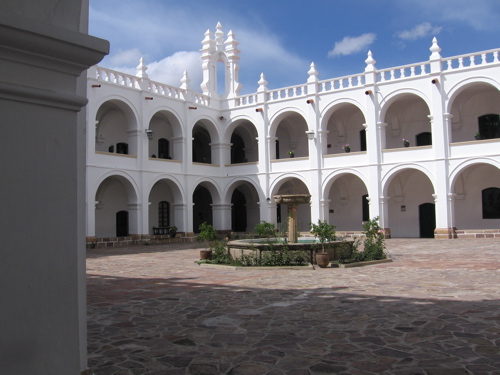
These shots are from the church of St. Philip Neri and school.


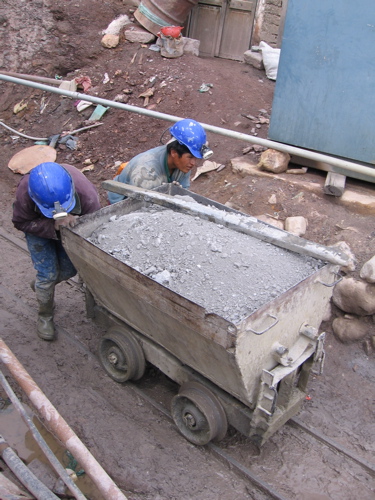
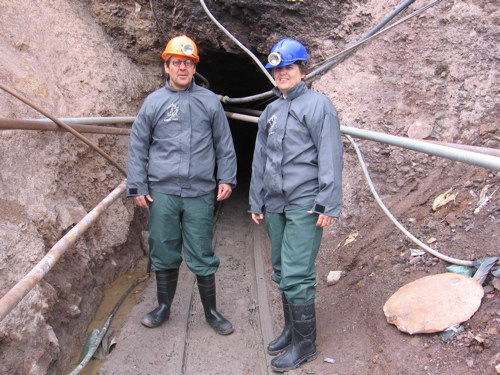
In Potosi, we went into the legendary Cerro Rico, rich mountain, which produced most of the world´s silver for the past 450 years. They´re still mining silver, zinc, copper and tin out of this same mountain. The mining tunnel we entered runs about a mile into the mountain.


We followed the tracks about 50 meters into the mine and stood inside a little niche where the miners pay tribute to the devil, ruler of the underworld, to ask for his indulgence and protection. The miners give the devil coca leaves, alcohol and cigarettes, which is what they subsist on during their long shifts. Teams of three men push a 1,000-pound handcart into the mine to collect a 2,000-pound load of ore. The guys pushing the empty carts into the mine have to pull their cart off the tracks into a niche and allow the full loads to go by. It´s all by hand. These guys earn about $75 to $150 a month, depending on their status. Lots of miners are in their teens. Our guide, Wilfredo, worked in the mine from the age of 12 till the age of 18. We saw several other young teenagers working there -- 14 and 16.


Wilfredo´s father and grandfather, both miners, died in the same year, his father from silicosis of the lungs at age 37, a common affliction, and his grandfather in a mine collapse.
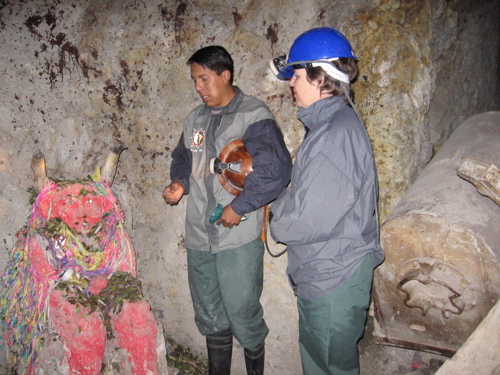


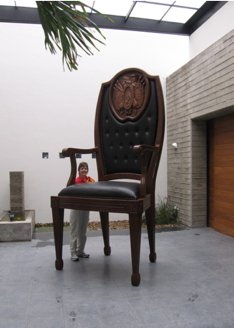
Cindy looks great, doesn´t she? Although some might think that she may be taking her diet too seriously.