Saturday, March 03, 2007

Veteran Bolivian reporter covers disaster


This is José Antonio Quisbert, reporter for El Nuevo Día newspaper, interviewing refugees from the flooding that has leveled vast areas of Bolivia. He has been reporting for newspapers and television for more than 30 years, and he approaches his work with the enthusiasm and curiosity of a rookie.
Quisbert, 53, has done a couple of impressive investigative series for the paper in the past several months. He won a national prize for investigative reporting a few years ago. In the early 1980s, during the brief, repressive regime of Garcia Meza, Quisbert´s house was bombed and destroyed, presumably by backers of the president in retaliation for articles he wrote.
For three days last week he and photographer Beto Justiniano let me tag along as they went into the most heavily damaged areas straddling the Rio Grande to capture the human side of the story. The rains began in late December and the waters have been rising steadily. This disaster has been unfolding like a train wreck in slow motion. Each day another town is affected.


On Feb. 27, we went about 80 miles north. We went as far as we could by car, then on the back of motorcycle taxis on rutted dirt roads (20 miles of terror), then paddling a boat and finally in a motor launch to a community known as Isla.
The land is dead flat. It´s almost completely under cultivation in soybeans, corn, sugar cane and some rice. The soil is very rich and productive, and almost all of the trees that used to anchor the soil have been removed in the past two decades. The land was less able to absorb the shock of one of the worst El Niños in the past 25 years. There are laws about leaving a tree buffer next to rivers but no one obeys or enforces them.


Last week, the swollen, surging Rio Grande blasted out of its normal channel and cut a new path through thousands more acres of farmland. The men you see in the photo here are wading back to their homes to see if they can recover anything.
The river claimed it all.


Quisbert is interviewing some of the farmers. Some belong to cooperatives that work land collectively, and some are essentially entrepreneurs who have borrowed heavily to buy tractors, seed and fertilizer and work tracts of several hundred acres. The man with his hands on his hips has 1,000 acres. He borrowed to buy the land and has $150,000 invested in a soybean crop that is under water. We went a couple of miles by boat and saw many houses like the one below, up to the roof line in water. The open areas around it were soybean fields.


Just in Santa Cruz province, 625,000 acres of soybeans has been destroyed. That´s one-sixth of the country´s biggest export crop and represents about
$125 million in losses. That´s a lot in Bolivia. This country´s gross national product is only $25 billion, a figure easily exceeded by the revenues of almost any Fortune 500 company.
In the cattle-raising province of Beni, about 20 million acres of land is under water. That´s equal to about one-third the land area of Ohio. Losses are about 300,000 head of cattle, or $20 million, which is very big money here.


These boys are part of 10 families who fled the city of Trinidad, a city of 90,000 that is completely surrounded by water. The 25 people managed to get free passage on buses to a modest house in Santa Cruz. At the moment Quisbert interviewed them, the families had exhausted all their food except for some handfuls of beans, which they were boiling in a pot in the yard. Several of the kids had skin infections from the water and insect bites. The adults had lung conditions. Supposedly relief services were aware of the family and had promised aid. Quisbert called a doctor after he finished the interview and asked him to look in on the family.
In his written account of the interview, he showed the families´plight in a compelling way with details gathered from meticulous reporting. He engages the reader emotionally through facts and a few revealing quotes. It´s not sob-story journalism but shoe-leather reporting.


The newspaper is part of a major national fund-raising and relief effort along with its sister newspaper in La Paz and ATB television network. Donors have contributed mattresses, clothing, tents, food, kitchen utensils, everything that a family might need.

We watched as volunteers sorted through a huge pile of donated shoes and sandals trying to match up pairs. Why they weren´t paired together at some point earlier seemed to be a mystery.


The needs are vast and the numbers are staggering. The last numbers I saw indicated that about 340,000 people had been affected by the flooding, which could mean they suffered losses or injuries or are homeless. About 40 people have died.

Photographer Beto Justiniano is working here to get some shots of a collection and distribution center under the stands of the city´s soccer stadium.


HOW TO HELP
People have asked if they can help. Catholic Relief Services has an online connection that gives information about its work in Bolivia and allows you to contribute: http://www.crs.org/our_work/where_we_work/overseas/latin_america_and_the_caribbean/bolivia/flooding.cfm
That is the only service I´m aware of that allows online contributions and that I feel comfortable sending people to.
The Cruz Roja (Red Cross) here doesn't appear to have any mechanism for foreign individuals to give. The International Red Cross doesn't have a program specifically for Bolivia.
Unicef is accepting donations for Bolivia relief at http://www.supportunicef.org/site/pp.asp?c=9fLEJSOALpE&b=2270607 You would have to specify Bolivia. And a local bank, Banco BISA has set up an account, 1177-5840-17, to accept donations. You would have to ask your bank how to do that.


The theory is that I´m supposed to be upgrading the skills of the journalists here in Bolivia, but Quisbert and his photographer don´t need my help. They´re real pros. I was just there collecting dust. They seem to like having someone else along to talk with. They bounce ideas off me and ask my opinion on things.
Quisbert is planning to leave the newspaper in June and start a true-crime TV show, with daily graphics showing crime rates and human stories of crime victims. He has the experience to pull it off. We kick around ideas for his show, how to make it different. Quisbert´s idea is to present crime in way that will make public officials have to do something about it. Not just blood and guts but with an accountability factor. What is being done about it.

Monday, February 19, 2007

Carnaval parade in Cochabamba

The Corso Infantil, or kids' parade, in Cochabamba, was interesting to see after a day in Oruro seeing an adult version. (That was spectacular; see next post) The kids' parade involved a lot of interaction between the participants and the crowd. Kids in the crowd used big soaker water-guns or cans of foam to shoot at each other and at the kids in the parade.
Certain people seemed to be identified as non-combatants and therefore escaped attack. Grandfatherly and grandmotherly types, very small children, people without protective plastic smocks and the Aymara and Quechua vendors of spuma (foam), water balloons and snacks.


There was a lot of warfare going on. Among the images you see are an Inca queen with a golden backdrop behind her throne, a devil dancer, a little chola girl in a white hat, a chola woman selling a can of foam, $1.25 each.


Oruro's world-famous festival


Many people had recommended taking a trip into the mountains to the mining town of Oruro to see its annual Carnaval (Mardi Gras) festival of dance and music. Every town has its own version of Carnaval, but Oruro’s is famous in Bolivia for its ancient dances and traditions.
It’s a 40-minute plane flight to Cochabamba and then a winding four-hour bus ride up to 12,000 feet and Oruro. It lies at the foot of the mountain that still yields tin and other mineral riches. I went with about 15 other people, mostly Bolivians but one Russian, two Chileans and a French couple.
It was worth the trip for the pictures I got. The spectacle is impressive. Some 28,000 dancers and 10,000 musicians start making a circuit at around 5:30 a.m. and go for 20 hours. The United Nations has recognized the dances and traditions as Masterpieces of Oral and Intangible Heritage of Humanity.


What the dances mean depends on whose history your read. The 24-page special section in the local paper, La Patria, traces this particular Mardi Gras fest to Feb. 2, 1789, when the Virgin of the Grotto appeared to a mortally wounded thief named Nina Nina and saved his life.


It’s a feast of the Virgin, then. And then she is also connected to a Robin Hood-like character named Chiru Chiru. What’s clear in reading the histories of each of the dances and the origins of the 40-some dance troupes is that there are numerous explanations for the meanings of particular dances and costumes and traditions.

Here is what the United Nations website says about the Oruro festival’s origins: “[It]
was an important pre-Columbian ceremonial site. It was refounded by the Spanish in 1606 and continued to be a sacred site for the Uru people, some of whom would travel from far afield to perform the rituals, especially for the big Ito festival.
“The Spanish banned these ceremonies in the seventeenth century, but they continued under the guise of the Christian
liturgy: the Andean gods were concealed behind Christian icons and the Andean divinities became the saints. The Ito festival was transformed into a Christian ritual, celebrated on Candlemas (2 February). The traditional "lama lama" or "diablada" dance became the main dance in the Oruro Carnival.

“The Carnival now takes place once a year, before Lent. It lasts ten days and gives rise to a whole panoply of popular arts expressed in masks, textiles and embroidery. The main event in the carnival is the procession "entrada", which combines Christian elements and borrowings from the medieval mystery plays.”


So it’s a mixture that is difficult to sort out. Arguing about what’s authentic and pure seems kind of pointless, but people get passionate about it.

Even modern choreography, despite written dance notation forms, is very much handed down person to person. And when you consider the difficulties modern choreographers have in maintaining some consistency in movement and meaning over just one generation, you have to imagine that these dances have been transformed over the past 20 generations by the individuals who performed them.


A sideshow was the battles between those armed with globos (little water balloons) and cans of espuma (foam). I tried to identify myself as a noncombatant by refusing to wear a long plastic poncho that many spectators wore. Mostly I suffered only collateral damage from nearby bombardments, but one globo exploded on my chest when I got caught in a crossfire.


We had great seats in a grandstand along the main drag. Vendors hawked Bolivia’s best-known beer, Paceña, for 60 cents a can, and a lot of people were drinking, but I didn’t see anyone really drunk. I watched and shot pictures for about five hours and then the sun got to me. It’s particularly strong at that altitude, even when you have a wide-brimmed hat and long-sleeved shirt. My exit was delayed for a minute as President Evo Morales and his vice president, Alvaro Garcia Linera, crossed the parade route to take their seats in the celebrity box. I got a good look at close range but a mob of journalists blocked my attempts to snag my own picture.

Monday, February 05, 2007

Watching the Super Bowl in Spanish


Dear Friends,

On Super Bowl Sunday I watched los Potros de Indianapolis trounce los Osos de Chicago on ESPN in Espanol. In about 210 minutes of an NFL broadcast, there is only about 20 minutes of actual action, so I flipped over during breaks to watch “American Splendor” on HBO, the biopic about Harvey Pekar, the comic book author from Cleveland, Shaker Heights High class of 1957. (Photo shows Paul Giamatti as Pekar and Hope Davis as his wife, Joyce Brabner.)
One of the scenes takes place in Elmwood Home Bakery, where I used to buy maple cinnamon doughnuts on the way to elementary school. Another takes place outside the Detroit Theater where we used to take in Saturday matinees for 25 cents. To see those familiar images and hear a couple of authentic Cleveland accents here in Bolivia was at first an emotional shock followed by waves of nostalgia. It was a pretty good movie (subtitled in Spanish). A little too sweet, probably, for the real Harvey.

*************
Get Shorty, and the poetry of profanity

A couple of weeks ago, HBO showed the 1995 movie “Get Shorty,” a great comedy based on an Elmore Leonard novel. I hear and speak Spanish all day, so to hear authentic American accents from a variety of familiar types had me grinning.
Gene Hackman does a wonderful job playing a slimy movie director named Harry Zimm, and Dennis Farina does a perfect rendition of a foul-mouthed Miami loan shark named Ray Bones Barboni. Farina makes profanity sound like poetry. He has the rhythms perfect. It doesn’t translate well into Spanish subtitles. John Travolta might not ever be as good in a movie. I just died laughing. Could be homesickness. (Photo shows Gene Hackman as the movie hack and Danny Devito as the insufferable movie star, Martin Weir.)

************
Shakespeare enamorado

Could be a pattern here…..”Shakespeare in Love” was on cable the other night, and again it was the sound of the words so beautifully and truly spoken that carried me away. Tom Stoppard, one of the best playwrights alive, did the script, which is filled with delightful inside baseball for both Shakespeare fans and modern theatergoers (jokes at the expense of directors and producers).
In an odd way, these doses of English at its best have a way of making Spanish come easier. For the first two months here, all I read was in Spanish – novels, history, newspapers, magazines. And I went to lots of Spanish-language movies. But dipping into great writers of English lately has been very refreshing. It seems to make the Spanish easier. (Photo is of Joseph Fiennes as the young Shakespeare.)
*******

James Bond's botched subtitles

The pirated DVD of Casino Royale that I bought here for $1 had laughably bad subtitles in Spanish. The pirates evidently hired someone who couldn't make heads or tails of one character in the movie who had a German accent. "What did you do with the bodies," he asks Bond at one point. The subtitlist rendered that as, "What did you do about Boris?" There's no Boris in the picture. The subtitle writer also had trouble with the code name Ellipsis, which enters into the plot several times. He confused "ellipsis" with "lips" and used the Spanish word for lips (labios) in several baffling subtitles. The Spanish subtitles in the legitimate version of Casino Royale are, by contrast, quite well done.

The El Nino effect

This is the rainy season, but the El Nino effect has made it worse this year. The city where I live, Santa Cruz, had rain on 27 of the 31 days of January, and the entire eastern half of the country is suffering from flooding. Paved roads are few here, and many of them have been washed away by high water. Many communities are isolated. (The photo is from El Deber.) There are 15,600 families that have been rendered homeless by the flooding, according to El Deber. The Spanish word for victims of natural disasters is "damnificados," which pretty much describes their situation. I wondered how the number of families displaced compares with New Orleans.

Here in the city, the rain is more of an inconvenience than a disaster.
It translates into a lot of mud, big puddles and enormous potholes. People don't dress for it. Only about half the people use umbrellas. They walk through light rain unfazed, and if it's heavy, they wait until it stops. What's the hurry?

*******

My media class

Sunday morning I spoke with Cindy for 90 minutes as a
way of celebrating the completion of final grades for my 25 students in
the course on how to start and run your own newspaper,
magazine, TV or radio program, etc. They had to do a
business plan and marketing plan. The photo shows the dean of Bolivian television sports, Papi Nurnberg, addressing my class. He was one of four guest lecturers I invited, all of whom started their own media companies.

There are lots of
talented people who just shouldn´t be in college, including a couple of my students.
They´re bored out of their minds and want to get their
hands on something real. They should be working as
what used to be called apprentices, now interns.


A tribunal of two other profs
and I listened to 10-minute presentations of the students' projects. We were
supposed to be potential investors or funders who they
were trying to persuade to lend or contribute money.
One kid who is bright and talented
came in with his proposal for a film production
company. He didn´t have any required samples of any
work. I told him, “This is the first time that this
group of movie investors has ever been handed a
proposal by an unkown without being offered a single
film clip or or sample script.” He was shameless and unfazed.

Today, I gave the third of a series of seminars at a weekly business newspaper
here. They asked me for help in meeting deadlines. We were always pretty good at it.
The problem with the paper here is that they basically have one deadline, Friday night. Last week, the paper went out the door at 3 a.m. I gave them a couple of tips. We'll see how they do.

Sunday, January 21, 2007

Carnaval and other cultural notes


People start celebrating Carnaval here months before it arrives. Carnaval is technically a weekend-plus of events leading up to Ash Wednesday and the pentitential period of Lent. But Ash Wednesday is more than a month away, and the party officially kicked off yesterday in Santa Cruz with a big parade presided over by Carnaval Queen Andrea Abudinen (photo from El Deber). Actually, Andrea has been in the newspapers on practically a daily basis for months. She is photographed and written about wherever she goes. Yesterday there was a big article about the creation of the dress you see in this picture.
Carnaval is a very big deal. Maybe it's bigger in Rio de Janeiro, but the New Orleans version would probably pale in comparison to what's planned here in many cities of Bolivia.
I am told that in La Paz I will have to watch out for flying water balloons and in Santa Cruz for paint ball pellets, which evidently are outward expressions of inward joy of the season, the last blast of sensuous indulgence before the fasting and denial of 40 days of Lent. Although it doesn't appear that the indulgence here is always followed by self-denial.
The city of Oruro is known for its more folkloric type of Carnaval (photo here from Oruro festival website)

Here's a sample of some other culture.....We took a day to go to the town of Tarabuco, which is famous for its Sunday market of textiles, some of which we bought and took back with us. While there we also stopped at a local farmers' market and got a glimpse of big red plastic bags filled with coca leaves. We didn't see anyone working on the textiles while we were there, but we could see weavers working at the textile museum in Sucre.


In the mining city of Potosi we were startled to hear a stick of dynamite explode, but it was just to announce the start of a student demonstration against the leadership of the university. The students were protesting 5 percent pay raises for the faculty, and the notorious nepotism of the university president, which would mean reductions in expenditures on various services for students.
Sucre is also famous around the world with students of dinosaurs. It has huge deposits of calcium-based rocks and material that is mined for concrete, and it was there that workers found footprints. There are trails several hundred meters long made by some of these beasts perhaps 100 million years ago.
While in Sucre on Jan. 6, we saw the city celebrate the Feast of the Three Kings, which celebrates the biblical story of the wise men from the East visiting the Christ child. Families go to church to have the priest bless their Jesus in the manger, and we ran into one family that had several.


It was also in Sucre at Liberty House, their equivalent of Independence Hall, that we got to see perhaps the biggest representation anywhere of the great liberator, Simon Bolivar, a bust in wood. Bolivia won its independence from Spain in 1825, thanks to Bolivar and a general named Sucre. The wall tapestry you see is one of the few done by men, a phenomenon of recent years.

Sunday, January 14, 2007

The siege of Cochabamba

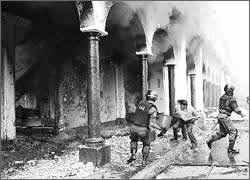
The split widened between the two Bolivias this past week. Tens of thousands of coca growers, peasants and supporters of the socialist government went on the march on Monday to force the resignation of the prefect of Cochabamba. His offense against the socialists was that he was asking for a referendum vote on autonomy for the key coca-growing region of Cochabamba. The socialists oppose autonomy for the departments of the east, which produce most of the country´s cash crops, petroleum and natural gas. (All photos are from El Deber and El Nuevo Dia)


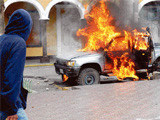
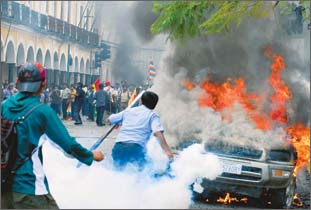
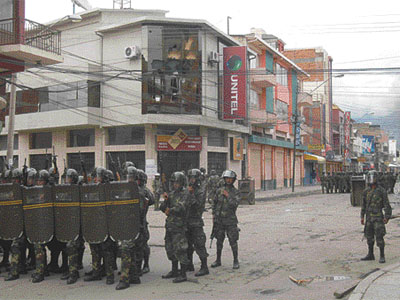
The socialist sympathizers started throwing rocks at the police protecting the prefecture offices, and the police responded with tear gas. The Interior Minister, who is a member of the socialist party, ordered the police to withdraw so they would not repress the social movements. With the police withdrawn, the mob burned the prefecture building.


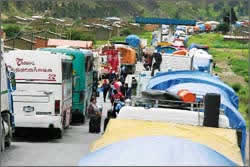
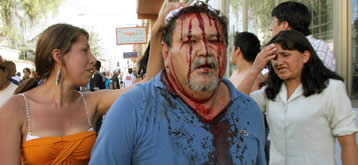
The siege was in its fourth day on Thursday, and Cochabamba, which lies on the road between the country´s two biggest cities, La Paz and Santa Cruz, was shut down by 15 blockades on the roads. Hundreds of trucks and buses were stranded, and the people in Cochabamba, who were running out of food, evidently lost patience with the socialists. A club-wielding group of youths crossed the riverbed to avoid a police barrier and attacked the socialists. Two people were killed and hundreds were injured.


Fifteen journalists were among those attacked and injured. They went on a march with muzzles over their mouths to protest the continuing violence against them. President Morales´s supporters in particular have targeted journalists, who are regarded as enemies of the socialist movement. A socialist mob surrounded the Cochabamba offices of Unitel, a national TV network owned by the government´s most vocal opponent and Evo Morales´s No. 1 enemy, broke windows and threatened the staff. Eventually police set up a barrier so the employees could escape.

It was not until Friday, the fifth day of the siege, before Morales called on his supporters to pull back and stop the blockade. A reasonable person might ask why he didn´t do so five days earlier.