Showing posts with label ponchos rojos. Show all posts

Thursday, June 14, 2007

The red ponchos and talk of civil war

The Aymara people, who represent about a third of Bolivia, have a tradition of putting on their red ponchos when they go on a war footing. So any display of this symbol can be interpreted as merely tradition or a threat.

On the day I arrived in Bolivia in September, the vice president, Alvaro Garcia Linera, recalled his days as a guerilla fighter and urged a crowd of indigenous people to have their rifles ready inside their red ponchos to fight against any attempt to divide the country.


He was talking about the eastern half of the country, known as the Half-Moon, which voted last July for autonomy, meaning more local control of its money and government affairs.

Talk of civil war heated up at that time and again in January when President Evo Morales, at a gathering of 10,000 Aymara in their red ponchos, called on them to fight against any attempt to divide the country. (People in the Half-Moon would say they´re not trying to secede, but they do want more autonomy.)


Morales´s Aymara host announced that day that he had 100,000 people ready to take up arms at a moment´s notice if the president wanted. You can imagine what a stir that caused. These images (the one at the top is from La Razon, the other is from El Nuevo Dia) were on TV and the front pages.

Morales, who has a very positive reputation in Europe and the U.S., frequently engages in saber rattling. When he was campaigning for office, for example, he ended speeches with, `Death to the Americans.´

The talk of civil war died down for a couple of months, but tension is growing again because of conflicts between the central government and the Half-Moon about everything from the Supreme Court to foreign trade agreements.

Sunday, November 19, 2006

Politics means high drama in Bolivia

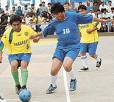
President Evo Morales, the socialist who took office this year, enjoys a good game of soccer and invited members of the press corps to a pickup game in October. Morales had four former members of the national team on his side, which crushed the journalists, 11-1. (This photo from La Prensa was from a different pickup game.) It had to be sweet for Morales, who has called the press his No. 1 enemy, and maybe not without justification. Some of his opponents like to make fun of his humble roots as a shepherd and his lack of a university degree.
Political discourse here is very strident and more provocative than we´re used to in the States.
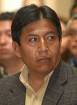
The day I arrived in Bolivia, Sept. 20, Vice President Álvaro García Linera told an audience of indigenous supporters they should be ready to grab their Mauser rifles to defend the socialist policies of President Evo Morales. (Photo of García Linera with Morales is from Igadi.org). The remarks of the vice president had everyone talking about the possibility of civil war for a time, but that has died down.
A couple of weeks later, Morales´s chancellor, David Choquehuanca, was condemning the racism of the well-to-do folks who live in the south part of La Paz. However Choquehuanca, who is Aymara, added that, "We (the Aymara) don´t hate them, because if we did, we´d poison their food.¨ He was referring to the fact that the household servants for the city´s elite are generally Aymara. (Photo from Aymara.org).
There are regular rumors of a possible U.S. invasion of Bolivia to protect the gas and oil fields, although the U.S. is not a major customer (Brazil and Argentina are), and Spain has far more of an investment interest in Bolivia´s fossil fuels than the U.S. Still, there are a couple of hundred U.S. military personnel over in Paraguay, and that helps fuel the rumors.
Venezuela´s president, Hugo Chavez, who likes to refer to President George W. Bush as a drunkard and ¨Mr. Danger,¨ has promised to defend Bolivia´s socialist democracy with military force, if necessary. Who would be the aggressor? He regularly points the finger at the U.S. as a potential invader of his own country.
Bolivia and Venezuela recently discussed the possibility of a Venezuelan military presence in Bolivia, but that is on hold until after Venezuela´s election. Venezuela´s ambassador to Bolivia, Julio Montes, got into the act a while ago, saying that Venezuela was ready to give blood and lives to protect Bolivia from a counterrevolution. Morales´s government has nationalized the oil and gas fields and is in the process of redistributing land to peasant farmers, both of which have provoked strong opposition from big landholders and business interests.