Showing posts with label La Paz. Show all posts

Sunday, July 01, 2007

Last week in Bolivia, then Mexico and home


The editors of La Razon have a little coffee and snacks after another session of leadership training. The last week in Bolivia, June 11-15, I did two leadership training sessions a day, one at La Razon and the other at their crosstown rival, La Prensa. A training consultant has to be like a confessor -- total confidentiality.


Cindy met me in La Paz, Mexico, which is near the southern tip of Baja California Sur, where we've been considering a move. On a boat trip in the Sea of Cortez, hundreds of dolphins surrounded us. Later, three timid manta rays glided along beneath the boat. At the island of Espiritu Santo, sea lions laze on the rocks.


My first day back in Baltimore, I trimmed the hedge that runs for about 150 feet along the sidewalk. Working out in the sun was a relief after a day wedged into airplanes.


Saturday night, we made our annual family outing to the ballpark and saw the Orioles beat the Angels in a very well played game. That's me, Cindy, daughter Christine and son Patrick. What did I notice about baseball after being away? People for several rows around us, young and old, were pounding down the $6 beers (10 times what they cost in Bolivia). The effect was obvious.

Tuesday, June 12, 2007

The people you meet in La Paz


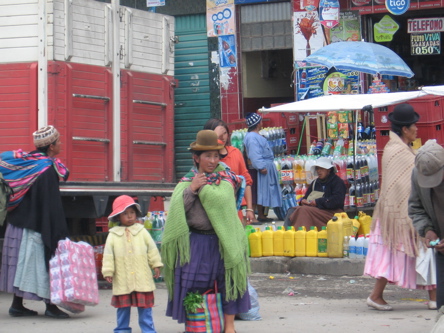
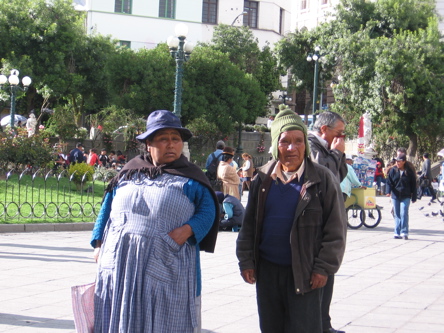
In the Plaza Murillo, which faces the Presidential Palace and the home of the Bolivian congress, you see a mix of people in modern and traditional dress.


A military band performs on a Sunday morning on the Prado, the main drag in La Paz. They performed a medley of Strauss waltzes punctuated with a lot of heavy pounding on the bass drum.


This lovely woman was standing outside my hotel yesterday. An hour later, as I was working at a computer in the hotel lobby, she sat down at the computer next to me. During a cell phone call she identified herself as Carla Ortiz. She is famous as the actress in the most expensive Bolivian movie ever made, The Andes Don´t Believe in God. Its budget was $500,000. She was great in it, and I told her so. She was very gracious and friendly. She´s a native of Cochabamba here, but she lives in the U.S., where she appears in TV shows like CSI Miami. This photo is from La Razon newspaper.


Theese men in traditional dress were walking on the Prado yesterday. You more often see women in traditional dress. I followed them for a block or two trying to discretely photograph them. They all hopped onto a big tourist bus.

In La Paz you have much more sense of the indigenous culture of the country. There is a museum of traditional clothing here as well as the Museum of Coca, which chronicles the history of coca in patent medicines (legalized opiates common in drugstores in the last century), toothpaste and modern anesthestics. The coca leaf is considered sacred.

On the street of the witches, ironically right behind the main cathedral, locals come to buy the stuff needed to cast spells on enemies, bring good fortune and guarantee fertility. A typical store is below. Mummified llama fetuses are in abundance in many stores (not this one). Not sure what they’re used for.


Up until 1975, most people in Bolivia did not speak Spanish. The education system missed them. Two-thirds of Bolivians consider themselves to be members of an indigenous group, with 30 percent identifying themselves as Aymara (the group of President Evo Morales) and 27 percent Quechua. About six in 10 Bolivians speak an indigenous language, depending on which source you refer to. Last fall El Nuevo Dia published a language map of the country that showed some 36 languages spoken, but most of these are very small groups and their languages are in danger of dying out.


Mount Illimani looms over downtown La Paz. How high is Bolivia? The western third averages about 15,000 feet. A wall three miles high separates the plains in the east from the capital. Although it’s only 335 miles from La Paz to Santa Cruz in the eastern lowlands, according to my World Book Atlas, a bus ride takes around 20 to 24 hours because of the twisting mountain roads. You´ve probably seen the pictures. I decided not to do it.

Flying is scary enough. La Paz is at about 12,000 feet, and its airport is higher than almost all of the Rocky Mountain peaks. The air is so thin that the takeoff run needed for a Boeing 737 to get airborne is about 30 percent longer than normal, which seems like an eternity when you’re in a passenger seat. The runway is almost twice as long as that of Reagan National.

Bolivia covers 1 million square kilometers, more than 8 times the size of Pennsylvania and 45 times the size of Maryland. Lake Erie has three times the surface area of Lake Titicaca, although the latter is much deeper.

Business note: There are 250 publicly traded U.S. companies that have higher revenues than the gross domestic product of Bolivia, which is $9 billion.

Sunday, April 01, 2007

Training the trainers at La Razon


This is my favorite souvenir of my six months here in Bolivia. I spent a week with these folks, the editors at La Razon newspaper in La Paz, giving seminars on leadership and coaching. What does that mean? Leadership means giving people extremely clear expectations, standards and direction. Coaching means helping them reach these goals and their own professional goals as well. Most of it is learning how to communicate frankly and effectively.

This group was really into the training, so there was lots of interchange and plenty of skeptical questions. On my last day there, they surprised me by running this photo on Page 2 of their paper. The photo caption says basically what I just said: that I was doing leadership training. If you click on the picture you can see it better. Here I´m always one of the tallest people in the room.

We did one day on how to handle real-life cases that editors face -- the arrogant reporter, the personal phone calls, the failure to meet deadlines, etc.. Most journalists get very little training in people stuff before they´re put in charge of other journalists, so this group welcomed the help.

Friday, January 12, 2007

Cindy's whirlwind visit


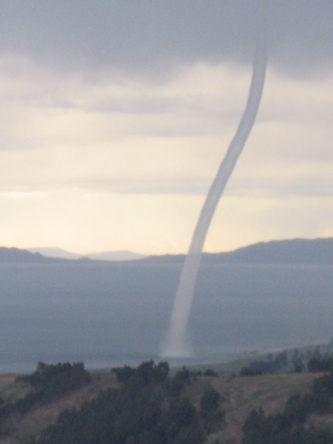
Cindy blew into town Dec. 26 and not a moment too soon. We hadn´t seen each other in three months, the longest separation in our 30-plus years of marriage. This waterspout appeared over Lake Titicaca as we were heading to Copacabana. The crazy weather on this leg of our trip also included a fierce hailstorm that left the ground covered as with snow. The van we were in skidded around on the mountain roads, eliciting yelps from us at moments.


We spent a couple of days in Santa Cruz and then headed for La Paz. We spent an evening there with Luis Ramiro Beltran, who is something of a legend in Bolivian journalism. He was the Defender of the Reader (ombudsman) for eight newspapers here, and he had helped me make connections with the journalists' association in La Paz. He also did a lot of work around the world for Johns Hopkins in the area of health communications, and when he was in Baltimore from time to time, he worked in the Candler Building, the same place I worked. Of course we didn't know each other then.


On our tour of La Paz, Cindy and I took in the Valley of the Moon and went up to a scenic overlook, where we saw an Aymara shaman (he's wearing the hat) working spells for one of his clients. Every so often he and the client would say a few words and toss something into the little fire. Kind of interesting to see this kind of ritual with the metropolitan backdrop. The other scenes are also in La Paz.


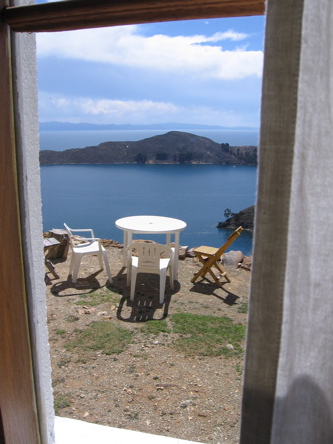
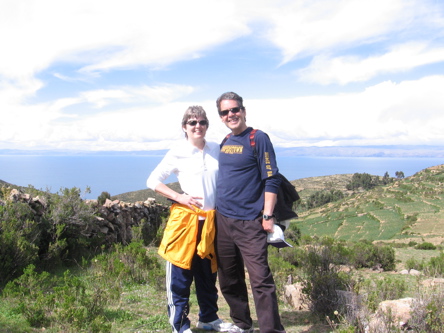
Copacabana is a lovely little town on the shore of Lake Titicaca. We spent a night there and headed out to Isla del Sol (the Island of the Sun), where the Incas believed their people, and all of mankind, were born. We stayed in a modest hostel overlooking the lake. It took us a good half hour hauling a ton of luggage up the hill to get to our place. No motor vehicles are allowed on the island, which is deliberately kept primitive. The Aymara Indians run everything. Every square inch of the island was cultivated at one time, to judge by all the terraced seed beds, but many of the fields appear not to be cultivated these days. I had a lot of excellent trout in our three days there.


On our last day we hiked 10 miles round trip to the Inca ritual site. It´s incredibly beautiful and quiet there, high above the lake. The highest point on the island is just over 4,000 meters, or 13,000 feet.

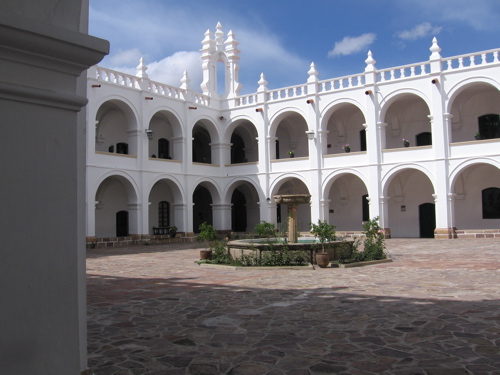
We headed on to Sucre, which is famous for its colonial style architecture. We asked the guide to show us some gardens, and she took us to the cemetery, which is like a little city where the ancestors reside. It was actually very lovely.


These shots are from the church of St. Philip Neri and school.


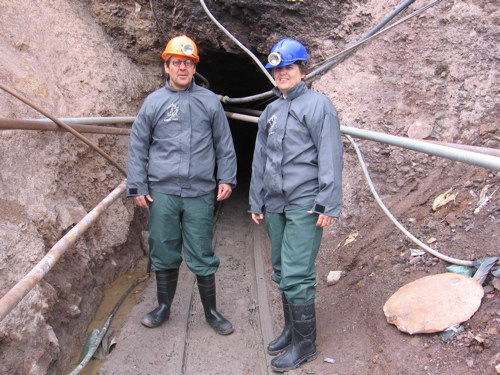
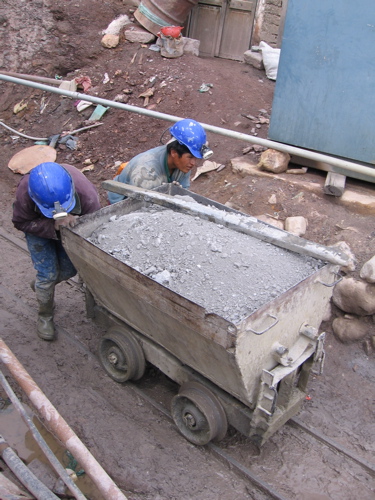
In Potosi, we went into the legendary Cerro Rico, rich mountain, which produced most of the world´s silver for the past 450 years. They´re still mining silver, zinc, copper and tin out of this same mountain. The mining tunnel we entered runs about a mile into the mountain.


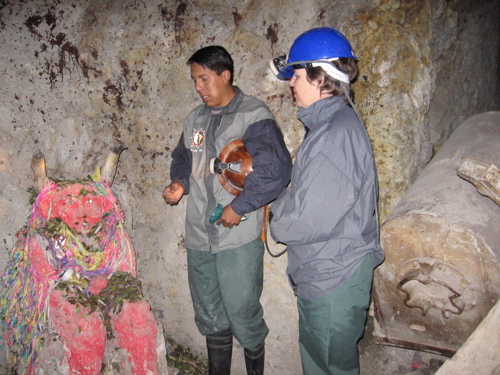
We followed the tracks about 50 meters into the mine and stood inside a little niche where the miners pay tribute to the devil, ruler of the underworld, to ask for his indulgence and protection. The miners give the devil coca leaves, alcohol and cigarettes, which is what they subsist on during their long shifts. Teams of three men push a 1,000-pound handcart into the mine to collect a 2,000-pound load of ore. The guys pushing the empty carts into the mine have to pull their cart off the tracks into a niche and allow the full loads to go by. It´s all by hand. These guys earn about $75 to $150 a month, depending on their status. Lots of miners are in their teens. Our guide, Wilfredo, worked in the mine from the age of 12 till the age of 18. We saw several other young teenagers working there -- 14 and 16.


Wilfredo´s father and grandfather, both miners, died in the same year, his father from silicosis of the lungs at age 37, a common affliction, and his grandfather in a mine collapse.


Cindy looks great, doesn´t she? Although some might think that she may be taking her diet too seriously.

Tuesday, November 14, 2006

Lake Titicaca and Isla del Sol


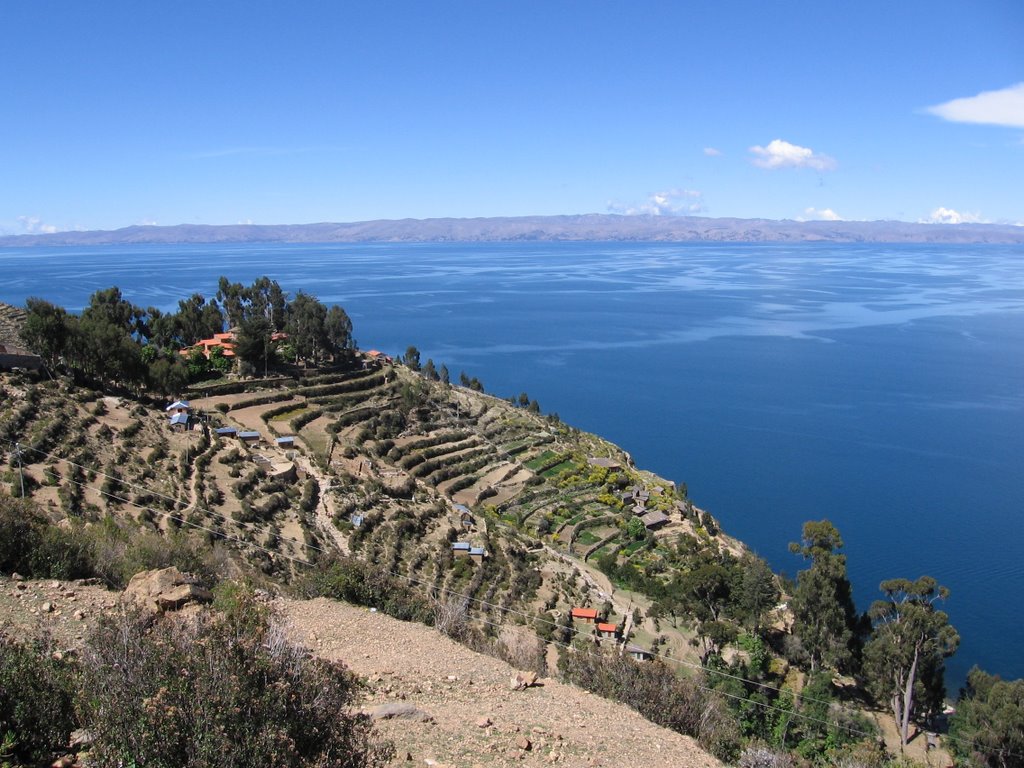
Much of the Isla del Sol in Lake Titicaca is terraced into plots for potatoes, cereal grains and other crops suited to the altitude of 13,000 feet above sea level. The hills that rise up all around the lake show a similar terracing. This area was part of the Tiwanaku empire 2,000 years ago, an empire I had never heard of. At its peak, it reached into Peru, Ecuador, Chile, Venezuela and Argentina. The island was a cultural and religious center for the Tiwanaku and the Incas who followed them.
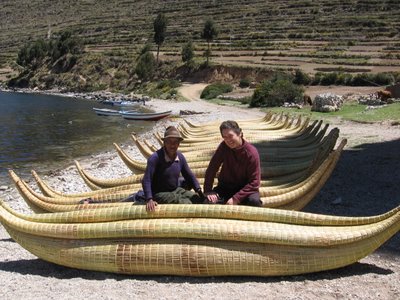
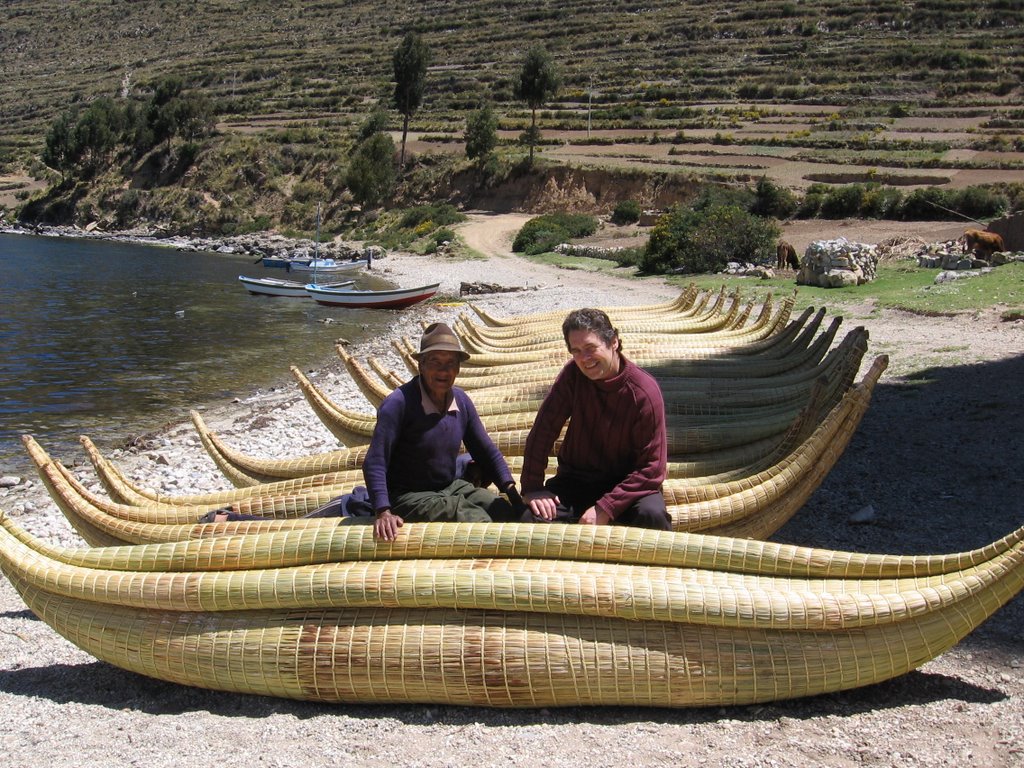
Local Aymara Indians still make boats (which they call balsas) from the totora reed, and these on the beach at Yampupata are specifically for use by tourists, two to a boat with paddles. I didn´t have time to indulge.
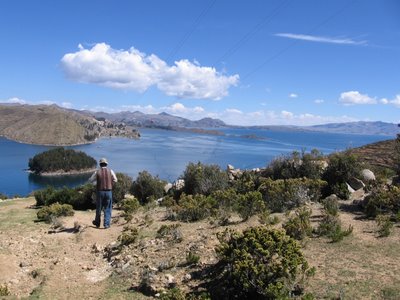
The terrain is very dry all around Lake Titicaca, whose name comes from two Aymara words meaning puma and stone. My guide, Samuel, speaks Aymara as do most people in the La Paz and El Alto area. Here we´re descending from the peaks on the Isla del Sol. I was short of breath after the climb.
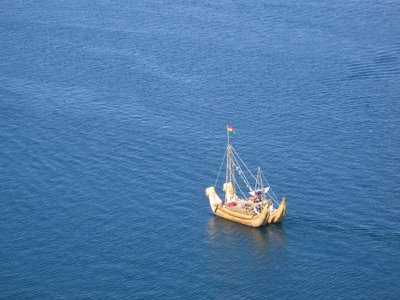


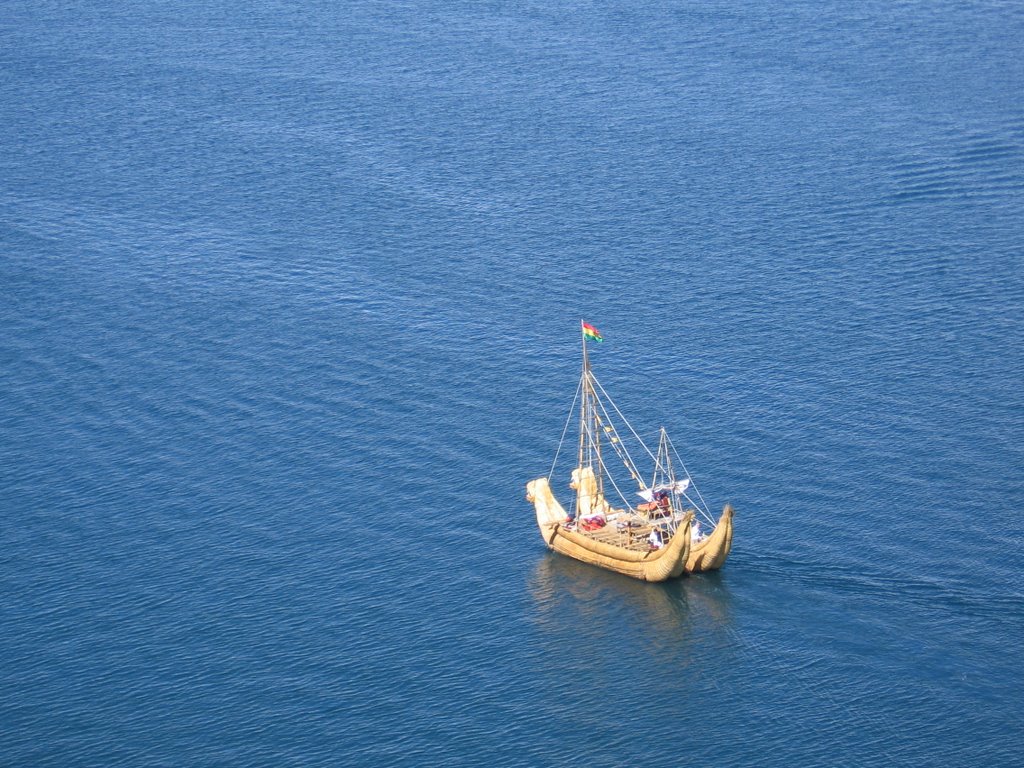
Unfortunately, this double-hulled reed boat pulled out before I could close enough for a good shot. The boat is probably 25 feet long and made completely of totora reeds that grow beside the lake. The prows display stylized puma heads.


Subsistence farming mixes in with tourism on the Isla del Sol, and not always comfortably. Still, a good hotel costs only about $30 night. Food and labor are inexpensive. A great meal of trout, salad and a couple of sides costs about $3.


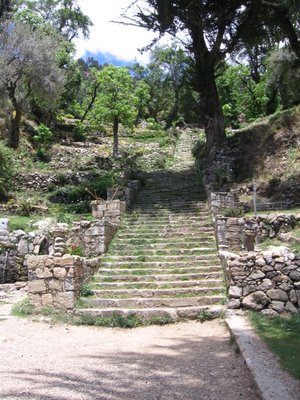


These stone steps up from the beach on the Isla del Sol are supposed to date from Inca times (the 1400s) or earlier.

+++

A diary entry from 2006 about this trip

Samuel was my guide for trip to Tiwanaku, a pre-Incan site west of La Paz, and Copacabana, jumping off point for Lake Titicaca and the Isla del Sol.  I found him in a little travel agency behind the church of San Francisco in the tourist area of La Paz.  We talked for an hour about where he would take me, various options. 

In the end, we agreed to a day and a half trip to the ruins of Tiwanaku, a night in Huatapata on the shore of Lake Titicaca, on to Copacabana and the Isla del Sol, an island with Inca ruins.
Meals, hotel, admission to museums, driver, boat trips, ferry, etc., $158.
OK.  I had a driver and private guide. I forgot to ask about the vehicle.

Samuel is 35, speaks Aymara, the language of President Evo Morales, as well as Spanish, and has different ideas about auto safety. The vehicle he picked me up in was a 1984 Jeep Wagoneer, a big thing with terrible shocks and springs, a front end out of alignment, and altogether shaky safety features.  The good thing about it was that it is a 4x4 with monster traction, which proved really important on some of the lousy dirt roads we took to some great sites.  To be honest, my nightmare scenario was seeing the Wagoneer conk out in the middle of nowhere, but it made it.

We went first to Tiwanaku, a huge site with a pyramid, several temples and lots of sculptures from a culture that preceded the Incas.  The Tiwanaku culture, which I had never heard of, sprang up about 1500 BC and at its peak in the early Christian era, it had an empire that reached into what is now Peru, Ecuador, Venezuela and Argentina. Their buildings had many of the astronomical features of the Mayas, that is they were built in a fashion that tracked the important stages of the sun and moon.  Some amazing sculptures on the site. 

The civilization died out in around 1200 AD, probably because of a Niño effect that resulted in a severe drought that lasted for several decades. Samuel hired a special guide, Macario, to take me around the site.  He was also an Aymara speaker.  His Spanish was very fast but very clipped and precise.  Some of the things he told me about the monuments were preposterous, but one of the marvels he showed me was the real thing.  The Tiwanaku had carved a swirled hole through a stone in the temple wall. The swirls were cut to mimic the shape of the inner ear. A priest would put a kind of megaphone into one end of the hole and it created a tremendous amplification effect.  Macario demonstrated to the sceptical journalist, who became a believer in this story.  The idea was that a priest could speak to 10,000 people in the courtyard of the temple and be heard. I believe it, although I don´t believe that sculptures in one of the temples represent races of China and Africa, as Macario said.  They represent different ethnic groups ruled over by the Tiwanaku, scholars believe.


Samuel asked me if I was OK with travelling on a dirt road rather than the highway to our hotel in Huatapata to cut the distance in half.  I said sure.  It´s all subsistence farms in every direction once you´re outside the city.  There are no vehicles and no machinery.  I saw people plowing with animals, either bovines or mules, and working with hoes and shovels.  They raise sheep, cattle, llamas and pigs, and they grow potatoes and cereal grains. The road was really bad in places, and it wasn´t always clear that we would make it through the mud.  At one point we came upon some Aymaras filling up the potholes with rocks.  One of the guys was wearing a Chicago White Sox cap.  I told him they were the world champions of baseball.  He was very amused.  Ball caps from US colleges and professional sports teams are everywhere – used clothing pours into this country from the U.S.

Since no one out here owns a vehicle, people walk, ride a bicycle, hitchhike or catch one of the minibuses.  It was getting dark, the road was really bad and all I could think of was that if the jeep got stuck in one of the mudholes, we were going to be sleeping in an adobe hut with a straw roof that night.

We made it into Huatapata and had a great dinner of Lake Titicaca trout.  The hotel, Hotel Titikaka, is right on the shore.  It was very cold in my hotel room, but it was a good place, $30 a night.

The next morning we rose early because we needed to get to Copacabana before the professional bicycle race (a sort of Tour of Bolivia, which lasts a week) closed down the road. As we came around a curve, we saw a minibus lying on its side in the road.  The driver evidently went into the curve too fast, went off the road, climbed up the hill on the opposite side and rolled over.  As is typical with public transport out in these areas, the bus (really a minivan) was overloaded with about 20 people. One teenage girl had a bloody nose, but otherwise no one was hurt.  I helped about a dozen guys turn the thing upright (of course, the counterfeit batteries I had unwittingly bought for my camera failed and I didn´t get a picture). We took two adults and six kids in the backseat to the straits of Tiquina, where we met another fine example of public transport, the motor launches that carry poor folks (all folks) across for 20 cents. The boats are small and they put two dozen people in.  The boat I was in listed to starboard about 5 degrees, the water was choppy, a crosswind rocked the boat and a 12-year-old was at the tiller.  I was ready to jump.  No life preservers aboard, no safety.  That´s why you read about these horrible accidents involving ferry boats and buses in poor countries.  The people can´t pay much and there is no maintenance or safety.

Copacabana is a corruption of two Aymara words that mean View of the Lake and refers to the high hills on either side of the city.  We had missed the morning ferry to Isla del Sol, so we decided to take the dirt track that follows the edge of the hills to Yampupata, which is much closer to the island.  Along the way we stopped at the stone city of Samaya, which has homes built around 800 years ago, before the Incas, and which the locals are trying to develop as a tourist attraction.   The biggest deterrent is the fact that the road there is pretty scary.  The road hugs the side of a hill for almost all of the 8 or 9 km. from Copacabana, and there is a dropoff of a couple hundred feet if the driver makes a mistake or hits a pothole and loses control.  Samaya reminds me of the abandoned stone village on Achill Island in Ireland and dates to about the same period. 

On the beach at Yampupata, we saw a dozen totora reed boats that the locals rent to tourists for little excursions.  The trip across the strait to the Isla del Sol takes about 15 minutes from here as opposed to the 90 minutes from Copacabana.  The lake has an average depth of 750 feet and looks turquoise and inviting, but it´s very cold. Titicaca is from the Aymara words for puma and stone.  El Alto, which is a city of about 800,000 poor folks lying above La Paz, contributes mightily to pollution of the lake, as does the Peruvian city of Puno, which has 2.5 million people and can be seen from the top of the Isla del Sol.  I had never heard of Puno.

We climbed the Inca steps from the dock up to a village and then on to the highest points on the island which are about 500 feet above lake level and are  above 13,000 feet.  At this altitude, I´m completely out of breath on a climb that would´nt normally have me huffing and puffing. The hills around the island and really all around the lake look to be completely cultivated in terraces (pampas) for cultivation of potatoes or the local grains.

The island has lots of ruins on the north end, but we really didn´t have time to visit them and still make it back to La Paz before dark.


Freedom of expression

In the towns on the Brazilian border, I heard that some journalists accept money for writing stories.  I also heard that they are subjected to pressure from local officials when they report something unfavourable.

The publisher of La Razon in La Paz told me that the newspapers might be engaging in some self-censorship because of threats from the government of controls or of pulling their advertising, which might represent 15 to 20 percent of a newspaper´s revenues.


Tuesday, November 07, 2006

Pirates of the Altiplano


On every street corner you can buy first-rate music CDs for 63 cents and DVDs of first-run American and European movies for $1.75. I am told that the Colombians are the world champions of music, film and book piracy. The bookstores in the center of La Paz and Santa Cruz have very convincing photocopied editions of bestsellers in Spanish for $3 or $4. A book at full price would represent a week´s salary for a domestic worker or a couple of days´pay for a construction worker.
The covers of pirated books are meticulously color copied and laminated. Then the pages are photocopied in the original size and cut so that at first glance the books appear to be the real thing. A closer look reveals the truth.
There is honor among thieves, however. The Colombian pirates have a gentleman´s agreement not to sell any pirated Bolivian movies, books or music in Bolivia.
Presumably the agreement stops at the border.
No one cares a whit that some American or European artist, publisher or movie distributor might be losing some money. They´re on the other side of the world. If you look through the other end of the telescope, we buy our clothing and shoes and electronics cheaply because they´re made offshore somewhere. We don´t really ask ourselves why the prices are so low. Both here in Bolivia and back in the U.S. the only thing the consumer really cares about is everday low prices. If someone is victimized in the process, we don´t see it.

Boys at work


On my first walk on the streets of La Paz a young guy stuck his head out of a microbus and started shouting at me. Then another microbus came by, and another young guy stuck his head out and yelled at me. At first I thought they were insults, and then I gathered that they were calling out the stops of these micros. This job is called the voceador (caller, voicer, whatever). I´m told it pays about $3 or $4 a day, which works out to about $80 a month which is not too bad. A full-time live-in housekeeper in Santa Cruz makes about $100 a month, a tin miner, who has a horrible, dangerous job, about $500 a month.

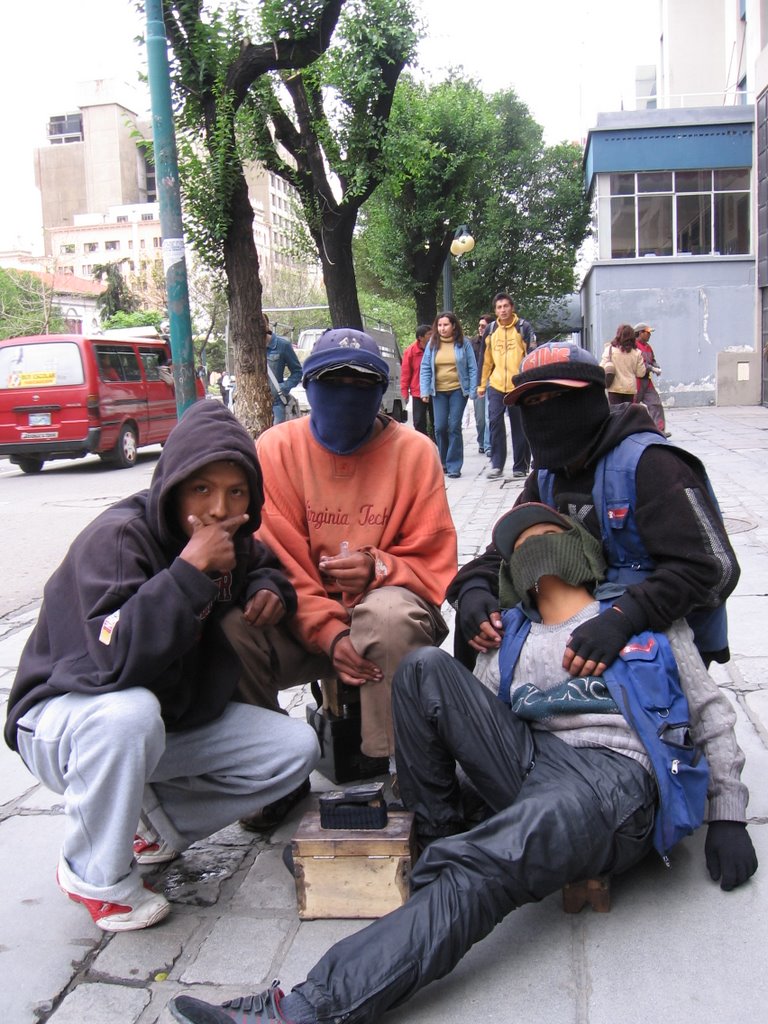
The limpiabotas (literally clean boots), or shoeshine guys in La Paz have the unique custom of wearing ski masks. One of the kids doing my shoes told me that the masks are to prevent discrimination from schoolmates. This kid, who is 15 and interested in mathematics, shines shoes in the morning and attends school in the afternoon. He doesn´t want to be teased by his friends. The going rate for a shoeshine is 12 to 37 cents. Women also get their shoes shined by the limpiabotas.

I was troubled by one thing I saw. A limpiabotas of about 13 in raggedy, dirty clothes was shining the shoes of a perfectly turned out girl of about 7 in her Don Bosco school uniform with white blouse and plaid skirt. The contrast between the two futures was unsettling.
I caught some images of the Don Bosco kids arriving for school in their uniforms, all blue and gold. The the boys wear white shirts and ties. Very familiar to a graduate of Catholic schools.
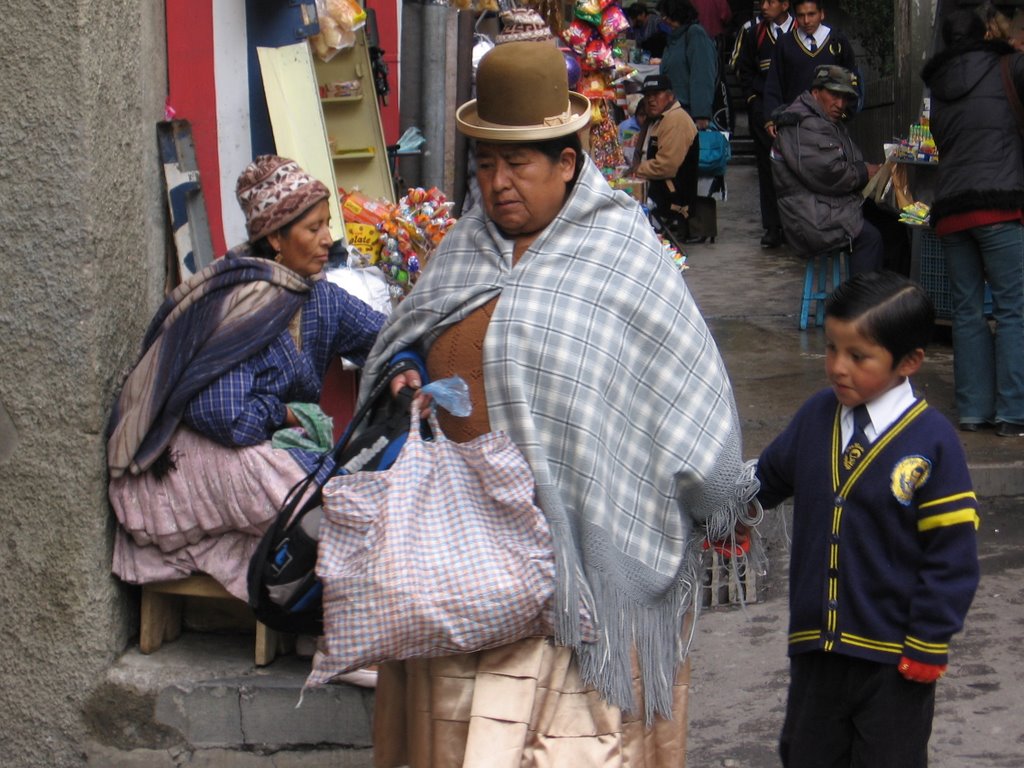
Along the alleyways that lead into the school are a bunch of stands selling candy, school supplies, toys and other stuff. The stands are run by cholos, who are Indians living in the city but keeping their traditional dress. One chola arrived with a Don Bosco student holding onto her manta. I assumed it was his nanny, but a local journalism prof who saw the photo said the quality of her clothing indicates she is not a servant, and that the women who work as nannies are much younger than the woman in the picture. So again I misread the cultural cues, or missed the important details.