These schoolteachers not only get low salaries, they get paid only once a month AND have to stand in line to collect it. You have to stand in line for everything in Bolivia. To pay your phone, electric and water bills you go to a bank or the utility offices and take a number. The post office doesn't do local mail delivery so you can't pay by check. (Your bill comes by courier.)
To buy a plane ticket, you go to the airline office and take a number. Or you can use a travel agent, but you still have to go to the office and pay in person. You can't pay online. People here accept the lines. Poor service to the public is endemic in government and business.

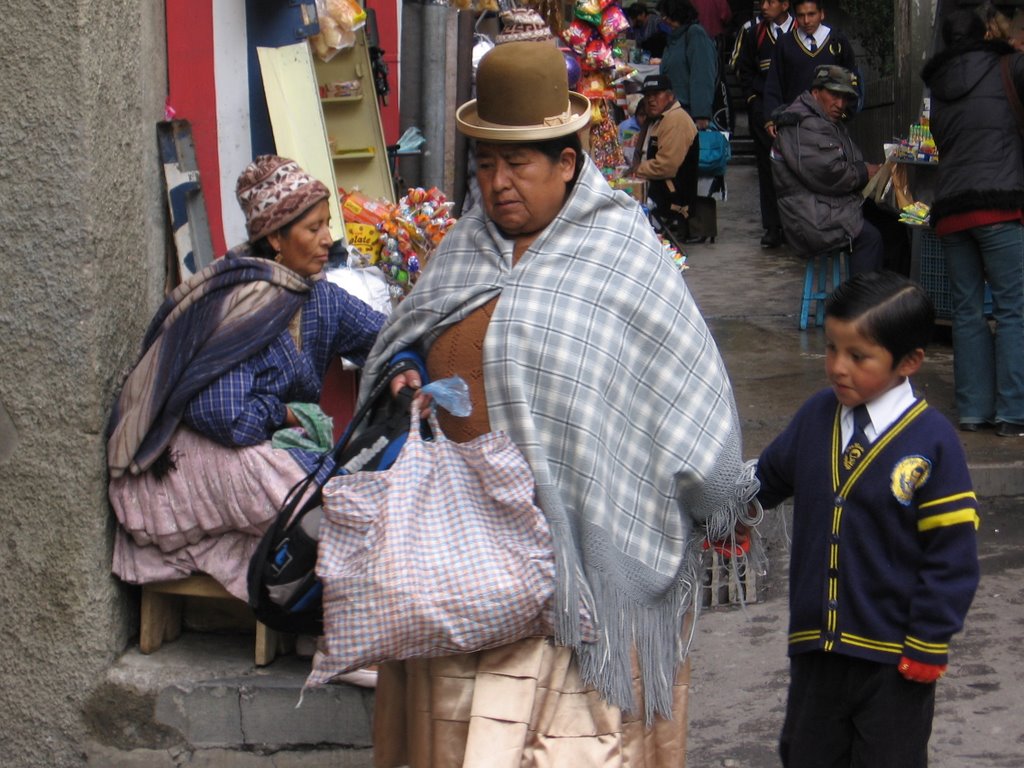
This little boy comes with his mother every morning as she cleans the classroom building where I'm working these days. Despite her son´s shirt, she is not a graduate of the University of Michigan or a fan of Wolverine sports. Used clothing floods into Bolivian markets from the U.S. and is killing local manufacturers and retailers. The government recently outlawed importing of used clothing, just as Santa Cruz was filling up with street vendors hawking cold-weather gear (it's winter here) from the States.
Cheap shoes made in China, for as little as $2.75 a pair, are another import that hurts local businesses.

Alvaro Garcia Linera, 43, is the vice president of Bolivia and attracted a mob of newspeople when he visited Santa Cruz in March. The newspeople here do act like a mob, especially the television people, who have to get close enough to make pictures and capture sound bites. I decided to watch and shoot from a distance.
Garcia Linera has a reputation as being quite the reader and intellectual. In the 1990s he was part of a leftist rebel group and was arrested and charged with being a terrorist. He spent five years in prison, where he studied Bolivian political history and read Karl Marx's Das Kapital "letter by letter, word by word."

Eduardo Bowles is the director (we would call him editor-in-chief) of El Nuevo Dia newspaper in Santa Cruz and loves to relax at his house in the country, where he keeps and rides quarterhorses. He is demonstrating the correct Santa Cruz hammock technique, with one foot out for balance, ideal for making quick turns to see what's going on. This photo is from Christmas week, high summer, during a churrasco, or barbecue, at his house.
Eduardo's great-great-grandfather came to Bolivia from Cincinnati, Ohio. He had served in the Civil War on the Confederate side and came to capitalize on a rubber-industry boom in Beni, in the Amazon basin to the north. He started many businesses, including Bolivia´s first ice-making plant. Bolivians pronounce the W in his name like a B, so it's pronounced BO-blase.

A construction supply magnate built this castle as a way to advertise his company. It sits on the third ring road here in Santa Cruz. Note the horse. It´s common to see them out scrounging around, even in heavily traveled parts of the city.