Showing posts with label El Nuevo Dia. Show all posts

Tuesday, June 12, 2007

The people you meet in La Paz


In the Plaza Murillo, which faces the Presidential Palace and the home of the Bolivian congress, you see a mix of people in modern and traditional dress.


A military band performs on a Sunday morning on the Prado, the main drag in La Paz. They performed a medley of Strauss waltzes punctuated with a lot of heavy pounding on the bass drum.


This lovely woman was standing outside my hotel yesterday. An hour later, as I was working at a computer in the hotel lobby, she sat down at the computer next to me. During a cell phone call she identified herself as Carla Ortiz. She is famous as the actress in the most expensive Bolivian movie ever made, The Andes Don´t Believe in God. Its budget was $500,000. She was great in it, and I told her so. She was very gracious and friendly. She´s a native of Cochabamba here, but she lives in the U.S., where she appears in TV shows like CSI Miami. This photo is from La Razon newspaper.


Theese men in traditional dress were walking on the Prado yesterday. You more often see women in traditional dress. I followed them for a block or two trying to discretely photograph them. They all hopped onto a big tourist bus.

In La Paz you have much more sense of the indigenous culture of the country. There is a museum of traditional clothing here as well as the Museum of Coca, which chronicles the history of coca in patent medicines (legalized opiates common in drugstores in the last century), toothpaste and modern anesthestics. The coca leaf is considered sacred.

On the street of the witches, ironically right behind the main cathedral, locals come to buy the stuff needed to cast spells on enemies, bring good fortune and guarantee fertility. A typical store is below. Mummified llama fetuses are in abundance in many stores (not this one). Not sure what they’re used for.


Up until 1975, most people in Bolivia did not speak Spanish. The education system missed them. Two-thirds of Bolivians consider themselves to be members of an indigenous group, with 30 percent identifying themselves as Aymara (the group of President Evo Morales) and 27 percent Quechua. About six in 10 Bolivians speak an indigenous language, depending on which source you refer to. Last fall El Nuevo Dia published a language map of the country that showed some 36 languages spoken, but most of these are very small groups and their languages are in danger of dying out.


Mount Illimani looms over downtown La Paz. How high is Bolivia? The western third averages about 15,000 feet. A wall three miles high separates the plains in the east from the capital. Although it’s only 335 miles from La Paz to Santa Cruz in the eastern lowlands, according to my World Book Atlas, a bus ride takes around 20 to 24 hours because of the twisting mountain roads. You´ve probably seen the pictures. I decided not to do it.

Flying is scary enough. La Paz is at about 12,000 feet, and its airport is higher than almost all of the Rocky Mountain peaks. The air is so thin that the takeoff run needed for a Boeing 737 to get airborne is about 30 percent longer than normal, which seems like an eternity when you’re in a passenger seat. The runway is almost twice as long as that of Reagan National.

Bolivia covers 1 million square kilometers, more than 8 times the size of Pennsylvania and 45 times the size of Maryland. Lake Erie has three times the surface area of Lake Titicaca, although the latter is much deeper.

Business note: There are 250 publicly traded U.S. companies that have higher revenues than the gross domestic product of Bolivia, which is $9 billion.

Tuesday, June 05, 2007

People and places around Santa Cruz


These schoolteachers not only get low salaries, they get paid only once a month AND have to stand in line to collect it. You have to stand in line for everything in Bolivia. To pay your phone, electric and water bills you go to a bank or the utility offices and take a number. The post office doesn't do local mail delivery so you can't pay by check. (Your bill comes by courier.)

To buy a plane ticket, you go to the airline office and take a number. Or you can use a travel agent, but you still have to go to the office and pay in person. You can't pay online. People here accept the lines. Poor service to the public is endemic in government and business.


This little boy comes with his mother every morning as she cleans the classroom building where I'm working these days. Despite her son´s shirt, she is not a graduate of the University of Michigan or a fan of Wolverine sports. Used clothing floods into Bolivian markets from the U.S. and is killing local manufacturers and retailers. The government recently outlawed importing of used clothing, just as Santa Cruz was filling up with street vendors hawking cold-weather gear (it's winter here) from the States.
Cheap shoes made in China, for as little as $2.75 a pair, are another import that hurts local businesses.


Alvaro Garcia Linera, 43, is the vice president of Bolivia and attracted a mob of newspeople when he visited Santa Cruz in March. The newspeople here do act like a mob, especially the television people, who have to get close enough to make pictures and capture sound bites. I decided to watch and shoot from a distance.

Garcia Linera has a reputation as being quite the reader and intellectual. In the 1990s he was part of a leftist rebel group and was arrested and charged with being a terrorist. He spent five years in prison, where he studied Bolivian political history and read Karl Marx's Das Kapital "letter by letter, word by word."


Eduardo Bowles is the director (we would call him editor-in-chief) of El Nuevo Dia newspaper in Santa Cruz and loves to relax at his house in the country, where he keeps and rides quarterhorses. He is demonstrating the correct Santa Cruz hammock technique, with one foot out for balance, ideal for making quick turns to see what's going on. This photo is from Christmas week, high summer, during a churrasco, or barbecue, at his house.

Eduardo's great-great-grandfather came to Bolivia from Cincinnati, Ohio. He had served in the Civil War on the Confederate side and came to capitalize on a rubber-industry boom in Beni, in the Amazon basin to the north. He started many businesses, including Bolivia´s first ice-making plant. Bolivians pronounce the W in his name like a B, so it's pronounced BO-blase.


A construction supply magnate built this castle as a way to advertise his company. It sits on the third ring road here in Santa Cruz. Note the horse. It´s common to see them out scrounging around, even in heavily traveled parts of the city.

Saturday, March 03, 2007

Veteran Bolivian reporter covers disaster


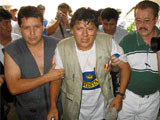
This is José Antonio Quisbert, reporter for El Nuevo Día newspaper, interviewing refugees from the flooding that has leveled vast areas of Bolivia. He has been reporting for newspapers and television for more than 30 years, and he approaches his work with the enthusiasm and curiosity of a rookie.
Quisbert, 53, has done a couple of impressive investigative series for the paper in the past several months. He won a national prize for investigative reporting a few years ago. In the early 1980s, during the brief, repressive regime of Garcia Meza, Quisbert´s house was bombed and destroyed, presumably by backers of the president in retaliation for articles he wrote.
For three days last week he and photographer Beto Justiniano let me tag along as they went into the most heavily damaged areas straddling the Rio Grande to capture the human side of the story. The rains began in late December and the waters have been rising steadily. This disaster has been unfolding like a train wreck in slow motion. Each day another town is affected.


On Feb. 27, we went about 80 miles north. We went as far as we could by car, then on the back of motorcycle taxis on rutted dirt roads (20 miles of terror), then paddling a boat and finally in a motor launch to a community known as Isla.
The land is dead flat. It´s almost completely under cultivation in soybeans, corn, sugar cane and some rice. The soil is very rich and productive, and almost all of the trees that used to anchor the soil have been removed in the past two decades. The land was less able to absorb the shock of one of the worst El Niños in the past 25 years. There are laws about leaving a tree buffer next to rivers but no one obeys or enforces them.


Last week, the swollen, surging Rio Grande blasted out of its normal channel and cut a new path through thousands more acres of farmland. The men you see in the photo here are wading back to their homes to see if they can recover anything.
The river claimed it all.


Quisbert is interviewing some of the farmers. Some belong to cooperatives that work land collectively, and some are essentially entrepreneurs who have borrowed heavily to buy tractors, seed and fertilizer and work tracts of several hundred acres. The man with his hands on his hips has 1,000 acres. He borrowed to buy the land and has $150,000 invested in a soybean crop that is under water. We went a couple of miles by boat and saw many houses like the one below, up to the roof line in water. The open areas around it were soybean fields.


Just in Santa Cruz province, 625,000 acres of soybeans has been destroyed. That´s one-sixth of the country´s biggest export crop and represents about
$125 million in losses. That´s a lot in Bolivia. This country´s gross national product is only $25 billion, a figure easily exceeded by the revenues of almost any Fortune 500 company.
In the cattle-raising province of Beni, about 20 million acres of land is under water. That´s equal to about one-third the land area of Ohio. Losses are about 300,000 head of cattle, or $20 million, which is very big money here.


These boys are part of 10 families who fled the city of Trinidad, a city of 90,000 that is completely surrounded by water. The 25 people managed to get free passage on buses to a modest house in Santa Cruz. At the moment Quisbert interviewed them, the families had exhausted all their food except for some handfuls of beans, which they were boiling in a pot in the yard. Several of the kids had skin infections from the water and insect bites. The adults had lung conditions. Supposedly relief services were aware of the family and had promised aid. Quisbert called a doctor after he finished the interview and asked him to look in on the family.
In his written account of the interview, he showed the families´plight in a compelling way with details gathered from meticulous reporting. He engages the reader emotionally through facts and a few revealing quotes. It´s not sob-story journalism but shoe-leather reporting.


The newspaper is part of a major national fund-raising and relief effort along with its sister newspaper in La Paz and ATB television network. Donors have contributed mattresses, clothing, tents, food, kitchen utensils, everything that a family might need.

We watched as volunteers sorted through a huge pile of donated shoes and sandals trying to match up pairs. Why they weren´t paired together at some point earlier seemed to be a mystery.


The needs are vast and the numbers are staggering. The last numbers I saw indicated that about 340,000 people had been affected by the flooding, which could mean they suffered losses or injuries or are homeless. About 40 people have died.

Photographer Beto Justiniano is working here to get some shots of a collection and distribution center under the stands of the city´s soccer stadium.


HOW TO HELP
People have asked if they can help. Catholic Relief Services has an online connection that gives information about its work in Bolivia and allows you to contribute: http://www.crs.org/our_work/where_we_work/overseas/latin_america_and_the_caribbean/bolivia/flooding.cfm
That is the only service I´m aware of that allows online contributions and that I feel comfortable sending people to.
The Cruz Roja (Red Cross) here doesn't appear to have any mechanism for foreign individuals to give. The International Red Cross doesn't have a program specifically for Bolivia.
Unicef is accepting donations for Bolivia relief at http://www.supportunicef.org/site/pp.asp?c=9fLEJSOALpE&b=2270607 You would have to specify Bolivia. And a local bank, Banco BISA has set up an account, 1177-5840-17, to accept donations. You would have to ask your bank how to do that.


The theory is that I´m supposed to be upgrading the skills of the journalists here in Bolivia, but Quisbert and his photographer don´t need my help. They´re real pros. I was just there collecting dust. They seem to like having someone else along to talk with. They bounce ideas off me and ask my opinion on things.
Quisbert is planning to leave the newspaper in June and start a true-crime TV show, with daily graphics showing crime rates and human stories of crime victims. He has the experience to pull it off. We kick around ideas for his show, how to make it different. Quisbert´s idea is to present crime in way that will make public officials have to do something about it. Not just blood and guts but with an accountability factor. What is being done about it.

Sunday, January 14, 2007

The siege of Cochabamba

The split widened between the two Bolivias this past week. Tens of thousands of coca growers, peasants and supporters of the socialist government went on the march on Monday to force the resignation of the prefect of Cochabamba. His offense against the socialists was that he was asking for a referendum vote on autonomy for the key coca-growing region of Cochabamba. The socialists oppose autonomy for the departments of the east, which produce most of the country´s cash crops, petroleum and natural gas. (All photos are from El Deber and El Nuevo Dia)


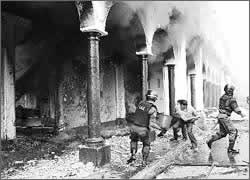
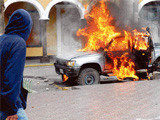
The socialist sympathizers started throwing rocks at the police protecting the prefecture offices, and the police responded with tear gas. The Interior Minister, who is a member of the socialist party, ordered the police to withdraw so they would not repress the social movements. With the police withdrawn, the mob burned the prefecture building.


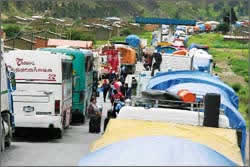
The siege was in its fourth day on Thursday, and Cochabamba, which lies on the road between the country´s two biggest cities, La Paz and Santa Cruz, was shut down by 15 blockades on the roads. Hundreds of trucks and buses were stranded, and the people in Cochabamba, who were running out of food, evidently lost patience with the socialists. A club-wielding group of youths crossed the riverbed to avoid a police barrier and attacked the socialists. Two people were killed and hundreds were injured.


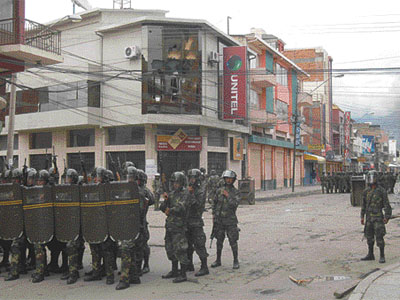
Fifteen journalists were among those attacked and injured. They went on a march with muzzles over their mouths to protest the continuing violence against them. President Morales´s supporters in particular have targeted journalists, who are regarded as enemies of the socialist movement. A socialist mob surrounded the Cochabamba offices of Unitel, a national TV network owned by the government´s most vocal opponent and Evo Morales´s No. 1 enemy, broke windows and threatened the staff. Eventually police set up a barrier so the employees could escape.

It was not until Friday, the fifth day of the siege, before Morales called on his supporters to pull back and stop the blockade. A reasonable person might ask why he didn´t do so five days earlier.

Monday, December 25, 2006

Christmas in Santa Cruz

The Christmas decorations started going up in October, and the retailers started advertising that month. Bolivians like Saint Nick, Santa Claus, the reindeer, and the Christmas music that comes from America, a lot of it with Spanish lyrics applied.
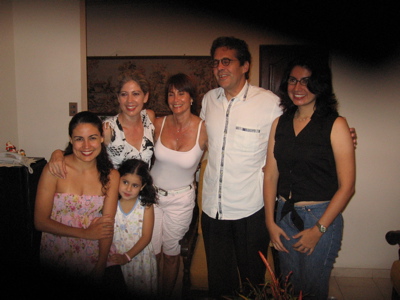
(Photo of Gina's sister, mom, aunt, and niece)

Santa Cruz residents have their own traditions as well, some of which I got a taste of. On Christmas eve, one of the reporters from El Nuevo Dia newspaper, where I had given a series of workshops, called me and invited me to have dinner with her and her family. Mom, sister, brother, aunt, cousin, niece. The event started at 9:30 p.m. and we sat around talking while the 6-year-old niece started opening presents. Beer, wine, cigarettes, lots of stories. At midnight, everyone in the neighborhood started shooting off bottle rockets and firecrackers for about 15 minutes, and then we went in to have dinner.

The traditional dishes are a kind of multi-meat soup, which is very tasty, baked turkey with a rice and date and nut stuffing, asparagus and pureed potatoes, as well as corn on the cob, with the cobs cut into small pieces. Dinner went on till about 1:30 a.m., at which time we all piled into two cars and headed over to an uncle's house, which happens to be right across the street from my condo building. There were about 30 people there, drinking and listening to music, with folks in their 60s down to teenagers. Christmas is all about getting together with members of your extended family. I stayed until about 3:30 a.m., and the party was going strong when I left. I'm known as a wimp, a pendejo, for not staying up late.


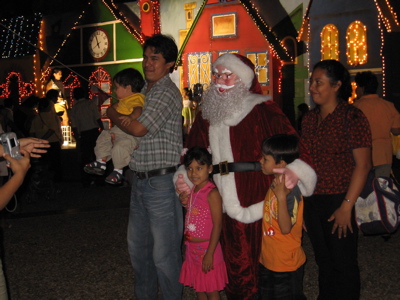
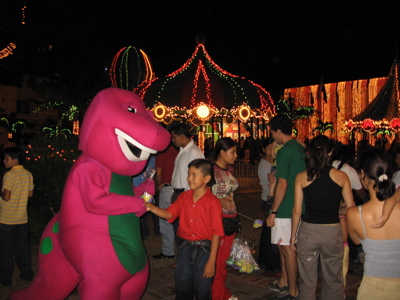
Today's edition of El Deber described different Christmas traditions and dishes in a half-dozen regions of the country. So you're getting a very superficial picture here. The local electric company has a big light display that goes up a couple weeks before Christmas and creates a traffic jam every night as the kids come to play games, get their picture taken with Santa and eat sweets.

Saturday, December 16, 2006

1 million people say yes


Eight hundred thousand people gathered in the square a couple blocks from me Dec. 15 for a cabildo, a town meeting. They were demanding that the government respect autonomy for this part of the country and respect a law that says each item of the new constitution requires two-thirds approval by the constitutional assembly. The top photo is from El Deber, the bottom from El Nuevo Dia. (My apartment is just outside of the upper right of the top picture.) El Deber did a detailed map with estimates of crowd density at various points to come up with the figure of 800,000. Cabildos in other regions brought the total to more than a million. People started gathering in force around 3:30, the music got going around 4:30, the speeches started around 5:30 and the big moment came at 7:30.

The prefect for the department of Santa Cruz asked the crowd for their approval on two questions, to which they replied yes to each, and the meeting was over. Except for the music and dancing.
The headline in El Nuevo Dia pronounced the event a ¡Cabildazo! You add “azo“ to anything to mean that it´s a big honkin' thing. A great goal in soccer is not just a gol but a golazo.
There were three other cabildos in departments that also want autonomy and respect for the two-thirds vote. These four departments represent about half the country and are referred to as the half-moon because that's what they look like on the map.

The violence

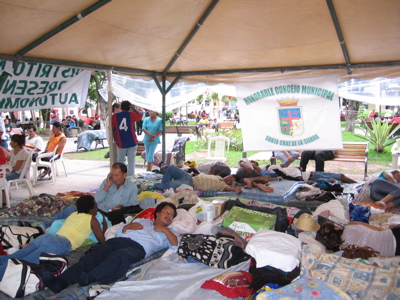
There have been peaceful hunger strikes throughout the eastern half-moon of the country for a couple of weeks to protest the government´s policies. Here are some in the main square of Santa Cruz Dec. 9.


It's kind of the reverse of what we're used to. The hunger strikers are generally white or mestizo and prosperous. They tend to be business people protesting actions taken by the indigenous majority, which is controlling the governnment for the first time in Bolivia´s history. The president made some veiled threats earlier in the week, calling on the army to be prepared to defend the unity of the country against secessionist groups trying to divide Bolivia (code for the half-moon region).


As it happened, the army didn´t try to stop the demonstrations (cabildos), but members of the president´s political party did. They set up roadblocks on a main highway to prevent people from outlying areas from reaching the cabildo in Santa Cruz.
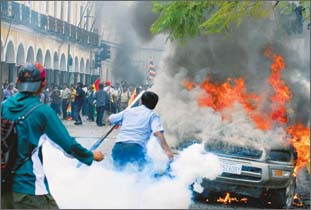
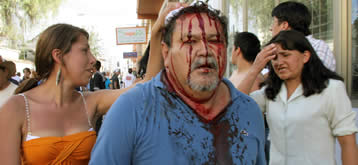
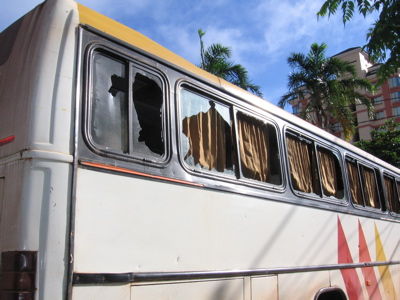
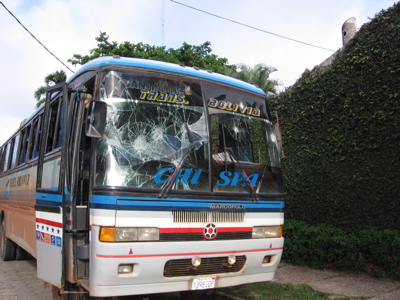
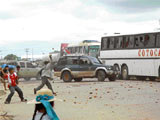
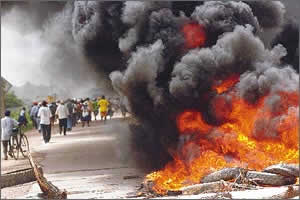
(The photo of the blockade of burning tires is from El Deber. The photo of the injured journalist is from El Nuevo Dia.) They stoned buses carrying people headed for the cabildo and sent five journalists to the hospital with severe head injuries. The trouble started when one of the buses broke through the first line of the blockade, and the blockaders started pelting it with rocks. After three hours of rock throwing, 90 people on both sides were injured. One man lost an eye. One of the buses was burned. Several press vehicles were destroyed. Eventually the buses went through. They were parked in my neighborhood this morning, with most of their windows knocked out. (Photos of the buses are mine.)

(The photo of the rock-throwers is from El Nuevo Dia)
Unfortunately, those who back the cabildos and autonomy went on their own rampage in several towns and burned the headquarters of the ruling party, the president's party, whom they deemed responsible for the violence in San Julian.
Last week a pro-government crowd in La Paz, which is the heart of the president's power base, set upon some anti-government hunger strikers who were in a church.
The mob wanted to kill one of the hunger strikers, a prominent novelist. They tossed a stick of dynamite into the room where the hunger strikers were located. Fortunately, someone was able to yank the fuse before it exploded. The hunger strikers barely escaped and went into hiding. (In retaliation for the rock attacks, supporters of autonomy burned MAS headquarters in San Ramon, photo from El Deber)
The night of the cabildos, I saw the president on TV, and he was very conciliatory toward the demonstrators, which seemed a statesmanlike thing to do. He was not talking about sending in the army or confrontation. He used the word dialogue a couple of times. Maybe this difficult period in Bolivia's history will be worked out without much violence.