Showing posts with label El Deber. Show all posts

Sunday, June 10, 2007

Bolivia´s growth industry: contraband fuel

Bolivia is suffering from shortages of all kinds of fuel because its low, government-subsidized prices encourage transporting it across the border where prices are higher.
In October I was on the border near Brazil and saw lots of little roadside stands where families had set up shop to sell contraband gasoline. All of the official local gas stations had exhausted their supply, so the driver we had hired to take us to Brazil filled up a fuel can at one of these improvised stations (while one of the family members smoked a cigarette).
If they had been wearing suits and ties, these local folks would be called arbitrageurs. They go to service stations, buy fuel at the government-subsidized price of $1.75 a gallon, collect it in all kinds of improvised containers and sell it for $4 a gallon to Brazilians who come across the border. The Bolivians make a nice profit margin and the Brazilians get a big discount from the $6.50 they pay on their side. So there are spot shortages of gasoline in Bolivia.


This photo of a gasoline stand at the Brazilian border is from the daily El Deber. Who´s worried about safety?

On the other side of Bolivia, the border with Peru supports a thriving industry of contraband liquefied gas used in cooking and as fuel in vehicles. In Bolivia a 22-pound canister of this fuel sells for $2.82, a government-subsidized low price. The market price in Peru is nearly four times higher, or $10.
So enterprising Peruvians and Bolivians buy low on one side of the border and sell high on the other. That´s why Bolivians can´t always get this essential household fuel.
The smuggling is so institutionalized that the customs officials from both countries have a gentlemen´s agreement not to enforce the laws on Wednesdays and Saturdays. The canisters pass through unchecked. The authorities also benefit from the contraband.

Saturday, June 02, 2007

Bolivia's media titans and a photojournalism show


This is Jose Pomacusi, who is Bolivian President Evo Morales's scourge in the news media. Pomacusi, 41, is the news director for Unitel, the country's most-watched television network. It has grabbed ratings with its soap operas and its sensationalistic and right-leaning news coverage. When Evo Morales talks about the press being his No. 1 enemy, Unitel is at the top of the list.
The station is owned by the Santa Cruz-based Monasterio family, whose interests include soybean farming, banking and other businesses. Monasterio reflects sentiments of most businesspeople in Santa Cruz, who oppose the government's plan for redistributing land to indigenous people, the nationalization of various industries and the centralization of political power in La Paz.
Pomacusi told me in an interview that he is not trying to advance any particular political philosophy, only to serve the public. However, neutral observers can easily identify the station's anti-government and pro-business tendencies.


Pedro Rivero is director (editor-in-chief) of El Deber and son of the newspaper's founder. The Rivero family is one of the few media owners in the country whose primary business is media. That is to say that most news media owners use their outlets to advance political or business agendas, like the Monasterios. El Deber has the highest circulation of any newspaper in the country, about 30,000 daily and 50,000 Sunday (figures are not audited and some say these numbers are on the high side), and is the voice of the Media Luna, the four eastern provinces which favor autonomy.

The Riveros take journalism very seriously, and their news columns are generally very balanced and fair in their treatment of issues. Their editorial page reflects Santa Cruz sentiments, but El Deber also carries opinion pieces by those who favor President Morales and his party.

Big complaints about the news media


When conversations turn toward the news media, few have anything good to say. The general public complains about sensationalism in television news coverage, particularly aggressive coverage of grieving families. The commonly expressed view is that the press is unethical, politically slanted, nosy, tasteless and too concerned with trivia, celebrities and sensuality.

The socialist government complains about right-leaning news coverage from media that are owned by, in their words, big land-owners and big businesses with an opposition agenda.


Erick Torrico is being interviewed here as he presented a study by the Media Observatory, a nonpartisan organization which describes and analyzes the performance of news media in the country. A lot of its funding comes from European and U.S foundations. No surprise that the observatory found big weaknesses in the press in terms of training, execution and fairness. Although there was a fair amount of publicity about his presentation, only a handful of people showed up.
El Deber summarized the study in today's paper.

The organization asked 33 "social leaders" in the community of Santa Cruz, "Do journalists work in a professional manner?" Only one-fourth of those polled responded "always" or "nearly always" and 39 percent responded "almost never." Of those polled, 4 in 10 felt that the press's professionalism had deteriorated in the past five years. And finally, when asked which news medium had the best information, printed media came in strongest with 48% of those polled, radio 39% and TV 3%. Nine percent didn't like any news medium.

At a time of big changes in the country, every story is a political story. For consumers of news, that often leads to baffling news articles in which there is extensive coverage of opposing views of an issue (nationalization of the gas industry) with too little probing into the facts at the root of the debate. A reader often is left with many, many questions. Still, daily newspapers tend to be voices of reason in the media landscape, with the space and time to give some depth and balance to issues.

A push for controls on the news media

Meanwhile, the Constitutional Assembly is in the process of drafting a new constitution for the country, and indications are that there is strong sentiment for putting controls on the news media. El Nuevo Dia had a story about this in yesterday's paper......


One part of the draft says that the ownership and control of news media "shall not reflect a monopolistic or oligarchic character in opposition to society in general and indigenous people, workers and those of African descent." This sounds as if it would outlaw most of the mass media as they now exist.

Given the complaints about the media, controls could win popular support. There is fear that Bolivia will start to follow in the footsteps of Venezuela, whose president and Morales supporter, Hugo Chavez, has fined and closed down opposition media.


Work by Santa Cruz photojournalists

All of these photos were in a photojournalism show here in Santa Cruz
This little boy showed up for the first day of school without his uniform. The Superman symbol seems to be no consolation.


A supporter of the president´s MAS party shows her displeasure with one of a group supporting autonomy from the central government Dec. 15 in San Julian.


This year´s El Niño effect produced widespread flooding in farming areas.


Bodies of victims of a bus crash are lined up along the road. Fatal crashes are common. Drivers are overworked and often drunk. Guardrails are rare.


Most public schools here are in sorry shape.

Sunday, April 01, 2007

A culture of bribes


Yesterday El Deber ran this picture of the head of the local Immigration office being hauled off to jail in a big bribery scandal. He is charged with running the highly lucrative business of providing quick turnaround on passports for $300 to $700 at a time when a lot of desperate Bolivians are trying to leave the country to look for work. If you don´t pay the bribes, you have to wait for months to get a passport. He´s smiling probably because he knows he won´t be in jail long. When things cool down he´ll be out.

The pace of bribery picked up recently as April 1 was an important deadline. On that day, Spain would no longer admit Bolivians on tourist visas, the usual way for them to enter the European Community to look for work illegally.
Ironically, the guy going to jail was brought in a few months ago to clean up all of the crooked dealing going on under his predecessor. But there is evidently too much money floating around for anyone to stay clean. One newspaper article mentioned that there was a network of more than 50 travel agencies and an unspecified number of paperwork fixers (tramitadores) involved in this illegal traffic.

Meanwhile, the ruling party of President Evo Morales has shown new levels of audacity in the business of giving jobs to political friends. The old corrupt system was bad, and the new one has taken it to new heights. Under the old system, you had to prove party loyalty to get a government job. Under the new corrupt system of Morales´s party, you also have to pay $500 to $1,000 to the party official who gets you the job. The cash payments are an innovation of the socialist government. When Morales learned of the problem he turned it over to his own party to supposedly clean it up. They charged a couple of low-level sacrificial lambs but all of the ringleaders have escaped any judicial action.

My own experience
I´ve had some visa difficulties of my own with Bolivia´s immigration officials. Let's just say that it helps to know the right people. Meanwhile, the visa that I actually need to be here as a guest university lecturer requires 15 steps, of which I have completed five.

1. It started with an Interpol background check at National Police Headquarters, where I was fingerprinted and photographed. In addition to the legally required fees of 50 bolivianos, I had to pay another 50 bolivianos, a day´s pay, in illegal, undocumented fees for which I was not given receipt. I have a document now that says I´m not an international terrorist or drug smuggler.

2. Center for Tropical Disease Research, 180 bolivianos for blood tests for AIDs and yellow fever; told to return the following day for results. No bribe required.

3. Back to police headquarters to get a certificate of antecedents (show passport to prove I´m an American), required thumbprint, 25 Bs official payment (plus 5 Bs payment, not legal, demanded by clerk), told to come back for document next day.

4. Police headquarters again, proof of residence, also required thumbprint, official payment of 13 Bs (plus 20 Bs illegal payment, demanded by clerk), told to come back for completed document next day.

5. Had photo taken for NIT, national tax ID, downtown atprivate studio, had to come back next day, 15 Bs.

Meanwhile, it´s possible to get your visa extended by anywhere from 30 to 90 days, depending on the whim of the immigration official, by leaving and re-entering the country. I did this once to Peru and once to Chile. It appears that the 15-step visa process will be moot. I´m good through June 18.

Sunday, January 14, 2007

The siege of Cochabamba

The split widened between the two Bolivias this past week. Tens of thousands of coca growers, peasants and supporters of the socialist government went on the march on Monday to force the resignation of the prefect of Cochabamba. His offense against the socialists was that he was asking for a referendum vote on autonomy for the key coca-growing region of Cochabamba. The socialists oppose autonomy for the departments of the east, which produce most of the country´s cash crops, petroleum and natural gas. (All photos are from El Deber and El Nuevo Dia)


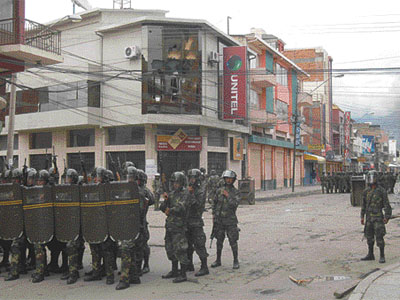
The socialist sympathizers started throwing rocks at the police protecting the prefecture offices, and the police responded with tear gas. The Interior Minister, who is a member of the socialist party, ordered the police to withdraw so they would not repress the social movements. With the police withdrawn, the mob burned the prefecture building.


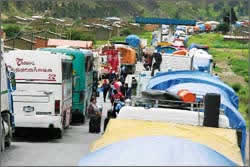
The siege was in its fourth day on Thursday, and Cochabamba, which lies on the road between the country´s two biggest cities, La Paz and Santa Cruz, was shut down by 15 blockades on the roads. Hundreds of trucks and buses were stranded, and the people in Cochabamba, who were running out of food, evidently lost patience with the socialists. A club-wielding group of youths crossed the riverbed to avoid a police barrier and attacked the socialists. Two people were killed and hundreds were injured.


Fifteen journalists were among those attacked and injured. They went on a march with muzzles over their mouths to protest the continuing violence against them. President Morales´s supporters in particular have targeted journalists, who are regarded as enemies of the socialist movement. A socialist mob surrounded the Cochabamba offices of Unitel, a national TV network owned by the government´s most vocal opponent and Evo Morales´s No. 1 enemy, broke windows and threatened the staff. Eventually police set up a barrier so the employees could escape.

It was not until Friday, the fifth day of the siege, before Morales called on his supporters to pull back and stop the blockade. A reasonable person might ask why he didn´t do so five days earlier.

Monday, December 25, 2006

Christmas in Santa Cruz

The Christmas decorations started going up in October, and the retailers started advertising that month. Bolivians like Saint Nick, Santa Claus, the reindeer, and the Christmas music that comes from America, a lot of it with Spanish lyrics applied.
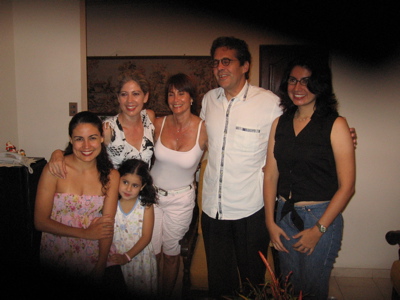
(Photo of Gina's sister, mom, aunt, and niece)

Santa Cruz residents have their own traditions as well, some of which I got a taste of. On Christmas eve, one of the reporters from El Nuevo Dia newspaper, where I had given a series of workshops, called me and invited me to have dinner with her and her family. Mom, sister, brother, aunt, cousin, niece. The event started at 9:30 p.m. and we sat around talking while the 6-year-old niece started opening presents. Beer, wine, cigarettes, lots of stories. At midnight, everyone in the neighborhood started shooting off bottle rockets and firecrackers for about 15 minutes, and then we went in to have dinner.

The traditional dishes are a kind of multi-meat soup, which is very tasty, baked turkey with a rice and date and nut stuffing, asparagus and pureed potatoes, as well as corn on the cob, with the cobs cut into small pieces. Dinner went on till about 1:30 a.m., at which time we all piled into two cars and headed over to an uncle's house, which happens to be right across the street from my condo building. There were about 30 people there, drinking and listening to music, with folks in their 60s down to teenagers. Christmas is all about getting together with members of your extended family. I stayed until about 3:30 a.m., and the party was going strong when I left. I'm known as a wimp, a pendejo, for not staying up late.


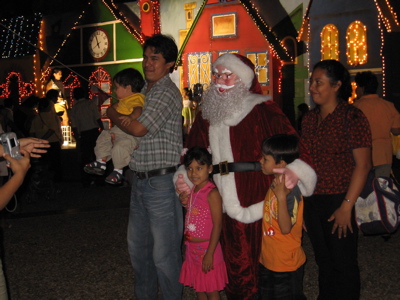
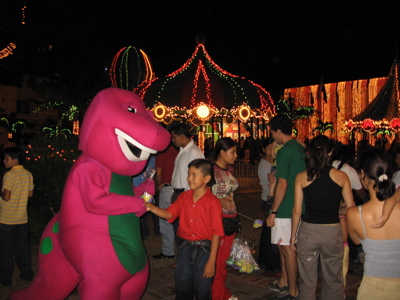
Today's edition of El Deber described different Christmas traditions and dishes in a half-dozen regions of the country. So you're getting a very superficial picture here. The local electric company has a big light display that goes up a couple weeks before Christmas and creates a traffic jam every night as the kids come to play games, get their picture taken with Santa and eat sweets.

Saturday, December 16, 2006

1 million people say yes


Eight hundred thousand people gathered in the square a couple blocks from me Dec. 15 for a cabildo, a town meeting. They were demanding that the government respect autonomy for this part of the country and respect a law that says each item of the new constitution requires two-thirds approval by the constitutional assembly. The top photo is from El Deber, the bottom from El Nuevo Dia. (My apartment is just outside of the upper right of the top picture.) El Deber did a detailed map with estimates of crowd density at various points to come up with the figure of 800,000. Cabildos in other regions brought the total to more than a million. People started gathering in force around 3:30, the music got going around 4:30, the speeches started around 5:30 and the big moment came at 7:30.


The prefect for the department of Santa Cruz asked the crowd for their approval on two questions, to which they replied yes to each, and the meeting was over. Except for the music and dancing.
The headline in El Nuevo Dia pronounced the event a ¡Cabildazo! You add “azo“ to anything to mean that it´s a big honkin' thing. A great goal in soccer is not just a gol but a golazo.
There were three other cabildos in departments that also want autonomy and respect for the two-thirds vote. These four departments represent about half the country and are referred to as the half-moon because that's what they look like on the map.

The violence

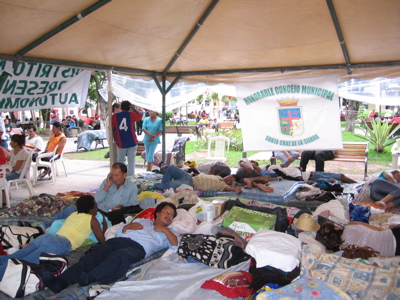
There have been peaceful hunger strikes throughout the eastern half-moon of the country for a couple of weeks to protest the government´s policies. Here are some in the main square of Santa Cruz Dec. 9.


It's kind of the reverse of what we're used to. The hunger strikers are generally white or mestizo and prosperous. They tend to be business people protesting actions taken by the indigenous majority, which is controlling the governnment for the first time in Bolivia´s history. The president made some veiled threats earlier in the week, calling on the army to be prepared to defend the unity of the country against secessionist groups trying to divide Bolivia (code for the half-moon region).


As it happened, the army didn´t try to stop the demonstrations (cabildos), but members of the president´s political party did. They set up roadblocks on a main highway to prevent people from outlying areas from reaching the cabildo in Santa Cruz.
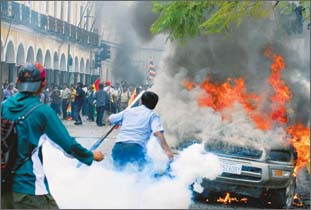
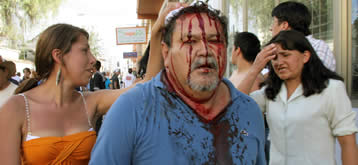
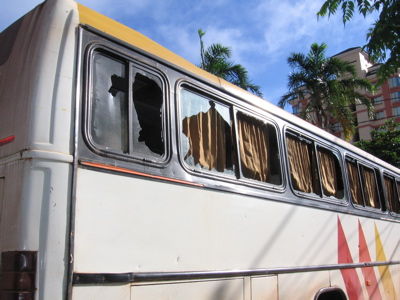
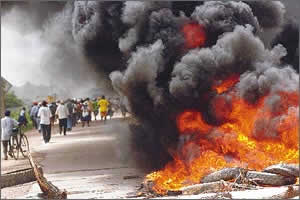
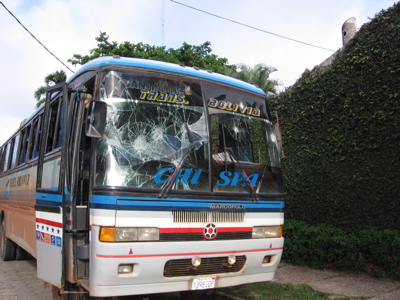
(The photo of the blockade of burning tires is from El Deber. The photo of the injured journalist is from El Nuevo Dia.) They stoned buses carrying people headed for the cabildo and sent five journalists to the hospital with severe head injuries. The trouble started when one of the buses broke through the first line of the blockade, and the blockaders started pelting it with rocks. After three hours of rock throwing, 90 people on both sides were injured. One man lost an eye. One of the buses was burned. Several press vehicles were destroyed. Eventually the buses went through. They were parked in my neighborhood this morning, with most of their windows knocked out. (Photos of the buses are mine.)

(The photo of the rock-throwers is from El Nuevo Dia)
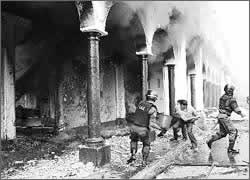
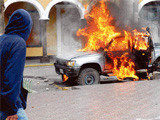
Unfortunately, those who back the cabildos and autonomy went on their own rampage in several towns and burned the headquarters of the ruling party, the president's party, whom they deemed responsible for the violence in San Julian.
Last week a pro-government crowd in La Paz, which is the heart of the president's power base, set upon some anti-government hunger strikers who were in a church.
The mob wanted to kill one of the hunger strikers, a prominent novelist. They tossed a stick of dynamite into the room where the hunger strikers were located. Fortunately, someone was able to yank the fuse before it exploded. The hunger strikers barely escaped and went into hiding. (In retaliation for the rock attacks, supporters of autonomy burned MAS headquarters in San Ramon, photo from El Deber)
The night of the cabildos, I saw the president on TV, and he was very conciliatory toward the demonstrators, which seemed a statesmanlike thing to do. He was not talking about sending in the army or confrontation. He used the word dialogue a couple of times. Maybe this difficult period in Bolivia's history will be worked out without much violence.