Saturday, July 17, 2010

Renewing a Mexican visa, or Catch-22

"Catch-22" is one of my favorite books because it makes hilarious comedy out of bureaucratic lunacy.

None of the bomber crew members in the story want to fly the suicidal missions over Italy. The only way they can get out of them is if they´re judged insane by the Air Corps psychiatrist.

But if they tell the psychiatrist they have horrific nightmares and they´re too terrified to fly the missions, that´s a healthy response, therefore they´re sane and have to fly the missions.

If a crewman really is crazy, then he enjoys flying the missions. So everyone has to fly the missions. That´s Catch-22. The world´s bureaucracies are full of Catches.

Mexico´s version of Catch-22

Getting a work visa renewed in Mexico is something like that. You´re wrong even when you´re right, and you will be punished. This year the government developed a new computerized streamlined system for the process. Here´s how it works:

1. It says on the helpful website that you just fill out the renewal form online. I ransack the website without finding the renewal form. There is no place on any page that has a link to it. I do a Google search for FM3 visas and find a blog dispensing immigration advice for Cubans living in Mexico. It has the link.

2. I fill out the form online. There is no English version, which is not a problem for me but must be for some of the other 1 million Americans who live in this country. At the end, the form gives me two choices: "save" (guardar) or "save and copy" (guardar y duplicar). Being a careful sort, I hit "save and copy".

Hitting "save and copy" was, I later learned, a big mistake.

3. Being a careful sort, before I fill out Cindy´s application, I take the printout of my application down to the immigration office to submit it to Answer Lady, whose job it is to help ignorant foreigners decipher the niceties of the system. She reviews my form. In the box for writing where the original visa was issued, I wrote, "Washington, D.C.", just as it said on my visa.

-- This is a mistake, said Answer Lady. Even though your visa says it was issued in Washington, it was really issued on Mexican soil because it was in the embassy there.

-- Oh, I said. So when I fill out my wife´s form online, I should write that her visa was issued in Mexico, right?
-- Right, said Answer Lady.

Believing Answer Lady was a big mistake.

4. At the immigration office the next Monday, the line is amazingly short at 9 a.m. We bring with us a fat file folder filled with documents that we had to present the previous year to renew the visas:
-- letter from me in Spanish attesting to the fact that I will support my wife during the time of my visa and not abandon her,
-- passport and two copies of each page of the passport,
-- visa and two copies of each page of the visa,
-- letters from the University and from Washington saying that I am in Mexico to do good things,
-- copies of passports of the letter writers with their signatures to prove that the letters aren´t forgeries,
-- copies of utility bills as proof of residence,
-- copies of three months of bank statements to prove income,
-- copy of my work contract with the International Center for Journalists,

-- three black-and-white photos face front, two photos in profile.....
-- and although we supposedly don´t need them this year in the streamlined system, I bring along the certified copy of our marriage license and certified copies of our birth certificates.

I also had obtained from Answer Lady the form you use to go to the bank and pay the visa fee for each of us.

To speed up the process, I paid the fees before submitting the application. Big mistake.

5. We submit our papers. Two women scrutinize various documents.

-- We have to reject your application, sir, because you made a mistake by hitting 'save and copy´. You only use that if you´re going to submit a duplicate for a child, and you don´t have a child seeking a visa. So you´ll have to go online and fill out the form again.

-- And we have to reject your wife´s application because it says she got her visa in Mexico but it was really in Washington, D.C.
-- But Answer Lady told me to put down Mexico, I protest.
-- Sorry.

6. We go to an Internet café near the immigration office and fill out the forms again, print them out, get back in line, which is longer now, and wait our turn. We submit our stuff again.
Do you have your payment forms? You bet we do.
-- I´m sorry sir, but we can´t accept your payment. It´s for the wrong amount.

Cindy´s is correct, but it turns out I had made a mistake and paid the same amount for both Cindy and me, about $100 each. I was supposed to pay $160 because I´m earning a salary down here.

7. They accept Cindy´s application but won´t accept mine until I go to a bank and execute a new payment for the correct amount. It´s not possible to just add on to the amount I´ve already paid. Cindy takes a taxi home. I take a taxi to the bank where I originally paid, pay again, this time $160, take a taxi back to the immigration office, take a ticket and get back in line. The line is longer now. I wait. I submit my application again, payment is correct, they accept the application and give me a number to check online. It will tell us when the visas are ready.

8. So what do I do about getting a refund for the erroneous $100 payment I already made?
-- You´ll have to talk to that lady over there.
She has me fill out some forms. Now what?
-- Well, the paperwork has to go through some channels and you´ll have to come back in three days.

9. I come back three days later, expecting to get a check or a voucher I can take to a bank and use to make a deposit.
-- Oh, no, you have to take this form to the office of a different agency, the SAT (tax collector) where they issue refunds.
-- Where is the SAT office?
-- There are several. You can look them up online, but you have to make an appointment.

10. I go online to try to make an appointment. The system is down and not working and continues not working the next day as well. I call the number listed on the website. A person answers and says that I made a mistake, this is the wrong agency. I check the number on the website. I had called the number listed, so evidently everyone who has this problem and calls this number will always get the wrong agency. She gives me the correct phone number.

11. I call the agency to make an appointment for getting my $100 refund. The woman asks me what SAT district I live in. I say I don´t know but I give her my address. She says she can´t tell from that what district I live in. I´ll have to go to one of the offices and ask which office is the correct one to go to for the refund.
Then I can make an appointment.

12. Meanwhile we find out that are visas are ready. On this day, the office is packed. We wait about two hours to get to the front of the line. I´m nervous as hell that I might have made some other mistake, that there is some hoop we forgot to jump through. The clerk asks us where our XXX forms are. What forms?
-- These forms. You mean no one told you to fill these out?
--No.
-- OK, we´ll just fill them out now."

Fortunately do not have to get back in line.
But this new form asks for information that we have already given them two or three times in different documents, but we have to fill it out.
We get our visas. Yay!

13. Now about my $100 refund for the erroneous payment.
There are two possible SAT offices that could be the one I´m required to go to. I pick the one by the Christopher Columbus Circle. I get in the line that says "without appointment". I give them my address. Yes, you´re at the right office. You´ll have to wait to see a counselor. I take a ticket. I wait. The counselor says that to get the refund I will need:
-- Proof of residence from a utility bill
-- a copy of my passport
-- the voucher that I already have and a copy of it
-- copy of my visa, both sides
-- the bank account details where they are to deposit the money (they don´t issue checks)
-- and I will need to make an appointment

Here comes Catch-22

-- So when would you like to make your appointment?
-- How about this week?

She looks at my newly issued visa. It´s a plastic card like a driver´s license instead of the old passport-style booklet. She checks the date. Technically, my new visa doesn´t take effect for two weeks because I renewed it two weeks before the old one expired.

-- I´m sorry sir, but we can´t make an appointment with you until this visa takes effect.
-- But I just renewed it. Look. Here´s a copy of my old visa.
-- Sorry, we´ll have to make an appointment no sooner than the effective date of this new visa.

14. Now uncertain whether my new visa is valid, I prepare to leave on a two-week trip to the U.S. I carry a 24-page full-color photocopy of my old visa, just in case. At the airport in Guadalajara, the immigration officer looks at my card-style visa as if he has never seen one before.
The new rules and new forms have been in effect for two months.
-- What´s this?
-- It´s my FM3 visa. It´s the new style. They just started issuing them.

He looks at me, looks at the picture, studies both sides of the card, trying to figure out what to do. Eventually he sees something he recognizes, writes something down and stamps some forms, giving me two copies.

15. I´m back now from the U.S. and have my appointment at the SAT office. I bring my fat file with me that has 10 times more information than is required because bureaucrats always want you to present something you don´t have.
She asks for a copy of the picture page of my passport, which by dumb luck I have. She looks at the bank account information.

-- This bank account isn´t in your name.
-- No that´s my wife. I don´t have a bank account. Here´s our marriage certificate.

After a half hour of looking at her computer screen and printing out a half-dozen documents, stamping each four or five times, she hands me a form that is a record of my application.

-- It will have to go through channels and be approved she says. You should hear within the next 40 working days.

40 working days. That´s more than eight weeks after you take holidays into account.

At this point, the authentic human response should be a shriek of frustration. But I know that within the bureaucratic system, you have to pretend to be civilized, or the system will punish you even more.

So now I´m waiting to see if the deposit will show up in Cindy´s bank account or for some notification that my application for refund was rejected.

On the other hand

The Mexican bureaucracy functions differently for special people, though. Yesterday I read in the paper that six state government officials, in illegal fashion and with approval from no one, awarded themselves bonuses last year totaling $2 million.

That averages to $333,000 apiece. I´m betting that they didn´t have to make an appointment at the local SAT office to get it.

Wednesday, July 14, 2010

Designing a master´s degree and becoming an academic


This month I think I have finally resigned myself to the fact that I am becoming less of a journalist and more of an academic.

For the past several months I´ve been meeting with a committee of about 10 academics within the University of Guadalajara´s Virtual University, their distance-learning unit, to design an online master´s degree in digital journalism.

This is a fairly innovative program. There are maybe a dozen digital journalism master´s programs in the U.S., and I don´t know of any of them that are completely online.

There are only one or two similar programs in the Spanish-speaking world that both teach digital journalism (how you practice journalism in the multimedia world of the Web) and do it online. So it´s a stretch for all of us.

Meetings of the minds

The University has its own processes and values that have to be understood and respected, just as a newsroom does.

To begin with, you design a degree program as a response to a series of "problematicas" in society. Basically needs, gaps, problems. Then you describe "intervenciones" which your courses are supposed to provide to satisfy those needs, fill those gaps, solve those problems. This took a couple of weeks.

These interventions, if you will, are courses. Most of the participants in the committee are experts in education, online course design and pedagogy. Two are journalism professors with some professional media experience but little experience with digital journalism.

Words matter

I spent a lot of time just describing to the committee what is happening in the world of journalism today, which is a revolution on the scale of the invention of the book.

They needed a context to understand why I wanted to have courses on multimedia storytelling, citizen journalism, ethics in the online world, new business models for journalism, writing for the web and so on.

Then the hard part. Each course has to be justified by the "competencia" (skill) that the student has to demonstrate upon completion. And each of these skills is described in terms of abstract nouns whose meanings even in English are not always clear to me and often seem to overlap.

For each course we have to describe what conocimientos (knowledge), habilidades (abilities), actitudes (attitudes) and valores (values) are necessary to achieve the competencia (skill).

Into the home stretch


So after a series of six or seven three-hour meetings over the past months, we had the basic map of a master´s program, with individual courses, hours and credits described.

For the last two days, my team and I have been writing up detailed course descriptions with all of the habilidades, actitudes, valores etc. spelled out along with a description of course units and a bibliography. I did most of the 16 course descriptions that you´ll find listed on the left side of this wiki of the master´s program http://maestriadigital.wikispaces.com/.

Then we need to write up a formal document that describes the program in academic terms and get it approved by various committees of the Virtual University.

Tuesday we have a teleconference with a University in Santiago, Chile, to discuss offering our program jointly with them. They have a master´s in digital journalism, but it´s not online. (In the photo above, Arturo Catalán, who directs the program in Chile, visits one of our meetings.)

The goal is to get all of this done before my fellowship ends in December.

Friday, June 25, 2010

Impunity in Mexico: 49 toddlers die in fire, officials absolved

That´s how it works here.

You can imagine how the justice system would have reacted in the U.S. if 49 children had been killed in a fire at a day-care center.

Mexico´s Supreme Court recently voted to absolve high-level officials of responsibility. A New York Times story quoted the reaction of legal affairs columnist Miguel Carbonell, who wrote in El Universal newspaper:

The surest thing is that the case ends as almost everything ends in Mexico: in oblivion and the most absolute impunity.


The Times story added:

In all, 23 people have been charged in the case and all of them are out on bail, said Lorenzo Ramos Félix, a lawyer for the victims’ families.

Except for the center’s four owners, all of the accused are low-level municipal, state and federal employees. “Neither the government nor the court wants to take a high-ranking official to trial,” Mr. Ramos said.


Families of the victims posted the Times story on their website, which is part of their campaign to seek justice.

Among the owners of the day-care center are a cousin of Mexico´s first lady as well as party and state officials and their spouses. It is no accident that those with political connections get contracts for these centers: they receive government payments for each child cared for. It´s guaranteed income.

Impunity for crimes against reporters

A similar impunity exists in crimes against journalists, which have been on the rise in Mexico.

We offer a course for Mexican journalists in how to protect themselves while covering drug trafficking and corruption. The journalists tell us that the institutions that are supposed to protect them, such as the courts, police and regulators, are sometimes in league with the criminals who threaten them.

This week there a ceremony in Tijuana honored journalist Francisco Ortiz Franco, who was murdered six years ago. According to a statement released by the Inter American Press Association:

Ortiz Franco was killed in front of two of his children as he was about to get into his car. A masked man, believed to be from the Arellano Félix cartel, shot him four times at point-blank range. Since then, despite the initial mobilization of justice authorities and the Public Prosecutor’s Office, the case has suffered numerous irregularities and today remains completely unpunished.


The complete statement is here.

This article describes Mexico as one of the most dangerous countries in the world for journalists.

In the past 18 months, the facilities of five media outlets have been attacked with gunfire or grenades, according to the Centro Nacional de Comunicación Social. So far this year at least 13 journalists have been attacked or killed.

Friday, June 11, 2010

Baseball at Nationals Park in Washington, sacred sites in Mexico


I was two days too late to see the Nationals´ new phenom, Steven Strasburg, in his major league debut, in which he struck out 14 batters and created national buzz.

Thursday night was just another bad night for Pittsburgh, as the Nationals
beat the Pirates 4-2, and completed a three-game sweep.

What I like about baseball in person is the space reserved for the game. A ball park and the diamond it contains have a kind of perfect beauty and orderliness that the messy reality of daily life does not. The simple rules of the game -- and this is true for any game, including soccer -- create a ritualized form of reality, a more ordered version of it, in which what men and women do can affect the way the world turns.

Today´s athletes are heroes in that they act out our myths and beliefs about life, and because they have replaced the gods. Mexican wrestling matches have this kind of mythic battle of good vs. evil, gringos vs. Mexicans, etc. (See the next entry on this blog.)

When you explore archeological sites in Mexico, most of them have a ball court where a game resembling soccer was played. The game had a sacred significance, but it is also true that people played the game for fun.

The ball court at Montealban in Oaxaca, which we visited in December.

Supposedly Moctezuma, the Aztec emperor defeated by Cortez, would strap on his belt and play with his nephews for fun.

At some sites, evidence suggests that the losers of a ball game were ritually sacrificed.

No one was sacrificed after the Nationals-Pirates game, but they were subjected to press interviews. Basically the same thing.


I´m in DC and Boston for a few days, training Knight Journalism fellows and getting some training myself.

Monday, May 31, 2010

Lucha libre: wrestling with Thunder Boy and Princessa Maya

Divino has his way with Thunder Boy on the ramp up to the ring, whose ropes are sometimes insufficient to contain all of the action and drama. Cameras aren´t allowed in the arena, but I snapped some images with my iPhone before an usher told me to desist.

You can´t live in Mexico without taking in a match of Lucha Libre (freestyle wrestling).

It´s a combination of morality play, superhero drama and acrobatics. Masked Mexican wrestlers are folk heroes. In movies they fight vampires, criminals and other forces of evil. The masks have a historical and cultural significance in this country whose indigenous roots run deep.

Here is the official website of the World Council of Lucha Libre and here is an article about the history and meaning of the sport.

On Sunday night a friend from the University who is a big fan took me to the Arena Coliseo to see six matches.

Siluetta throws Princessa Maya to the canvas.

Women wrestlers

It was family night. Adults pay $2 to $12 and kids get in for 40 cents. There were maybe 1,000 people for a two-hour spectacle that started at 6. A beer is $2, a bag of microwaved popcorn $1.50.

Not on the card was the leadoff match between two women wrestlers, Princessa Maya and Siluetta (a more appropriate name might have been Big Shadow).

They did some impressive acrobatic and gymnastic moves as they threw each other around the ring for a few minutes. Part of the deal is to create a villain who takes cheap shots. Then the aggrieved makes a comeback and overcomes evil. But sometimes evil wins.

Siluetta won out over Princessa Maya.

Kids love the wrestlers´ masks. Stores have hundreds of different styles and colors.

Aerial combat outside the ring

The top-billed match was between three guys without masks -- Strong Man, Gigante Bernard and Blue Panther -- and the three masked heroes, Atlantis, Averno and Mephisto.

Gigante Bernard and Strong Man were gringos who had a Mexican ally, the Blue Panther, and they beat the snot out of the three masked wrestlers. I wonder if the gringos always win in these dramas.

Gigante Bernard and his two partners claim victory, while the vanquished lie at the right.

Strong Man shakes hands with the fans. Sorry about the light.

In any case, the referee was completely ineffective at keeping the wrestlers inside the ring. A favorite aerial maneuver is to stand on the ropes in the corner and launch oneself onto an opponent.

They execute these flying maneuvers outside the ring as well, which looked awfully dangerous to the wrestlers, not to speak of the audience and vendors.

Leo, a handsome young guy without a mask, was a favorite with the young crowd. He took on the Exterminador.


Wrestler action figures.

The wrestler Alpha pose is everything. The jersey is for the Black Lions, the University of Guadalajara´s professional soccer team.

Saturday, May 15, 2010

Family of free agents, wandering the world

Cindy and I hung out with some journalists from Mexico, Brazil, Venezuela, Argentina and Paraguay when we were in Bogotá, Colombia, recently. We spent an afternoon at the country house of our hosts, Carlos Eduardo Huertas and his wife, Lili, at extreme right and left.

Christine the mathematician is on a three-month visiting scholar gig at the Max Planck Institute in Potsdam, Germany, and has been giving lectures around Germany and, most recently, London.

She has started blogging. She´s the funniest member of the family. I liked her take on the low-cost airline RyanAir´s service from Berlin to London.

Potsdam is near Berlin, about six hours by train from Stuttgart, where our other daughter, Bridget has been dancing with the Stuttgart Ballet for some 14 years (here´s her website).

Bridget is now a guest artist with the company, so she has been booking free agent gigs to dance and choreograph in various cities around Germany. Here´s a description in English of of some of her latest choreography.

So the two daughters have had a chance to hang out together a bit on weekends.

Which brings us to Patrick, the jazz saxophonist, who has been out playing jobs in New York, Baltimore, Chicago, Cleveland, etc.

The jazz scene in Madison, Wis., where he and his girlfriend, Emily, are living is not providing enough work for him. So he´s been on the road a lot.

Cindy and I were recently in Bogotá, Colombia, for about a week. It was our first time there. The Colombian organization of investigative journalists hosted an international conference and invited me to give a series of seminars and classes to their members.

Cindy has become a professional tour guide. She puts together briefing books on every place we visit, with a list of all the sights, the history, maps, etc. Without her research, I would have been ignorant of the significance of many recent events in the country.

The wars between liberals and conservatives depicted in Gabriel García Márquez´s "One Hundred Years of Solitude" have gone on intermittently for most of two centuries, in different guises with different names for the players. They´re still going on: right-wing paramilitaries vs. the left-wing guerillas, the FARC.

Cindy takes hundreds of photos while I´m in conference rooms.

Here´s a garden in the heart of Bogotá.

Bogotá has a dramatic skyline. It´s set amid mountains 8,600 feet above sea level. Climbing stairs leaves you short of breath.

May Day demonstrations in Bogotá brought out activists who occasionally clashed with the police.


We spent a morning inside the cathedral of salt, which was built in the depths of a mine near Bogotá.


Santiago, Chile, nine hours in the air from Guadalajara

The skyline of Santiago, Chile, city of more than 5 million, a third of the country´s population. Smog is a problem.

Cindy returned to Guadalajara and I went on to Santiago, Chile, where I had been invited by the Universidad Mayor to give a two-day seminar on new business models for news, which has become something of a specialty for me.

The University of Guadalajara, where I´m working, is trying to get an agreement with the Universidad Mayor to offer a joint master´s degree in digital journalism, completely online. I´m working on the design of the Guadalajara master´s.

The Santiago folks took me to a couple of very nice restaurants and treated me to lobster and fish of all kinds.

It is hard to describe just how far south Santiago is. It´s about nine hours in the air from our home in Guadalajara, Mexico, about the same distance from New York to Warsaw, Poland, 4,300 miles.

Signs of wealth


The city´s streetscapes reflect a history with the British, who exploited the country´s nitrate deposits, and other European powers.

I enjoyed using Santiago´s subway system. Chile is among the most developed and wealthiest countries in the hemisphere.

There were few visible signs of the February earthquake, although I heard from a reporter that quite a few apartment buildings, especially those built in recent years, were ruled uninhabitable.

It´s fall in Santiago.


College students (not mine) are the same everywhere.

Sunday, April 04, 2010

The church built on the pyramid in Cholula


We´ve been reading a lot of books on Mexican history, and we wanted to visit the site of one of the most notorious acts of cruelty that took place in Cortez´s conquest of Mexico in 1519.

Cholula had a population of about 100,000 at that time and was a major city. Today it is part of the Puebla metropolitan area.

Cortez invited the nobles of the area to a meeting. They were unarmed. He and his native allies ambushed and slaughtered them and then sacked and burned the city. Thousands were killed.

Supposedly Cortez wanted to send a message to Moctezuma, the Aztec emperor, about what was to come. Moctezuma´s city, Tenochtitlán (where Mexico City is today), later suffered a similar fate.


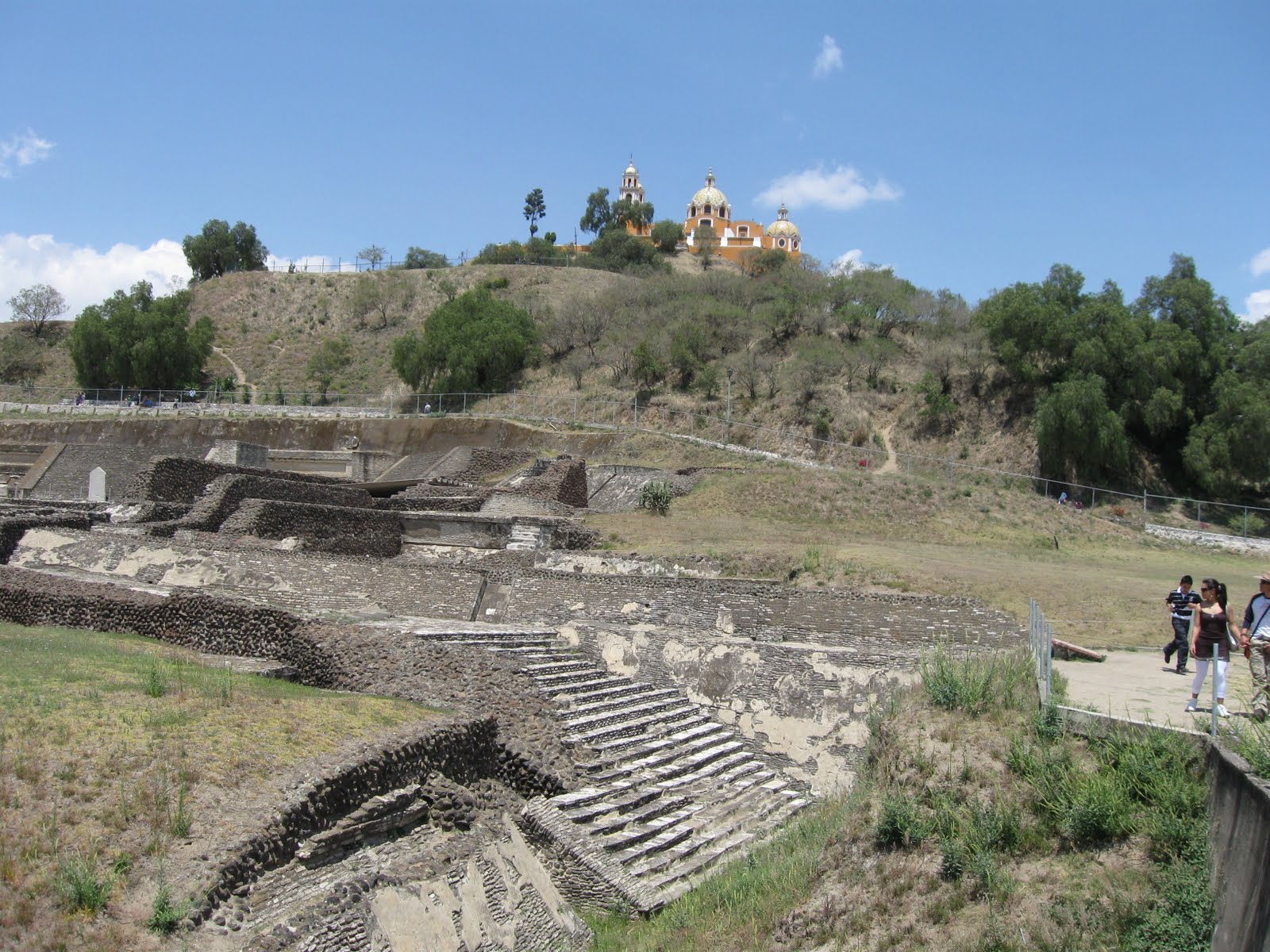
Cholula is also known for its great pyramid, supposedly the largest in the world. The Spaniards built a church on top of it in 1596, Nuestra Señora de los Remedios. In the photos you can see where part of the pyramid and its lower platforms have been excavated.

Cindy is climbing the stairs at the base, which gives you some sense of the massiveness of the pyramid. The church is out of sight behind the top of the structure.

The church itself is very impressive inside, which helps explain why it was not removed so the pyramid could be completely excavated.