|
| We started in Casablanca, drove to Meknès and Fez, then crossed the Middle Atlas Mountains, and followed the Ziz Valley down to the Sahara at Merzouga. We made many stops all along the way. Ourzazate is Morocco's Hollywood, with natural backgrounds and some constructed ones used for movies and TV. The trip finished in Marrakesh. We took a fast train to Casablanca and spent an extra two nights there before flying back home to Pamplona. |
This was a trip that I was
not looking forward to. I pictured an impoverished third world country where rich foreign tourists are accosted on all sides by squads of poor beggars. I pictured endless featureless desert. I worried that I would be unable to tolerate the eight English-speaking strangers who would also be part of this tour. These worries made me realize that I am an expatriate snob and a cantankerous old fart.
But Cindy had it on her list of places to visit, and my sister Nancy and her husband, Tom, jumped at the chance to make the trip.
First surprise: Our other eight traveling companions turned out to be fun and interesting -- four Canadians from Calgary and four members of a family from Boston and Louisville.

(Put your cursor on the photo above to see all the photos in the slideshow.)
Second surprise: the tour itself disrupted all of my assumptions and stereotyped expectations about North African culture and people.
 |
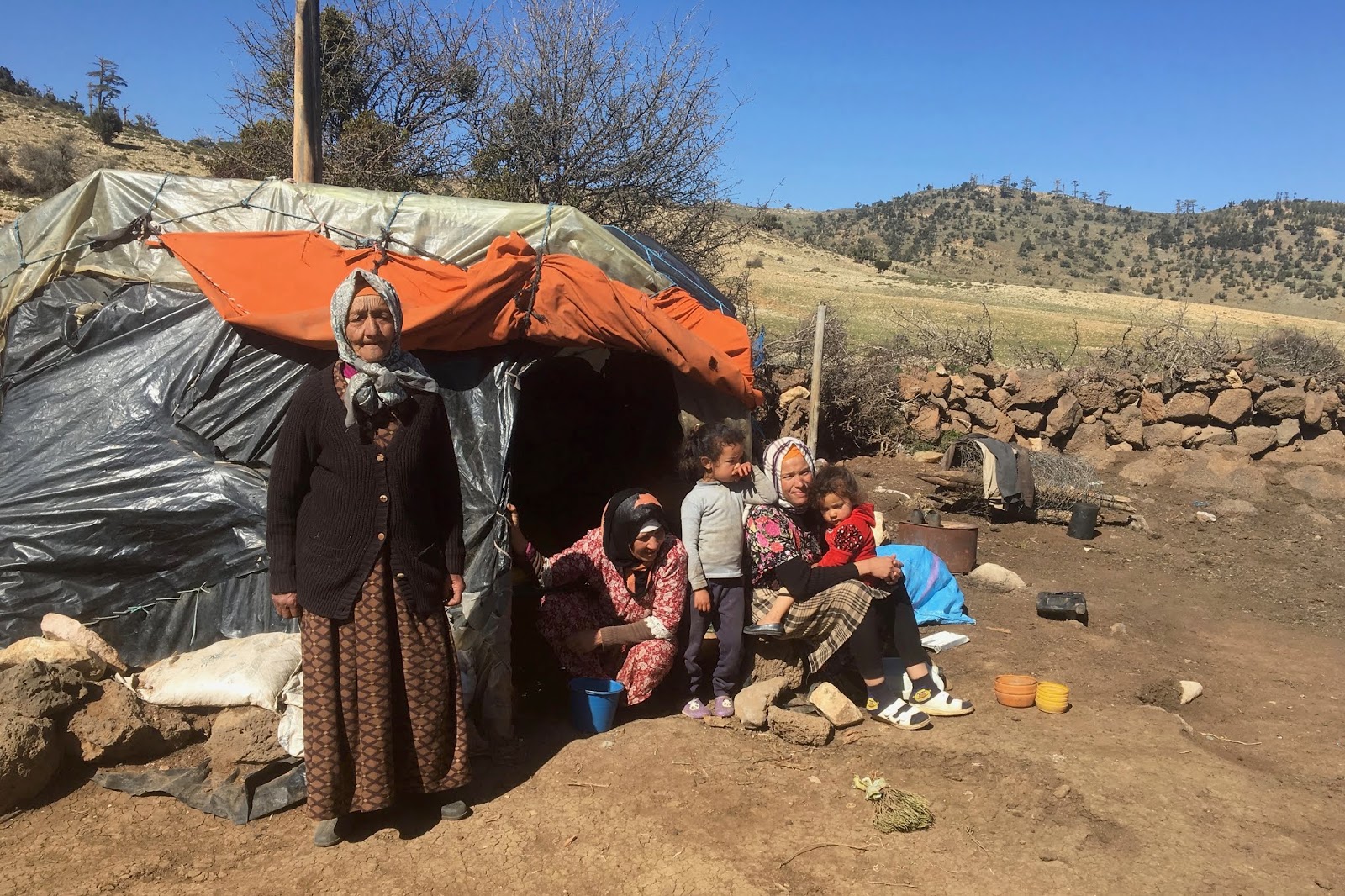
| Yassin, our guide, introduced us to a nomad family that hosted us in their tent with sweet tea. |
Cindy organized everything through
Gadventures.com,
which is a partner of National Geographic tours. One of their goals is
that clients are "travelers" on an adventure of discovery, not tourists:
in other words, the goal is appreciation, learning, connection, not
just gawking and shopping. So we often took "the road less traveled by."
Our tour's main guide, Yassin, is a member of a
Berber ethnic group, and there are three main ones in Morocco. Yassin spoke his Berber dialect, Tamazight, as well as Arabic, French, and English. He had personal relationships with many of the people we met along the way. He has been doing this work for 13 years.
 |
| A Berber nomad family we encountered on the road from Fez to Merzouga. They herd sheep and goats, and they set up their tent along the highway to invite travelers to tea for some extra income. |
Our first stop on the road from Casablanca to Fez (spelled Fes by the French) was Roman ruins at Volubilis.

(Put your cursor on the photo above to see all the photos in the slideshow.)
 |
| Volubilis was important for production of olive oil, grain, and various metal ores long before the Romans took control of it. The area is still an important agricultural center. |
We stopped to visit the ancient imperial city of Meknès, famous for its elaborate gates. We also visited the palace of one of its kings, who loved horses and kept 12,000 in his stables. He also had several hundred wives in his harem.
 |
| Our guide in Meknès was from the Berber ethnic group. |
Berber culture
The Berbers are the people who occupied Morocco long before the Phoenicians, Greeks, Romans, Arabs, and other invaders.
One of the things that makes Morocco different from the rest of North Africa culturally, socially, politically, and economically is that they were never dominated by the Turkish empire the way that its neighbors were -- Algeria, Libya, Tunisia, and Egypt.
Another difference is how much the
cultures of Morocco and Spain flowed back and forth over many centuries, based on the changing politics and power. This affects language, art, architecture, and religion. For example, the minarets of Morocco -- the towers from which Islamic clergy call the faithful to prayer -- are rectangular, like those in southern Spain, where the Arabic and Muslim influence was strongest. Elsewhere in the Muslim world, minarets are circular.
France and Spain in Morocco
Arabic speaking Muslims conquered much of the Iberian peninsula (Spain and Portugal) starting in the 8th century, and they ruled much of it for almost 800 years until the so-called Catholic kings, Ferdinand and Isabella,
conquered Granada in 1492, and
expelled all Moors who refused to convert to Catholicism. These rulers are the same ones who hired
Christopher Columbus in that eventful year to find new commercial routes to the west. And in that same year, the Catholic kings
expelled all Jews. Those who converted to Catholicism could stay.
Along the Mediterranean coast of Morocco today, many people speak Spanish and there are two cities that are declared Spanish soil, Melilla and Ceuta.
But south of the Mediterranean, we found French spoken by most of the people involved in the travel industry. My sister Nancy and I enjoyed
using our rusty French to communicate with the local people. The
French presence in North Africa began in the 17th century but expanded early in the 19th century.
 |
| We were told never to take photos of police or military or there would be problems. Here, though, they were posing to show all of the different branches of military. A few days later, in Casablanca, some naval officers began yelling at Nancy when she tried to take a picture of the entrance to the naval academy. |
Fez is cool and green. Its medina (the
old city, within walls), is famous for its labyrinthine streets (some 9,000) and
many souks (specialized markets for rugs, pottery, shoes, clothing,
etc.)
(Put your cursor on the photo below to see all the photos in the slideshow.)

 |
| A donkey caravan in the narrow streets of the medina of Fez. Look out. |
 |
| The tiny tiles in the mosaics are hand cut rather than molded. |
 |
| Very narrow streets in the Fez medina. |
Our guide in Fez took us to the neighborhood in the medina where he grew up. His mother
tongue is Berber, but he also spoke Arabic, French, and, of
course, English.
On the dunes of the Sahara
The drive from Fez in the north to Merzouga in the south was about 10
hours, but we stopped several times for lunch or coffee or to see
particular sights, such as the oases that lie in the valleys between the
mountain ridges.
Some of the towns along the route have
become ski resorts with architecture that looks very Swiss with steeply
slanted roofs to shed snow easily. Along the roads are snow fences to
prevent drifts forming on the highways.

We saw barbary apes -- a species of monkey -- at one place. They are also found on Gibraltar.
(Put your cursor on the photo above to see all the photos in the slideshow.)
Cindy and Tom decided to take a camel ride in the evening when we got to Merzouga on the edge of the Sahara. I wasn't interested, recalling problems when riding a recalcitrant horse on another trip. Their three-hour trek took them far enough out into the dunes that they couldn't see any sign of the town. Just occasionally some other caravans. The quiet and the emptiness were impressive. I regretted not going.
The next morning, we went in a 4x4 out onto the dunes and went for a walk. It would be very easy to get lost in the dips between the dunes. It was astonishing to see how some plants manage to find water when there is apparently none to be found. And around some of the tufts of grass or bush, you could see the tracks of birds or lizards or other small creatures. Life finds its niches.
Arab traders enslaved black Africans to work in their mines and plantations in Morocco starting in
the 9th century at least. Some of the descendants of those slaves, the ethnic group Gnaoua, live in the village of Khamlia, which we visited to hear them play some traditional music (click on the video above).
We learned how to take a scarf and twist it into a turban that covers the head, the back of the neck and, when needed, the face, to keep the wind-blown sand away. Morocco is very windy everywhere, all the time, it seems. The video below proves it; but this was later, at Aït Ben Haddou Kasbah.
Hollywood of the Sahara
The casbah (can mean fort or castle
or palace) at Oarzazate (pronounced wahr-ZAH-zah-tay) and the
surrounding area have been used for location shots for lots of movies
and TV shows --
"Babel" and "Game of Thrones", for example.
Some
film and TV production studios have large sound stages here, but they
also use the natural exteriors for shooting historical and fantasy
dramas. I wondered if the Monty Python movies might have been shot
around here, but no; those were shot in Tunisia using many of the sets
from Franco Zeffirelli's "Jesus of Nazareth."
We stopped several places along the highway
from Ourzazate to Tinghir, including to see this jeweler in the slideshow below. We also saw many casbahs that face the Dades River
gorge and have their backs against the cliff, for defensive purposes.
(Put your cursor on the photo below to see all the photos in the slideshow.)

 |
| Hotel Tomboctou in Tinghir was filled with African art and sculpture. Each room was unique. |
Marrakesh
This is a city famous for its markets. In its heyday, it was a place to buy hashish. Not sure that's a good idea today. We spent our first evening there having dinner in one of the pop-up restaurants that are set up nightly in the main square, La Place, or Djema el-Fna in Arabic, a name which few of us could remember.
At these restaurants, you could order the traditional tagine (a kind of stew with meat or fish and vegetables, with varied seasonings) or couscous, which also had many variations. Each restaurant welcomes guests with a little song, as in the video below. Martin, the Canadian wildlife expert, makes a brief appearance in the video and politely excuses himself, in true polite Canadian fashion.
The specialty of our particular restaurant was goat's head, Grande Tête, the most expensive item on the menu at 80 dirham, around 9 dollars U.S.
 |
| Goat heads. A local delicacy. The most expensive item on the menu. |

(Put your cursor on the photo above to see all the photos in the slideshow.)
We also visited two palaces and a madras, or school. The art and architecture, as you can see in the slides, is magnificent.
Casablanca
We took a train from Marrakesh to Casablanca and ended up in a compartment with two local guys. We started chatting with them in English. Turns out both of them were involved in telecommunications and engineering. One was more on the programming side, the other more on the construction side. With us, they spoke in English. After a while, when they were speaking in French, we commented on their conversation, and then began a lively chat in French on politics, our remarkable government, their remarkable constitutional monarchy.
Morocco on the surface is a lot more progressive, more open, than many of its neighbors, and its government seems to be a lot more stable than its neighbors. The newspapers and TV programming I saw were very timid, very much promotional. So it left me wondering if dissent was being suppressed.
Reporters without Borders ranks Morocco as having
among the least press freedom in the world, ranked at 135th out of 180 (Norway and Finland rank 1 and 2, the U.S. ranks 48th). So there is a lot of censorship and self-censorship, and those who don't restrain themselves go to jail.
Tom Lukens, a huge movie fan, wanted to visit the replica of Rick's Cafe from the movie "Casablanca". The 1941 movie was shot in Hollywood on sound stages, not on location. So the Casablanca cafe is a replica of a fake, you might say. Still, it does try to capture some of the atmosphere of the film in its design. The food was good and not pricey.
It was Sunday night in Casablanca, and we went for a walk through the old medina, where local folks were stocking up for the next week's work and looking for bargains in clothing, toys, tools, and what have you. Very few foreigners or tourist types were in the crowd.

(Put your cursor on the photo above to see all the photos in the slideshow.)
The Grand Mosque
This magnificent building was designed by a French architect and constructed almost completely with local materials by local artisans and craftsmen. It is relatively new, completed in 1993. Supposedly the grand square can hold 100,000 people (totally believable), while the inside can accommodate 25,000. The scale is breathtaking, and has a dramatic setting, with the Atlantic's wind and waves buffeting its base.
Tourists are only admitted during the times between the five daily prayers. We heard tour guides speaking in French, Spanish, Arabic, Japanese, German, and Chinese.
Very impressive.