Tuesday, November 07, 2006

Pirates of the Altiplano


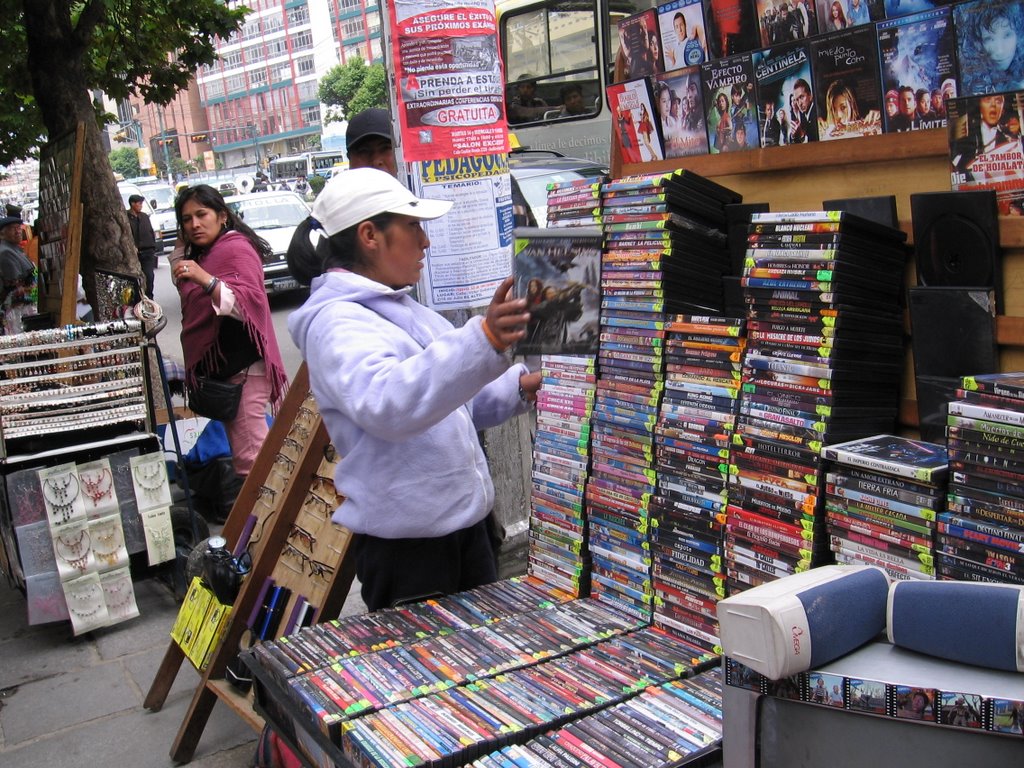
On every street corner you can buy first-rate music CDs for 63 cents and DVDs of first-run American and European movies for $1.75. I am told that the Colombians are the world champions of music, film and book piracy. The bookstores in the center of La Paz and Santa Cruz have very convincing photocopied editions of bestsellers in Spanish for $3 or $4. A book at full price would represent a week´s salary for a domestic worker or a couple of days´pay for a construction worker.
The covers of pirated books are meticulously color copied and laminated. Then the pages are photocopied in the original size and cut so that at first glance the books appear to be the real thing. A closer look reveals the truth.
There is honor among thieves, however. The Colombian pirates have a gentleman´s agreement not to sell any pirated Bolivian movies, books or music in Bolivia.
Presumably the agreement stops at the border.
No one cares a whit that some American or European artist, publisher or movie distributor might be losing some money. They´re on the other side of the world. If you look through the other end of the telescope, we buy our clothing and shoes and electronics cheaply because they´re made offshore somewhere. We don´t really ask ourselves why the prices are so low. Both here in Bolivia and back in the U.S. the only thing the consumer really cares about is everday low prices. If someone is victimized in the process, we don´t see it.

Boys at work


On my first walk on the streets of La Paz a young guy stuck his head out of a microbus and started shouting at me. Then another microbus came by, and another young guy stuck his head out and yelled at me. At first I thought they were insults, and then I gathered that they were calling out the stops of these micros. This job is called the voceador (caller, voicer, whatever). I´m told it pays about $3 or $4 a day, which works out to about $80 a month which is not too bad. A full-time live-in housekeeper in Santa Cruz makes about $100 a month, a tin miner, who has a horrible, dangerous job, about $500 a month.

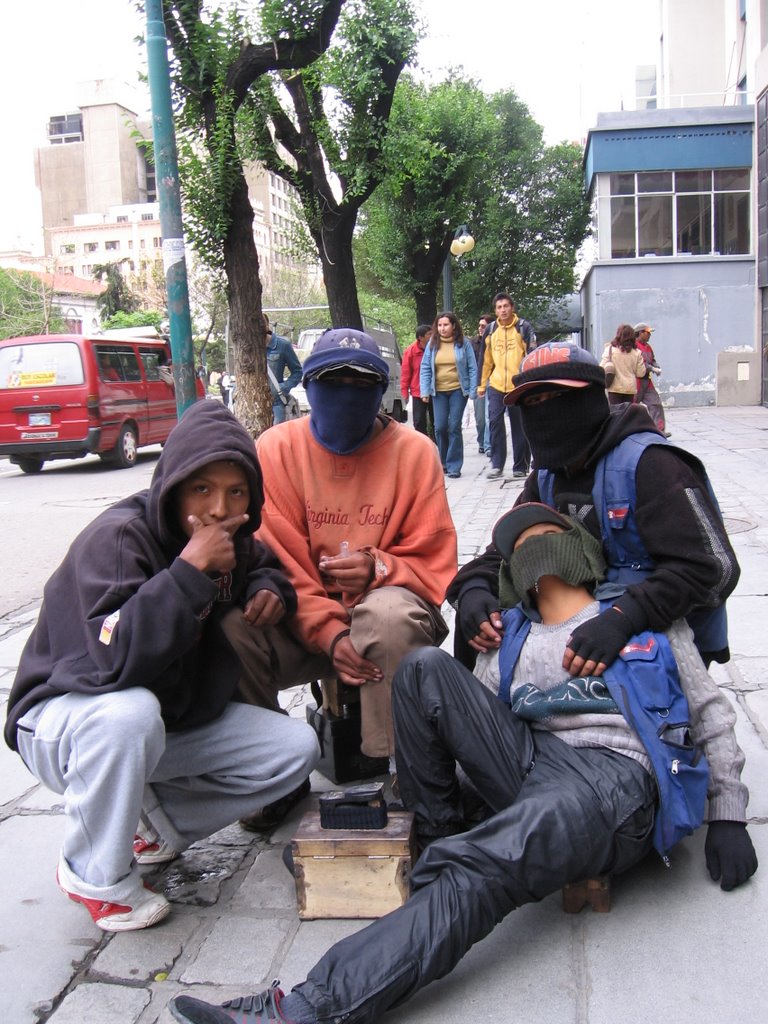
The limpiabotas (literally clean boots), or shoeshine guys in La Paz have the unique custom of wearing ski masks. One of the kids doing my shoes told me that the masks are to prevent discrimination from schoolmates. This kid, who is 15 and interested in mathematics, shines shoes in the morning and attends school in the afternoon. He doesn´t want to be teased by his friends. The going rate for a shoeshine is 12 to 37 cents. Women also get their shoes shined by the limpiabotas.

I was troubled by one thing I saw. A limpiabotas of about 13 in raggedy, dirty clothes was shining the shoes of a perfectly turned out girl of about 7 in her Don Bosco school uniform with white blouse and plaid skirt. The contrast between the two futures was unsettling.
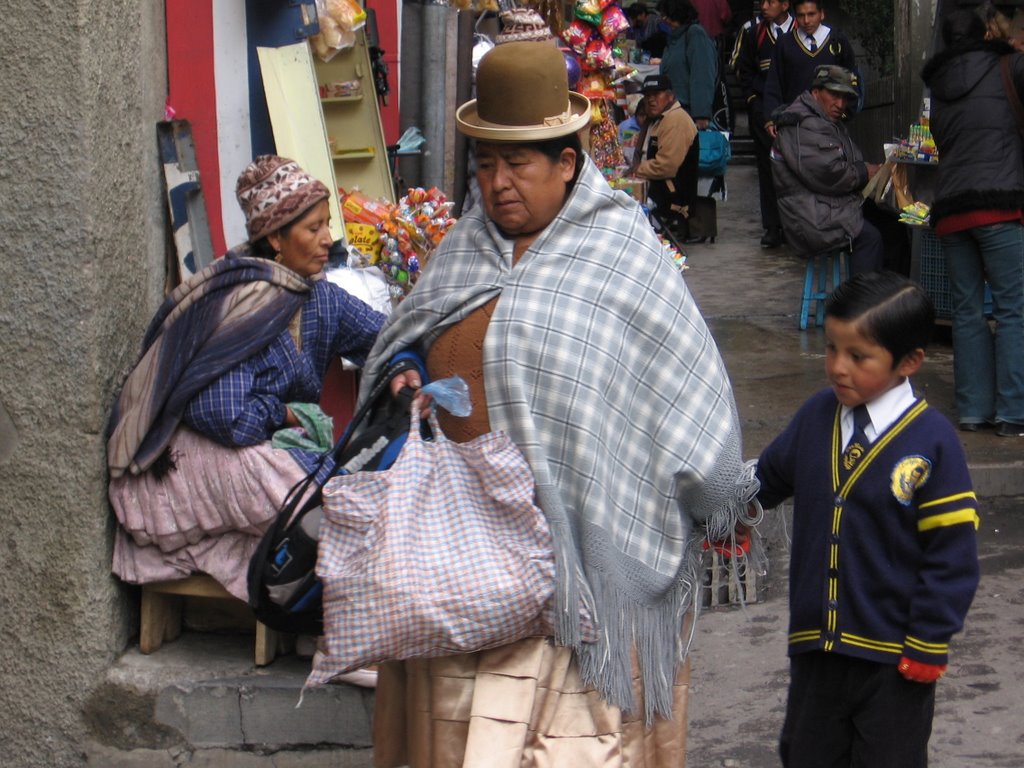
I caught some images of the Don Bosco kids arriving for school in their uniforms, all blue and gold. The the boys wear white shirts and ties. Very familiar to a graduate of Catholic schools.
Along the alleyways that lead into the school are a bunch of stands selling candy, school supplies, toys and other stuff. The stands are run by cholos, who are Indians living in the city but keeping their traditional dress. One chola arrived with a Don Bosco student holding onto her manta. I assumed it was his nanny, but a local journalism prof who saw the photo said the quality of her clothing indicates she is not a servant, and that the women who work as nannies are much younger than the woman in the picture. So again I misread the cultural cues, or missed the important details.

Friday, November 03, 2006

Frontier justice


In the past few weeks there have been two big stories in the papers about vigilante groups killing supposed malefactors. A few days ago, villagers in an indigenous community, Puesto Nuevo, got together at a meeting and passed a death sentence on a 38-year-old father of six who they believed was a witch. There had been a series of three unexplained deaths in the town and they decided it was this guy´s fault. It was never clear in the articles why they suspected him. The townspeople grabbed the guy, locked him in a trunk and threw it into a bonfire. Two schoolteachers were among those leading the mob. They freely admitted what they had done and said it was just community justice. The authorities are investigating.
A few weeks before that, the mototaxi drivers of a the community of San Julián responded when one of their colleagues was beaten within an inch of his life by robbers. The injured driver named one of his attackers, and the mototaxistas went looking for him. First they found the suspect's brother, 16. They threatened to burn him to death unless he told them where to find the suspect. Then they found the older brother, 17, who was evidently the leader of a group that had been attacking and robbing mototaxi drivers in the area. At least one other mototaxi driver had beeen killed. The mob found a stolen mototaxi at the suspect's house.

The mob led the brothers into the public square where, by now, some 12 hours into the drama, the news media and police had also gathered. But no one dared stop the mob, who put the younger brother on a pedestal for public judgment and beat the other one to death with sticks, stones and fists. All of this was recorded on film.

The photos show the body of the older brother, and the younger brother during his public display, after the beating and in a jail cell, where the public is making fun of him. Photos are from El Deber and El Nuevo Dia.
We of course have our own history of frontier justice for rustlers, robbers and suspected killers Out West, and of racially motivated lynchings well into the 20th century.

Thursday, November 02, 2006

The day of the dead, Nov. 2


Today was a national holiday, the Day of the Dead, when the living go to the city where the dead people reside. The General Cemetery of Santa Cruz looks like a little city. Its streets are lined with trees and little tombs designed to look like homes. The less wealthy end up in the equivalent of apartment houses, with the crypts stacked on top of each other in neat rows.
The city of the dead was packed with family members, who brought along their folding chairs and refreshments to sit by the crypts of their departed loved ones and have a little chat. It's a matter of family pride to have fresh flowers on your departed's headstone. Everyone will notice if a grave is neglected. Size of the bouquet seems to matter. The bigger tombs had arrangements of like proportions.


The city's main flower market lies outside the cemetery and the merchants were doing a brisk business. To prevent price gouging, the city established fixed rates just for today. So much for a dozen roses, so much for carnations. On the opposite side of the street, vendors took advantage of the street's closing for the holiday and offered all kinds of food and other goods.
I've never seen anything like this before.

Tuesday, October 31, 2006

Soccer players and taxi drivers


This photo was shot from the train and is a typical country scene, with kids playing soccer and a horse grazing behind the opposite goal. Kids are always kicking a ball around on the street. On cable TV it seems as if there are at least three or four soccer games on at all hours of the day and night. The president, Evo Morales, regularly gets into pickup games. A few weeks ago, he put together a team with four ringers who once played for the national team for a match with the press corps. The president's team whomped the journalists, 11-1, which must have been sweet, since Morales has called the press his No. 1 enemy.
Venezuela seems to be the only South American country that has baseball. You have to get up to Central America, specifically Panama, before you see much.

*****
The cab that didn't make it.


Cabs in Santa Cruz range from comfortable to rattletraps. Today was the first time that one actually conked out, although a dozen or so have seemed as though they wouldn't make it to their next stop. This driver was using a pair of pliers to adjust some of the electronic connections and stalled out twice before he admitted defeat and radioed his dispatcher for a relief driver. Clearly almost no one uses seatbelts in this city because they're always covered with dust and show other signs of neglect and disuse. Cabs are cheap. You can ride five or six miles, from one end of town to the other, for about $1.75. Most rides are less than $1. People use them to move all kinds of stuff, such as what seems to be a radio antenna in the photo below.


I spend a lot of time in cabs and get lots of language practice with the drivers, whose Spanish ranges from eloquent to impenetrable to these ears. One driver launched into an eloquent critique of TV stations that he said were guilty of "tergiversacion," a lovely word for manipulation. Given his mastery of the spoken word, he seemed a good person to ask about the local newspapers. He confessed that he doesn't read them. Turns out he's illiterate. Then there is a driver named Richard, who has picked me up twice, an unlikely occurrence given the number of cabs and the disparate locations where we hooked up. Today an older driver gave a dissertation on the meaning of the Day of the Dead, which is celebrated Nov. 2. Other drivers have provided background on news events that to a foreigner seemed strange.
You can always tell when a news reporter or sportswriter is desperate for material. The story starts with a quote from a cab driver. Guilty. More times than I would like to admit. Still, some of them are really poets at heart.

Sunday, October 29, 2006

Who killed the little white llama

A low-budget road movie made here in Bolivia has been drawing crowds and a lot of critical attention. "Who Killed the Little White Llama" is the story of a scrappy couple named Jacinto and Domitila who get mixed up in a drug deal and have to haul 50 kilos of cocaine from one end of the country to the other.
(In this scene, Jacinto, with a fake mustache, seduces a French woman.)
It's very funny, probably more so if you get all the cultural jokes and accents. The tissue-thin plot is a pretext to explore all the cultural and political issues of the day and to caricature the people who represent some of Bolivia's problems -- racism, political corruption, crime, drugs and violence. The title comes from an incident in which the two main characters, high on cocaine, accidentally run over a little Indian girl's pet llama. They make their escape, but a car carrying a gringo happens upon the llama, a crowd forms and they immediately begin hurling insults and take to him with their cudgels. The gringo protests to the crowd in Spanish, "I'm a Bolivian! I'm Mister Bolivia."
And as the narrator of the movie delights in telling us in an aside, the gringo, Duston Larsen, is a University of Nebraska graduate who has Bolivian citizenship and whose father lives here. True. Mr. Bolivia 2004, Duston Larsen, plays himself in the movie.
Jacinto and Domitila make their way through 10 cities to the border with Brazil, and the resolution of the plot is worthy of Fielding's "Tom Jones" or a Dickens novel -- long-lost relatives, mistaken identities, double- and triple-crosses, etc.
Here's the link to the movie's website: http://quienmatoalallamitablanca.com/
The director, Rodrigo Bellott, who is from Santa Cruz, shot the movie in 10 cities in Bolivia for $150,000. I'm glad I didn't see it my first week here. I would have missed half of the cultural references. As it is, I saw the movie twice and still had trouble figuring out what Jacinto was saying most of the time.

Dancing in the streets


Yesterday, October 28, there was a parade of ethnic dancers here in Santa Cruz. Most of them are part of university groups and clubs. Here's a sample of the groups.