Sunday, June 10, 2012

Guangxi: Terraced rice paddies, sugarloaf mountains

Rice paddy near Ping'an
Yao women are famous for their long hair.


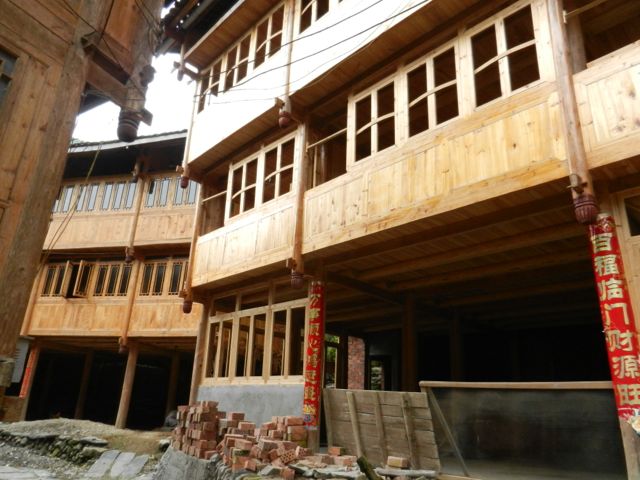
A tourism boom is fueling construction of new homes and hotels in rural areas.

In Old Drum village
This rice farmer, 70, said he had worked 50 years in the fields.

Ethnic Zhuang and Yao people showed their wares.


Village tucked in between the terraced rice paddies.

We happened upon a rice-planting ceremony. Note the water buffalo to the left.

Guilin is famous for its limestone hills -- karst formations. My
colleague, Yoichi Nishimura, news exec with Asahi Shimbun
in Japan.


Inside a Zhuang family's home.
Related:

Impressions of China
China's grandparents
A little tour of Tsinghua University campus
Chinese adults stay limber with hacky sack


Why the Chinese will never drop their written language
Deciphering China, ideograms to menus
Three days on the Yangtze River
Video: Chinese calligraphy in Xi'an
The madding crowd in the Forbidden City

Hike in hills has auspicious beginning
Beijing revisited, 23 years later
From the Economist: Daily chart: Choked


Saturday, June 02, 2012

China's grandparents

In a park in Beijing.
Many Chinese families still live with three and four generations under one roof. Some of my acquaintances leave their children in the care of their parents while they work.

In our neighborhood of apartment houses on the edge of the Tsinghua campus, we often see grandparents taking little ones with them on the back of their bicycles or walking and playing with them. It is very touching to see how much they enjoy each other's company.

Wednesday, May 09, 2012

Three days on the Yangtze River

The rugged terrain of the Three Gorges region of the Yangtze sheltered it from much of the development taking place in the rest of China in the 1980s and '90s. Roads and bridges were few. The river was the main highway that linked the huge metropolis of Chongqing to Shanghai on the coast, 1,500 miles away.
Our cruise was far upriver between Chongqing and
the Three Gorges Dam (map from discoveryangtze.com)

There is still much natural beauty, and a cruise is relaxing and beautiful. About 200 Chinese, German, French and American tourists were on the ship.

We visited a famous pagoda. We took a trip on the Shennong Stream in peapod boats manned by the local Tujai people, who used to survive on fishing and farming. Now they have added industrialized tourism as a source of income. They hawk books of local history and DVDs with folk songs in their dialect. (video below)


Our trip ended at the Three Gorges Dam, the world's largest hydroelectric project. What we couldn't see on our cruise was how much has changed in the past decade. Much of the evidence was under water. Since 2002, the water backing up behind the dam has covered homes, factories, farmland, temples.

Today the river is about 300 feet deeper at the dam site than before the project. Above the limits of the water there are new towns to accommodate some of the 1.3 million people displaced by the project, and there are new bridges and highways connecting the gorges to the rest of China.

The Dam was highly controversial among the Chinese themselves because of the relocations and environmental issues. But in 1987, the government shut down debate on the project and it went forward. Scientific American did a review of the environmental issues in 2008.

At the Three Gorges Dam

Dawn


Shennong Stream
Related:

China is opening up, slowly, by fits and starts

Guangxi: Terraced rice paddies, sugarloaf mountains
Video: Chinese calligraphy in Xi'an
The madding crowd in the Forbidden City
Why the Chinese will never drop their written language
Impressions of China
A little tour of Tsinghua University campus
Deciphering China, ideograms to menus

Wednesday, May 02, 2012

Video: Chinese calligraphy in Xi'an

Many Chinese artists are as famous for their calligraphy as for their landscapes and poetry. Actually, they are all mixed together in many paintings.

In Xi'an, we got a demonstration of traditional writing with a brush. One of the characters, "guo", means country or kingdom and is still used today in the name of China: Zhong Guo, or middle kingdom. The U.S. is Mei Guo, or beautiful kingdom. France is Fa Guo, Germany De Guo and so on.

The guide also did a lovely rendering of Cindy's name in Chinese. Watch:


Connoisseurs of Chinese calligraphy may have some critical comments about our guide's skill.

Related:

China is opening up, slowly, by fits and starts

Guangxi: Terraced rice paddies, sugarloaf mountains
Three days on the Yangtze River
The madding crowd in the Forbidden City
Why the Chinese will never drop their written language
Impressions of China
A little tour of Tsinghua University campus
Deciphering China, ideograms to menus

Sunday, April 08, 2012

The madding crowd in the Forbidden City

Bernardo Bertolucci's 1987 film "The Last Emperor" had some great
shots of the enormous plazas within the Forbidden City.
Beijing's winter wears you down. Every day the high temperature is around 30 degrees, at night it goes down into the teens and the wind from the north can freeze your eyeballs. As recently as last week, there was still some ice on parts of the canals that never get sun on the Tsinghua University campus. 

Lately though, we began to feel spring in the air and now it is in full bloom. The warm weather makes it more inviting to get out and around. Last Saturday we went to the Forbidden City, which was built 600 years ago and was the palace for the Ming and Qing dynasty emperors.


Lining up for tickets. They cost $10.

People had warned us not to go on a weekend because of the crowds. They were right. You get pushed and shoved a lot more in China than you might somewhere else. People don't speak to strangers, so it is rare to hear someone say, "Pardon me" or "sorry."

This couple asked to have their picture taken with us
 outside the Forbidden City. I said we were "meiguo ren"(Americans)
 and they said something back that sounded friendly. Mao's
 huge portrait is just behind my head. 

The scale of the place is breathtaking. Inside the 26-foot-high walls are some 900 buildings on a rectangular site the covers the equivalent of 170 football fields. This was the home of the last emperor, Pu Yi, who abdicated in 1911 and then was permitted to stay until he was evicted in 1924. The site was then converted into a museum.

When I visited Beijing in 1988 with a group of journalists, we were taken to meet the brother of Pu Yi. Evidently the government brought him out to meet foreigners. He talked about how it was good that the empire was overthrown and the people were running the country.


All the roofs have golden tiles, the color of the emperor.

Lots of parents lifted their kids over the railings to touch the lion's head on this bronze water cistern. The woman wearing an army cap with a red star is probably not making a political statement. The caps are a nostalgia item for tourists. You never see them on the streets. Only at tourist sites. 

Tour groups from all over China come to see the old palace.
Most groups don identical hats to keep track of each other.

Sunday, February 12, 2012

Sitting on top of a volcano

Steam vents at the Craters of the Moon, Taupo
Here in New Zealand we are perched on a land mass where two continental plates collide. Below us, the friction and fracturing create tremendous heat and release the molten rock that lies beneath the crust.

When that magma contacts groundwater, the steam finds its way up to the surface in the form of vents and geysers and bubbling hot springs. They make up one of the tourist attractions around the two big islands. The Earth here shudders and moves. A year ago, hundreds of people were killed in Christchurch on the South Island when a major earthquake struck.

Wednesday, February 08, 2012

How to speak Kiwi in New Zealand

At the moment, the New Zealand accent sounds the same to me as Australian, and its most notable distinguishing features are:

The short-e is pronounced like a short-i. "Yes, we expect to visit that section of town" is pronounced "Yiss, we expict to visit that siction of town." If you're good you go to hivven.

The short-a sound, as in, "The fact is, it's a hard task," sounds like a short-e: "The fect is, it's a hahd tesk."

Long-a becomes long-e in New Zealand, so "Be careful in that area" comes out "Be keerful in that eerea."

And you park your car here with a Boston accent: "Hey, mate, don't park your car there" comes out, "Hye, myte, don't pahk ya cah theah."

New Zealand chicken is where you go in the airport before you get on the plane.

That's half of it. With a day's practice, you could pass for a Kiwi in the U.S.

New Zealand was one of the last places settled by Polynesian peoples,
probably around 1250-1300 A.D. Map from Wikipedia. 

Recent settlement

Because of its isolation, the land we now call New Zealand developed thousands of unique species of birds and plants. The history of human habitation here is very short. Eastern Polynesians were the first humans to visit the islands, and they arrived a mere 800 years ago. They were also the first mammals. [Correction: there were three species of small bats when humans arrived.] They brought mice and pigs with them.

New Zealand's long isolation is remarkable given that Australia, the nearest large land mass only 900 miles to the west, has 40,000 years of human habitation. But the Polynesians had a great tradition of seafaring, and the aborigines who settled Australia did not.

Today the Maori people, descendants of the original settlers of New Zealand, represent about 15% of the population, and about one-fourth of them speak the Maori language. Maori is taught in the schools, but use of the language does not appear to be growing.

A grain of geology

Mount Ruapehu is one of the most active volcanoes in New Zealand.
It last erupted in 1995-96, but there are ski resorts on its slopes anyway.
On our bus ride today from Ohakune, we passed a number of volcanic cones. We will spend the next few days at Lake Taupo, new Zealand's largest lake, which fills an enormous volcanic crater. When the volcano erupted some 26,000 years ago, its dust clouds spread around the world and may have contributed to the last ice age.