Yoichi Nishimurais a newspaper editor on a one-year sabbatical here at Tsinghua University to study China-U.S.-Japan relations. We go to lunch together most days with Joe Weber, a visiting professor of business journalism from the University of Nebraska.
Yoichi has a nose for good restaurants and is always scouting for the next unique experience. He learned well during five years as a correspondent in Moscow for Asahi Shimbun, Japan's second-largest newspaper, and six years at the Washington bureau. "The secret of working in a foreign country is finding good restaurants," he says.
Yoichi is managing editor of Asahi. Twenty years ago the paper sent him to Moscow State University for a year of intensive study of Russian. He lived with a family and developed his conversational skills. All of this helped him cover the fallout from the collapse of the Soviet Union. He wrote a book about Russia's army and weapons systems in the post-Soviet era.
You have to keep your head up and your eyes peeled while riding a bicycle around in Beijing, especially during the lunchtime rush on campus, as this 13-second video shows.
We have been in country for two weeks now. Yesterday I taught my first class at Tsinghua University, where I am co-director of the Global Business Journalism master's program. The kids are the cream of the crop.
My bio, posted in the Journalism building, says nice things, I believe.
Hospitality
The staff of the university has dedicated enormous time and energy to help us get settled. They assigned graduate students to to go with us on our first shopping trips and visits to the administration offices, cellphone stores and other places where English is useless.
I wonder if U.S. universities are as thoughtful, hospitable and gracious with visiting foreign professors? I hope so. It makes a great impression.
The cost of everything
Rent is high here, equivalent to New York City, they tell me. So our apartment, given to us rent free by the University, is a really nice benefit. It is modest by U.S. standards but enviable by standards for what a Chinese professor could hope to rent.
In fact, many of the professors live in this university-subsidized housing. A couple of the Chinese journalism faculty live in the nearby apartments.
My new Gallop brand bicycle -- hand brakes, one speed, basket, bell, lock all included -- cost me $50. But a simple toaster that would cost you $10 in a Wal-Mart in the U.S. cost nearly the same as the bicycle, $47. Point and eat
Last night Cindy and I went to a "hot pot" restaurant. They bring you a little pot of broth with spices, heated by a flame, and you drop in raw meat, vegetables and other stuff. We weren't doing it right but the waitresses didn't speak English so we just did the best we could.
Even menus with pictures are something of a mystery. The food is very good but what is it? On the menu it looks like chunks of meat but it might turn out to be tofu. Are those peanuts or soybeans that are part of that vegetable dish? We have to wait and see.
Manicure or pedicure?
The Great Big Lie that you hear everywhere in America is that when you travel abroad, "everyone speaks English". Well, if you are in a tourist hotel in an area frequented by Americans or Brits, yes. But most of the world does not fit that description.
Beijing's subway system and many of its stores are actually pretty user friendly with signs in English or in Roman characters.
But the normal language barriers are raised to another degree of difficulty when you cannot even decipher a street sign or any sign, for that matter. Are you on Haidian Street? If the signs are only in Chinese, and they usually are, you cannot know.
Seven thousand characters
Chinese newspapers supposedly use a limited number of ideograms, or characters. But still the total is 7,000. Will I ever try to learn the written language? I am not sure that I am up to it. At the moment I am learning a few phrases. The Berlitz books Cindy and I have are great because they show the English phrase, the pronunciation and then the Chinese characters. We show the appropriate phrase to the waiter or salesperson.
Store clerks have been helpful.
When I use Chinese words or numbers, people usually say them back to me in a helpful way, with the correct pronunciation. They know it is difficult to get the tones right.
Written Chinese was simplified a few decades ago, so you have different written versions. The old form is much more ornate. An analogy might be the Gothic script you see in medieval manuscripts.
50% more density than New York City
Beijing has a metro population of 19 million, almost exactly the same as metro New York, but the population density is 50% greater, 3,023 per sq km vs. 2,050 in NYC.
If it weren't for the fact that so many people ride bicycles, the density would be unimaginable. As it is, the massive expressway system built for the 2008 Olympics has trouble handling all the traffic.
In general, Beijing residents appear to be like residents of New York, Paris or Madrid in that they are in a hurry and you might be in their way.
We rode the subway across town last Sunday. It was standing room only all the way. Given the density, the city is amazingly clean and orderly.
The Russian novelist Vladimir Nabokov (Lolita) was also a butterfly expert. I thought of him when I saw this beautiful specimen along the road between Luninets and Brest, Belarus.
Coldborscht soup is a summer favorite. It has beets as a base with a mix of greens, a bit of cheese, a bit of pork and some spices. Another local restaurant served Fantasia, a kind of potato casserole topped with a tender slice of roast pork, tomato sauce and cheese. Great, for about $3.
You can have a nice dinner here for about $4. A pint of good local beer is about 75 cents. Ten hours of high-speed internet access costs about $1.75. A three-room hotel suite goes for $84 a night.
The Belarus ruble has been falling against the dollar and the euro, which causes problems for businesses. Newsprint and printing services, for example, are priced in dollars but paid in rubles. So although the nominal price in dollars is the same, the newspaper has to come up with more rubles to pay suppliers.
Inside the local Orthodox Church, where I was told after snapping this that pictures were not permitted. Older women with headscarves are referred to generally as "babushkas," which means grandmothers. As a kid I remember hearing the head scarf itself referred to as a babushka.
Houses here all have fences around them. When I showed a picture of my old street in Lakewood to a Belarusian guy, he asked, Where are the fences?
Sunflowers are a favorite for the yard. In neighboring Ukraine, they are a huge agricultural crop.
The countryside of Belarus is as flat as the Great Plains. It reminded me of Manitoba, with its forests interspersed with fields of wheat, corn and flax. Lovely.
Never lost, never out of control
I spent a total of seven hours on the road yesterday with Feodor, a charter member of the World Association of Over-Confident Cabdrivers (rearrange the initials to spell Wacco). Like all members of this club that I have met, he tailgates at 70 mph, passes on the unpaved shoulder, demonstrates his maneuvering skill by swerving in front of gasoline trucks and passes on curves in dense fog. The Wacco card says on the front, "The bearer is one of the best drivers in the world"; on the back it says, "No, really I am the best" in 12 languages. Feodor assured me that his 15 years’ of driving experience guaranteed my safety, and to prove it, he showed me that he never wears a seatbelt.
Feodor inspects the insects that have plastered themselves on his grille. He does not smoke in his car and would not let us bring any food inside.
Feodor´s global positioning system led us down a dirt road to this path in Luninets. It was trying to lead us to the bridge overhead.
He had to ask directions from a woman on a bicycle. Such humiliation for a Wacco member!
Some of the museums we visited on our trip through Spain got me thinking about the unrecorded history of ordinary people.
Up until a century ago, the vast majority of the world, even in the West, was living in villages. Even today, more than half of China’s 1.3 billion people live in rural areas.
The history we learn does not focus on village life, where people were illiterate, but on on the civilizations that had developed writing. Writing recorded the doings of the rich and powerful.
The Museum of the Galician People in Santiago de Compostela in northwestern Spain goes some way to correct the omission. The displays capture the detail of the crafts, homes, culture and language of these people.
A traditional Galician fishing boat.
Visitors can see their bagpipes, their farm implements and crafts, the fishermen’s nets and how they were made. This type of history by definition is harder to record. It depends on some published records and on inferences drawn from archeology and remnants of practices that persist today.
This museum was a welcome relief after several weeks of visiting palaces and castles and seeing the wealth accumulated by the warlords and thugs we call royalty.
Basque whalers roamed the world
When we moved on to San Sebastian, in the Basque Country of northeastern Spain, I was delighted to discover the Maritime Museum’s exposition on the history of Basque whalers. (Moby Dick is one of my favorite books.)
From www.heritage.nf.ca
The village fishermen in Basque country developed the industry 1,000 years ago and ventured all over the North Atlantic. As early as the 1500s, they had established outposts in Newfoundland and Labrador. I was surprised to learn British and American whalers learned the trade from the Basques.
Stone age cave paintings
In Altamira, Spain, we visited a museum with breathtaking re-creations of cave paintings from 14,000 years ago. The artists who made them were hunter-gatherers who had not domesticated plants and animals.
This is a modern interpretation of a bison depicted in one of the cave paintings of Altamira, Spain. The original dates from 14,000 years ago. Our ancestors’ transformation from hunter-gatherers to farmers and fishermen took place over just a few thousand years.
The original cave has been closed to protect the paintings from deterioration caused by the press of visitors. However, the replica cave captures every curve and niche of the original with the aid of 40,000 laser measurements. A team of artists used materials as close to the original as possible to duplicate the effects of the Stone Age artists.
The museum has videos showing how these hunter-gatherers made their tools of stone and bone and how they might have hunted. People in some parts of the world still use these techniques. We are not that far removed in time from them.
From village to city and back
All of this got me to thinking about what recent visitors we are to most of the known world. Although the genus homo has been around for several million years, our species, homo sapiens, is a newcomer. We left Africa only 40,000 years ago.
Only recently has our species had to adapt to all of the stresses of living in cities. That may explain why so many of our pathologies manifest themselves there. Villagers began leaving the country two centuries ago as the Industrial Revolution created new jobs, but the migrants have always expressed a desire to go back.
The return to the country is a theme of country music and the blues. We really want to go back home to the village.
Addendum from Belarus
As it happens, today I am working in Belarus and it is their Independence Day. There are parades and celebrations everywhere. On national television, folk dancers and singers form various regions are performing. It is a celebration of the rich variety of village culture.
I spent a week running around Beijing to meet journalists and people connected to the business journalism program at Tsinghua University where I will start teaching in the fall.
Little is recognizable from a visit I made in 1988. The city and society have packed a century of progress into two decades. Beijing is now like Manhattan with wider streets. Freeways of 10 and 12 lanes ring the city center. Then it seemed there were 1,000 bicycles for every car; now it is the reverse. I have a few photos from then and now.
China, 1988
Bikes owned the road.
A hutong, courtyard home
The hutong homes once seen everywhere in Beijing are rapidly disappearing. In hutongs, several one-story brick homes surround a coutryard and families share toilet facilities. High-rises, highways and other new constructions are replacing them.
At the People’s Daily, printers were still hand-setting type 23 years ago. Today the media have world-class technology.
Beijing today
High-rises surround the Tsinghua University campus
The National Center for the Performing Arts, also known as the Egg, is one of many avant-garde buildings in Beijing. The Egg houses several large concert halls. The massive scale of the place is not, unfortunately, captured in this photo.
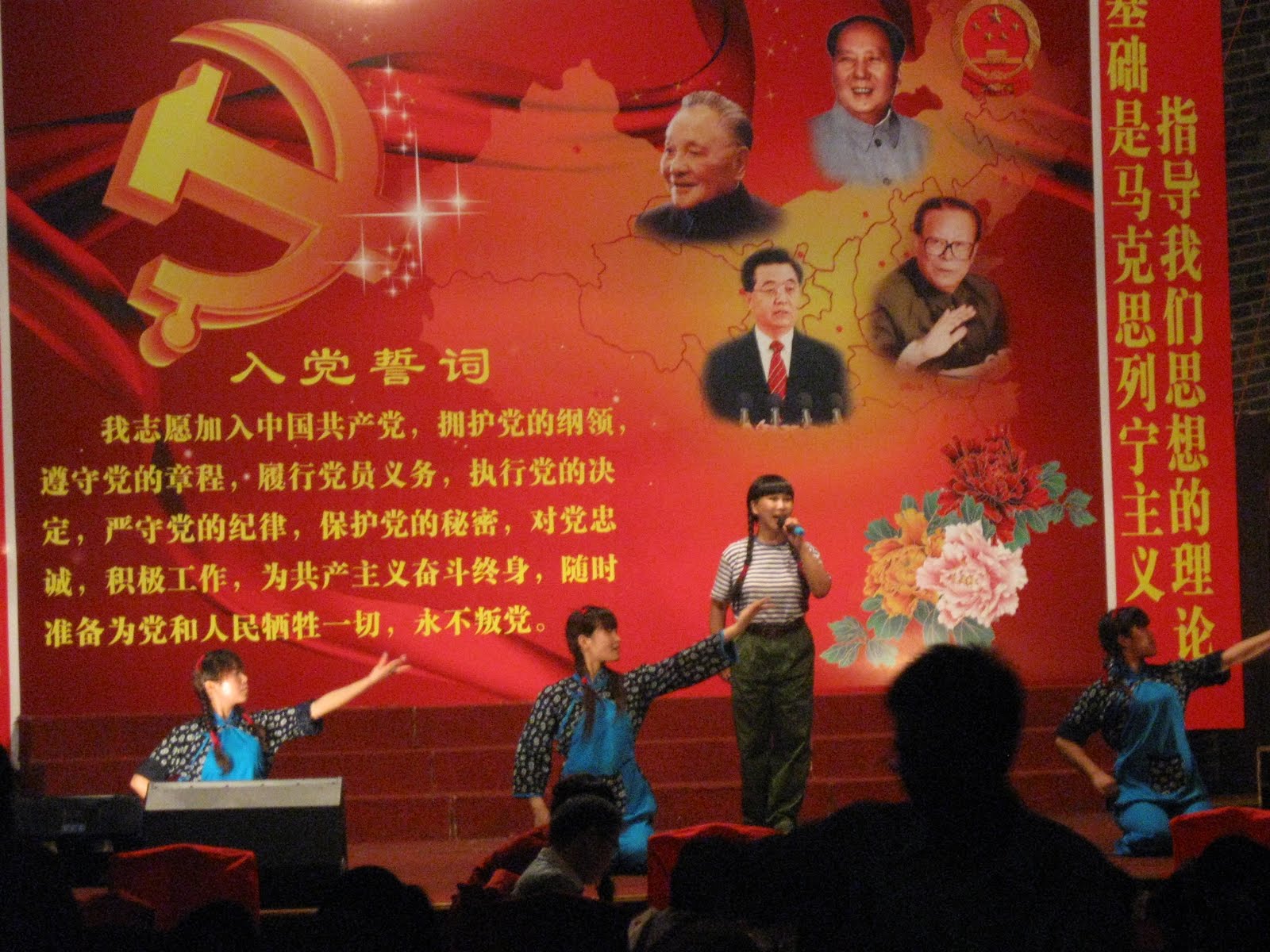
China’s economic success has made many people nostalgic for the simpler life of the old days. This night club is a kind of Cultural Revolution dinner theater, where songs from the era are performed. The Long March ballet was amazing. The restaurant’s tasty peasant style food was served by waiters in Red Army garb.