Showing posts with label beijing. Show all posts

Monday, October 14, 2013

Walking tours of Beijing and beyond


Above, a 1-minute video of the rickshaw tours in Beijing's popular Houhai area.
The Forbidden City, where the emperor and family lived until 1911.
We spent the spring visiting some of our favorite places and doing some walking tours of Beijing. Cindy got around more than I did.

Goodbye to China, hello to Miami

I had been meaning to write something about China since leaving in July. Two years of teaching at Tsinghua University had made me long for a return to working in Latin America, where I knew the language and understood the culture better.

Hiking to the Silver Pagodas north of Beijing
Over the years, international profs left their bikes behind.
Graduation, July 2013
Easy rider on mom's motorbike.

Saturday, April 27, 2013

Walk through "intelligence valley"

Fruit and nut trees were in bloom in the valley
Cindy and I have been back in Beijing for just over a week but decided it was time to get out of the city.

A group called Beijing Hikers organizes trips every week. We picked one that advertised relatively flat terrain and lovely hike through a rocky area called "Intelligence Valley." The towns in the area have odd names as well. One is called Lucky.

Sunday, January 20, 2013

In Beijing, the air is chewable


Wearing my 3-M special mask at the Bridge Cafe in northwest Beijing
For the first year and a half we have been here in Beijing, Cindy has monitored the air quality daily. It was nearly always up over 100 micrograms of small particulates (2.5 microns) per cubic meter, which is considered unhealthy. Often it is like today, over 200. And last week it was up over 300, 400, 500...up to 700. You could practically chew it.

By comparison, on Saturday in New York City, the same measure was 19,  Edward Wong reported in the New York Times.

Saturday, October 27, 2012

Chinese adults stay limber with hacky sack


The adults in this video are pretty limber. https://www.youtube.com/watch?v=d5ckSU7X7wg 


Cindy and I went to Ritan Park on Saturday in Beijing. It's right in the heart of the city, and you see all kinds of activities -- people playing badminton without a net, table tennis on public tables, dance classes, lots of kids running around and adults playing hacky sack.

Sunday, October 07, 2012

Hike in hills has auspicious beginning

Cindy and farmer near Auspicious Village

On Sunday we joined about 20 other folks on a hiking trip to villages about 90 minutes north of Beijing. A company called Beijing Hikers arranges tours every weekend.

This hike, which lasted a bit more than three hours, took us through several farming villages, walnut groves, orchards and up over some steep, rocky paths. The trip started near Jisicun (pronounced jee-see-tsoon), which we were told means "auspicious village."

Three-wheeled motorcycles haul everything.


Morning glories were all along the route. 


We finished the hike at Huanghuacheng, where the Great Wall rides the mountain ridge like a dragon's back down to a reservoir

On our tour we we had people from Sardinia, Slovenia, Pakistan, Malaysia, France and some others who were speaking languages we couldn't place.

This section of the Great Wall doesn't get many tourists.
Our two dozen folks were about the only folks up there
on a beautiful day. 
Related:

Impressions of China
China's grandparents
A little tour of Tsinghua University campus
Chinese adults stay limber with hacky sack


Guangxi: Terraced rice paddies, sugarloaf mountains
Three days on the Yangtze River
Video: Chinese calligraphy in Xi'an
The madding crowd in the Forbidden City
Why the Chinese will never drop their written language
A little tour of Tsinghua University campus
Deciphering China, ideograms to menus
Beijing revisited, 23 years later
From the Economist: Daily chart: Choked


Sunday, April 08, 2012

The madding crowd in the Forbidden City

Bernardo Bertolucci's 1987 film "The Last Emperor" had some great
shots of the enormous plazas within the Forbidden City.
Beijing's winter wears you down. Every day the high temperature is around 30 degrees, at night it goes down into the teens and the wind from the north can freeze your eyeballs. As recently as last week, there was still some ice on parts of the canals that never get sun on the Tsinghua University campus. 

Lately though, we began to feel spring in the air and now it is in full bloom. The warm weather makes it more inviting to get out and around. Last Saturday we went to the Forbidden City, which was built 600 years ago and was the palace for the Ming and Qing dynasty emperors.


Lining up for tickets. They cost $10.

People had warned us not to go on a weekend because of the crowds. They were right. You get pushed and shoved a lot more in China than you might somewhere else. People don't speak to strangers, so it is rare to hear someone say, "Pardon me" or "sorry."

This couple asked to have their picture taken with us
 outside the Forbidden City. I said we were "meiguo ren"(Americans)
 and they said something back that sounded friendly. Mao's
 huge portrait is just behind my head. 

The scale of the place is breathtaking. Inside the 26-foot-high walls are some 900 buildings on a rectangular site the covers the equivalent of 170 football fields. This was the home of the last emperor, Pu Yi, who abdicated in 1911 and then was permitted to stay until he was evicted in 1924. The site was then converted into a museum.

When I visited Beijing in 1988 with a group of journalists, we were taken to meet the brother of Pu Yi. Evidently the government brought him out to meet foreigners. He talked about how it was good that the empire was overthrown and the people were running the country.


All the roofs have golden tiles, the color of the emperor.

Lots of parents lifted their kids over the railings to touch the lion's head on this bronze water cistern. The woman wearing an army cap with a red star is probably not making a political statement. The caps are a nostalgia item for tourists. You never see them on the streets. Only at tourist sites. 

Tour groups from all over China come to see the old palace.
Most groups don identical hats to keep track of each other.

Saturday, December 10, 2011

Impressions of China


Pickup games at Tsinghua, from October.

A couple of times a week I go to the Olympic-size pool on campus to swim. There are a dozen outdoor basketball courts adjacent, and on class days, the students have pickup games. Even when I go swimming at night, there will be some guys still out on the courts in the dark, playing by the weak light seeping in from the street. The ball rings off the cement, the shadowy figures move around, the ball planks off the backboard. The game goes on even when the temperatures are in the 40s. I have never seen a girl on the courts or in a game on the many soccer fields. 

Sunday, November 27, 2011

Thanksgiving in Beijing

Cindy on the campus of neighboring Beijing University. 

Today I am thankful for having a spouse...

....who is comfortable living in a country where she can't speak the language as long as she can figure out how to take the subway wherever she wants.

...who gave up a nice house and all its contents so we could have a couple of years of adventure on the road.

Saturday, October 01, 2011

A little tour of Tsinghua University campus


The music is composed and played by Patrick Breiner: "Dance Music for Tony Malaby."

Saturday, September 17, 2011

Deciphering China, ideograms to menus


You have to keep your head up and your eyes peeled while riding a bicycle around in Beijing, especially during the lunchtime rush on campus, as this 13-second video shows.

We have been in country for two weeks now. Yesterday I taught my first class at Tsinghua University, where I am co-director of the Global Business Journalism master's program. The kids are the cream of the crop.

My bio, posted in the Journalism building, says nice things, I believe.

Hospitality

The staff of the university has dedicated enormous time and energy to help us get settled. They assigned graduate students to to go with us on our first shopping trips and visits to the administration offices, cellphone stores and other places where English is useless.

I wonder if U.S. universities are as thoughtful, hospitable and gracious with visiting foreign professors? I hope so. It makes a great impression.

The cost of everything

Rent is high here, equivalent to New York City, they tell me. So our apartment, given to us rent free by the University, is a really nice benefit. It is modest by U.S. standards but enviable by standards for what a Chinese professor could hope to rent.

In fact, many of the professors live in this university-subsidized housing. A couple of the Chinese journalism faculty live in the nearby apartments.

My new Gallop brand bicycle -- hand brakes, one speed, basket, bell, lock all included -- cost me $50. But a simple toaster that would cost you $10 in a Wal-Mart in the U.S. cost nearly the same as the bicycle, $47.

Point and eat

Last night Cindy and I went to a "hot pot" restaurant. They bring you a little pot of broth with spices, heated by a flame, and you drop in raw meat, vegetables and other stuff. We weren't doing it right but the waitresses didn't speak English so we just did the best we could.

Even menus with pictures are something of a mystery. The food is very good but what is it? On the menu it looks like chunks of meat but it might turn out to be tofu. Are those peanuts or soybeans that are part of that vegetable dish? We have to wait and see.

Manicure or pedicure?

The Great Big Lie that you hear everywhere in America is that when you travel abroad, "everyone speaks English". Well, if you are in a tourist hotel in an area frequented by Americans or Brits, yes. But most of the world does not fit that description.

Beijing's subway system and many of its stores are actually pretty user friendly with signs in English or in Roman characters.

But the normal language barriers are raised to another degree of difficulty when you cannot even decipher a street sign or any sign, for that matter. Are you on Haidian Street? If the signs are only in Chinese, and they usually are, you cannot know.

Seven thousand characters

Chinese newspapers supposedly use a limited number of ideograms, or characters. But still the total is 7,000. Will I ever try to learn the written language? I am not sure that I am up to it. At the moment I am learning a few phrases. The Berlitz books Cindy and I have are great because they show the English phrase, the pronunciation and then the Chinese characters. We show the appropriate phrase to the waiter or salesperson.


Store clerks have been helpful. 

When I use Chinese words or numbers, people usually say them back to me in a helpful way, with the correct pronunciation. They know it is difficult to get the tones right.


Written Chinese was simplified a few decades ago, so you have different written versions. The old form is much more ornate. An analogy might be the Gothic script you see in medieval manuscripts.

50% more density than New York City

Beijing has a metro population of 19 million, almost exactly the same as metro New York, but the population density is 50% greater, 3,023 per sq km vs. 2,050 in NYC.

If it weren't for the fact that so many people ride bicycles, the density would be unimaginable. As it is, the massive expressway system built for the 2008 Olympics has trouble handling all the traffic.

In general, Beijing residents appear to be like residents of New York, Paris or Madrid in that they are in a hurry and you might be in their way.


We rode the subway across town last Sunday. It was standing room only all the way. Given the density, the city is amazingly clean and orderly.


Saturday, July 02, 2011

Beijing revisited, 23 years later

I spent a week running around Beijing to meet journalists and people connected to the business journalism program at Tsinghua University where I will start teaching in the fall.

Little is recognizable from a visit I made in 1988. The city and society have packed a century of progress into two decades. Beijing is now like Manhattan with wider streets. Freeways of 10 and 12 lanes ring the city center.  Then it seemed there were 1,000 bicycles for every car; now it is the reverse. I have a few photos from then and now.

China, 1988

Bikes owned the road.
A hutong, courtyard home

The hutong homes once seen everywhere in Beijing are rapidly disappearing. In hutongs, several one-story brick homes surround a coutryard and families share toilet facilities. High-rises, highways and other new constructions are replacing them.
At the People’s Daily, printers were still hand-setting type 23 years ago. Today the media have world-class technology.  

Beijing today

High-rises surround the Tsinghua University campus

The National Center for the Performing Arts, also known as the Egg, is one of many avant-garde buildings in Beijing. The Egg houses several large concert halls. The massive scale of the place is not, unfortunately, captured in this photo.  

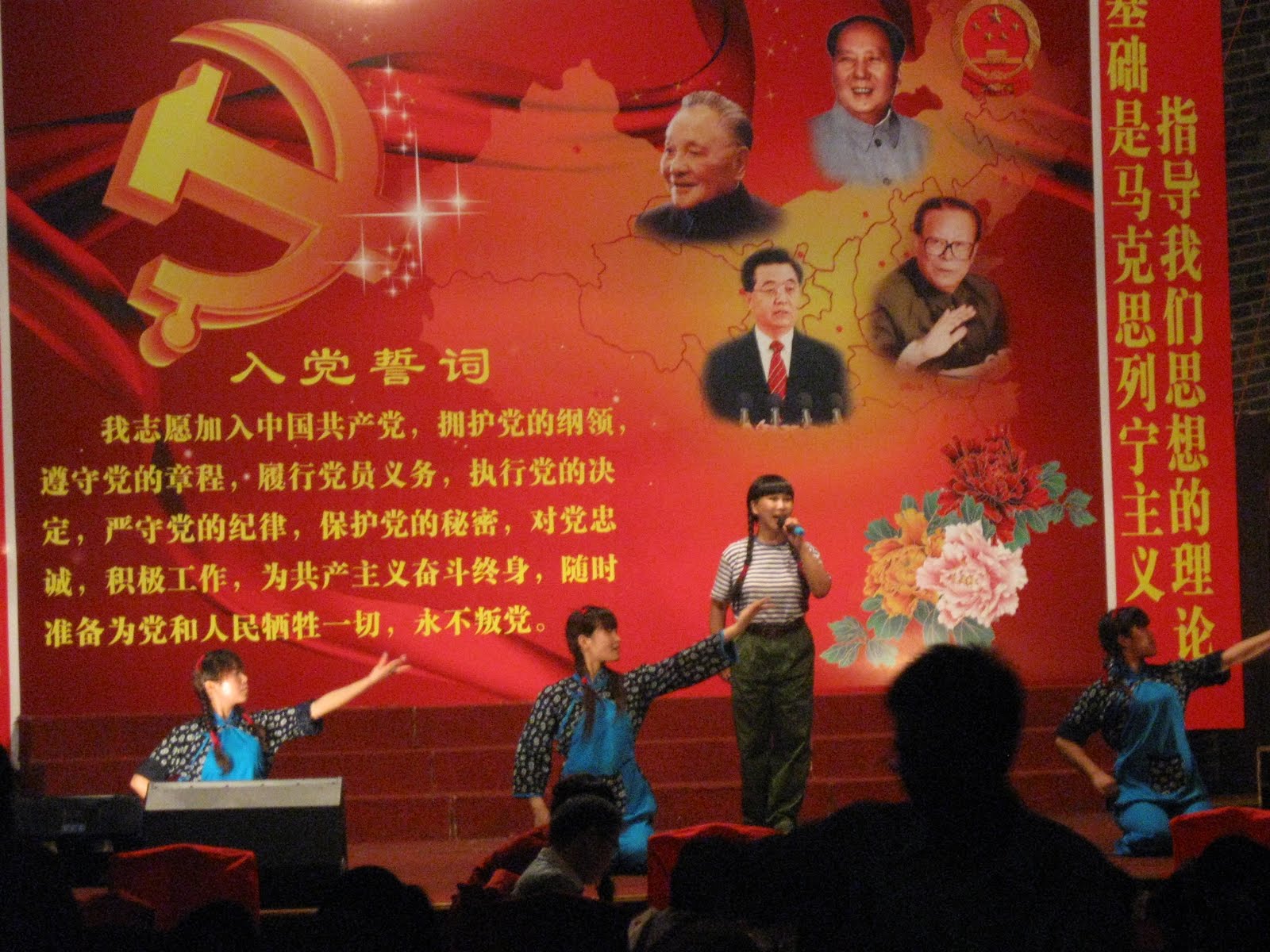
China’s economic success has made many people nostalgic for the simpler life of the old days. This night club is a kind of Cultural Revolution dinner theater, where songs from the era are performed. The Long March ballet was amazing. The restaurant’s tasty peasant style food was served by waiters in Red Army garb.